A Look at the Life of Iran’s Legendary IRGC Commander – Qasem Soleimani
A Look at the Life of Iran’s Legendary IRGC Commander – Qasem Soleimani
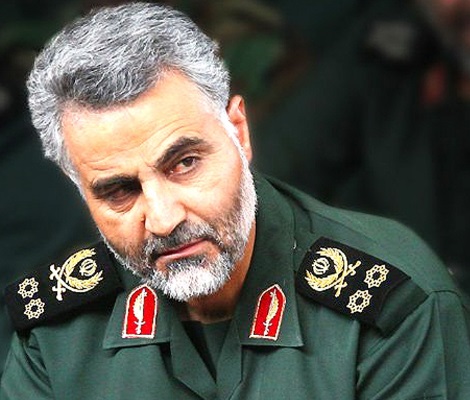
In the eyes of his supports and foes alike, Qasem Soleimani is a man larger than life. In the West, Soleimani, the commander of the elite Quds forces of Iran’s Revolutionary Guards Corps, is viewed as the fearsome evil genius behind most Iranian intelligence and military operations (Fars News September 23, 2013; Tabnak, September 6, 2013; Asre Iran, April 12, 2012). With U.S. sanctions imposed on him for an alleged connection to a plot to assassinate the Saudi Arabian Ambassador to the United States and military collaborations with the Assad regime in Syria, Soleimani is also viewed as Iran’s most formidable political-military strategist with authority over Iran’s regional policy (BBC Persian, June 17). In Iran, however, Soleimani is viewed by many as a humble warrior, a national hero and, in the words of Supreme Leader Ayatollah Ali Khamenei, a “living martyr” for the revolution (Javan Online, November 3, 2011; Meybodema, September 14, 2013; Haraznews, November 5). For Shi’a Arabs, likewise, he is known as “Haj Qasem,” the legendary warrior who trained and protected Shi’as in Iraq, Lebanon, Syria and Yemen against Sunni and Zionist enemies (Tabnak, October 26). In reality though, it is in the aura of a mythical figure that Soleimani has emerged as one of the most influential figures in the Middle East, a man whose reputation for expanding the Quds forces’ sphere of influence and challenging Iran’s foes, especially Sunni militants and the United States, will most likely live beyond his death.
Early Life
Born on March 12, 1957, Soleimani grew up in a peasant family in southeastern Iran’s Kerman province. His first encounters with Shi’a revolutionary ideology occurred from 1978-1979 when he attended the sermons of Hojjatollah Reza Kamyab, a cleric student of Ayatollah Ruhallah Khomeini, while living in the city of Kerman as a construction worker (Haraz News, November 5; Khateem, November 14). After the victory of the 1979 revolution, Soleimani joined the Kerman branch of the newly established Revolutionary Guard, responsible for protecting the ideals of the Islamic revolution (Nakhlestan, June 19).
Enter the Warrior
It was with the 1980 Iran-Iraq War that Soleimani quickly emerged as an important military figure in the newly established Islamic Republic (Haraz News, November 5). As a young military volunteer, also known as Basiji, he earned respect for his fortitude and military skills in the 41 Sara-Allah Division, a military unit famed for its bravery on the frontlines (Meshreghnews.ir, November 14, 2013; Shahid News, October 30, 2013). After the war ended in 1988, Soleimani became an IRGC commander in Kerman, where he led military operations against drug trafficking (Nakhlestan, June 19). Between 1997 and 1998, Soleimani took command of the Quds forces, an elite unit in charge of protecting the revolution beyond Iran’s borders.
While the second half of the 1990s saw the consolidation of the anti-Shi’a Taliban in Afghanistan and the weakening of the Ba’athist regime in Iraq due to UN sanctions, Soleimani operated as a military commander of a growing network of Shi’a operatives in the region. The two most decisive events that put Solemeini on the region’s radar were the U.S.-led invasions of Afghanistan and Iraq in 2001 and 2003 respectively, in which he demonstrated his abilities as both a military leader and a shrewd negotiator.
Enter the Shadow Commander
After the Iran-Iraq War and especially during the presidency of reformist Muhammad Khatami beginning in 1997, the IRGC’s military role outside of Iran focused on protecting Shi’a networks and vying for influence in the region with Saudi Arabia, all the while keeping a low-profile as a way to project a friendlier image of the Islamic Republic among its neighbors. The Quds force was in charge of various training and operational activities across the region, including advising the Lebanese Hezbollah on the militant organization’s transformation into a political force after signing the Taif Accord in 1989 (Radio Farda, November 24).
The 2001 toppling of the Taliban, Iran’s archenemy in Afghanistan, brought to light a pragmatic Soleimani, who directly negotiated with the Americans in a joint military operation against a common enemy. The 2003 war in Iraq, however, showed Soleimani as a formidable and astute military strategist who commanded Shi’a militia operations in asymmetrical warfare against U.S. and coalition forces. The 2006 conflict between Israel and Hezbollah, a.k.a. the 33-Day war, was a critical victory for Soleimani, who engineered a successful Shi’a resistance against the powerful Israeli Army (Rasa News, May 23, 2011). During the war, Soleimani was in close contact with Shaykh Hassan Nasrallah, at times delivering messages from Iran’s Supreme Leader to the Hezbollah secretary general (Farda News, November 12). But Soleimani continued with this multitasking as a negotiator. When, in 2008, Moqtada al-Sadr and the Iraqi Army forces fought each other in a series of clashes in southern Iraq, Soleimani played a critical role in mediating peace talks between the camps (Pars Online, April 5, 2011). Later, in 2011, Iran’s entry into the Syrian civil war further enhanced the image of Soleimani as a commander who could coordinate Hezbollah, Iranian and Syrian forces to battle Sunni militants. While this fueled sectarianism, it also shaped Soleimani’s reputation as a fiercely capable military man and, in the eyes of his enemies, as the “most dangerous man in the world” (Katteemam.ir, November 14).
In January 2011, Soleimani was promoted to the rank of major general, but despite his military promotions, it would be too narrow to regard Soliemani as merely a military figure (Fars News, January 24). In terms of Iranian domestic politics, during reformist-conservative rivalry between 1997 and 2005, the shadowy military man showed possible reformist leanings in Iran’s domestic politics. Some reformists even described him as a “genuine patriot” and different from other public figures in the country (Persian.fri.fr, November 5; November 15). The possibility of a reformist political leaning hints at an intrinsically pragmatic outlook. More important, however, is the reference to patriotism, a term hardly used to describe the IRGC, which is seen by many as the most powerful and corrupt political force in the country.
Enter the Savior
What reinvented the enigmatic image of Soleimani was the rapid advancement in 2014 of the Islamic State organization (previously the Islamic State of Iraq and Syria – ISIS), in particular, the assault on the Syrian Kurdish town of Kobane, which has become a rallying point for the Kurdish population in the region. Photos from social media accounts of the grey haired and bearded Quds commander posing with Kurdish peshmerga fighters in Iraq are a rare public display of Soleimani and hint at a possible change of policy regarding his public persona (Al-Monitor, October 21). Stepping out of the shadows now is an Iranian commander who is a savior of both Sunni Kurds and Shi’a Iraqis against Salafist militancy.
To Shi’as, in particular, he is the savior of Baghdad, the commander who successfully curbed the Islamic State’s advance over the summer (IRIN, October 17). While there may be an Iranian troop presence, most likely of volunteer forces, Soleimani’s role in Iraq has been, by and large, strategic, although he has overseen some training of volunteer Shi’a forces (al-Jazeera, August 23; Mashregh, October 14). He is also responsible for supervising the transportation of military goods across Iraq to Iraqi government forces with the aim of protecting Iraq against further Islamic State attacks (Fars News, October 28). The most important military hardware Iran has contributed to Iraq’s battle against the Islamic state is artillery, which was instrumental in the joint Iranian-Kurdish operation to take Jalawla in Diyala province (al-Jazeera, August 23).
Since the summer of 2014, a number of photos have appeared showing Soleimani with major Shi’a Iraqi figures, including the secretary general of Asa’ib Ahl al-Haq (The People of Righteousness), Shaykh Qais al-Khaz’ali, and Badr Brigade commander Hadi al-Ameri. [1] The Iranian commander is shown socializing with Kurdish and Shi’a militants, but a key feature of the photos is that no other Iranians are present. The propaganda idea behind these pictures is carefully framed to depict Soleimani as a friendly commander who collaborates with local militias, rather than leading them. In this spirit, it is highly likely that other splinter groups from Jaysh al-Mahdi, like Kataib Hezbollah, are also operating with Soleimani to battle the Islamic State organization in Iraq. For the most part, Soleimani continues to lead various Shi’a militant groups in Iraq in their ongoing fight against the Islamic State organization (Tabnak, October 15).
One of the most successful military operations to date against the Islamic State organization took place on August 31, when government forces consisting mostly of Kurdish peshmerga fighters broke the two-month siege of the Shi’a Turkmen town of Amerli (al-Jazeera, September 1). Although U.S. airstrikes played a significant role in pushing back the Islamic State fighters, Soleimani appears to have been at the center of ground operations. Several media sources have showed Soleimani engaging in celebratory activities, such as shaking hands and performing prayers with the militias (Asre Iran, September 4; Raja News, September 4).
Soleimani has also been a savior for the Houthi militias in Yemen. Although his role in Yemen has been limited physically, the Shi’a militants who took over Sana’a in September have received financial and military support from Iran for reshaping politics in Yemen in a way favorable to Tehran (Keyhan, October 10). While his precise involvement remains unknown, it is highly likely that Soleimani controls Iran’s policy with respect to Yemen, Bahrain, which has a large Shi’a population, and all the countries in the Gulf region.
Conclusion
Since the Islamic State organization’s rise to power, Qasem Soleimani has emerged as a major regional figure, in particular for Shi’as, and also a national hero in Iran. In recent Iranian documentaries and newspaper commentaries about his bravery, Soleimani has been described as a legendary warrior, a Pahlevan (hero) figure from the legendary book of Shahnameh, a long epic poem with descriptions about ancient Iranian warriors and heroes (Khabar online, October 7; NamehNews.ir, September 22). For the most part, these tales of bravery and selflessness hype up an image of mythical stature. However, in the Shi’a world, Soleimani is respected for his ability to negotiate between Shi’a groups and also help in fights against Sunni militancy and, in the case of Hezbollah, against Israel. While Soleimani’s immediate role in the region’s future cannot be overlooked, it is in this changing mythical image that his influence should be understood. His legend will outlive him, as will his efforts to reshape the region in favor of Iran and Shi’as more broadly.
Nima Adelkhah is an independent analyst based in New York.
Note
1. Photographs were found on Twitter by searching #Mehdi ya raqiyeh.