Authorities Securitize Response to Tai Po Fire
Executive Summary:
- Hong Kong authorities have deployed national security measures to manage the aftermath of a fire in Tai Po that killed over 150. They have turned to censorship and intimidation, and used state-aligned civic organizations to suppress grassroots responses and facilitate centralized relief efforts.
- Official efforts to seek justice and accountability appear largely symbolic. Hong Kong Chief Executive John Lee has created an “independent committee,” but it is unable to open a commission of inquiry, limiting its ability to produce credible and substantive findings.
- Information control and the national security framing emerged after Xia Baolong, director of the Hong Kong and Macao Work Office of the Chinese Communist Party’s Central Committee, met with mainland officials, underscoring the increasing synergies between governance in Hong Kong and that of the mainland.
On November 26, two weeks before Hong Kong’s second “patriots-only” Legislative Council (LegCo) election, a catastrophic fire swept through Wang Fuk Court in Tai Po, killing more than 150 residents and injuring many others. The tragedy drew global attention not only for its scale but for how the Hong Kong government quickly framed its response through a national security lens.
This shift became evident after Xia Baolong (夏宝龙), director of the Hong Kong and Macao Work Office of the Chinese Communist Party (CCP) Central Committee, received briefings in Shenzhen on December 1. From that point on, the Hong Kong government increasingly adopted stability-maintenance rhetoric and tools more commonly associated with mainland governance. In doing so, Hong Kong’s authorities transformed a domestic disaster response operation into an exercise in regime security, relying on information control, weakened accountability mechanisms, and the monopolization of community relief through state-aligned groups. The governance model emerging from the Wang Fuk Court fire reflects a deeper integration of Hong Kong’s local administration into the CCP’s national security apparatus.
Blame Shifts from ‘Scaffolding’ to ‘Foreign Forces’
In the days after the fire, public discussion focused on the devastating loss of life. Soon, however, mainland outlets began to promote a narrative that blamed the building’s flammable bamboo scaffolding for the rapid spread of the fire (Xinhua, November 27; Global Times, November 28; Initium Media, November 30). This explanation was echoed by some international media before independent reporting revealed deeper systemic failures: longstanding resident grievances about repair delays, possible negligence by government departments, and evidence that pro-government actors were involved in vendor selection (The Independent, November 27; New York Times [NYT], November 28). As scrutiny began shifting toward institutional accountability, authorities moved to constrain the flow of information with criminalization and censorship.
Police arrested several individuals, including a 71-year-old man, under the local national security law for allegedly circulating “seditious” (煽動) materials related to the fire (hk01, December 6). University student Miles Kwan (關靖豐) was detained after distributing flyers promoting an online petition calling for an investigation by the statutory commission of inquiry (The Witness, December 1; Change.org, accessed December 8). His arrest drew global attention because authorities deployed national security charges, which are typically reserved for political cases. At least three others were arrested for similar offences, creating a chilling effect on petitions, commentary, and community-driven initiatives (InMediaHK, December 1; Lianhe Zaobao, December 7).
Censors even targeted state-aligned media. Ta Kung Pao briefly published and then removed an investigative report on the fire, along with social media posts containing critical commentary (Ta Kung Pao, November 28; RTI, December 3). This signaled that narrative cohesion, rather than transparency, guided editorial decisions.
The Hong Kong-based Office for Safeguarding National Security (OSNS; 維護國家安全公署)—a Beijing-controlled agency empowered under the 2020 National Security Law—issued a statement accusing “anti-China, Hong Kong-destabilizing forces” (反中乱港分子) of spreading false information and attacking the government’s rescue efforts (OSNS, November 29). It praised the authorities for “promptly clarifying the facts” (及时澄清事实真相) and curbing improper acts by individuals allegedly exploiting the crisis (OSNS, November 29). OSNS’s involvement framed the fire not as a governance failure but as a battleground for national security, elevating the stakes and enabling more aggressive intervention in public discourse.
After Xia Baolong’s Shenzhen meeting, information control intensified (hk01, December 2). A planned press conference by professionals and community organizers on building-repair policies was abruptly canceled after organizers reportedly received contact from national security police (Yahoo News, December 1; The Collective, December 2). Prominent online commentators, namely Hailey Cheng (郑曦琳) and Ellie Yuen, who had been documenting the incident or archiving public information, also announced they would cease commentary due to “irresistible forces” (不可抗力) (RFI, December 4). Before their announcements, Cheng created a database on GitHub, titled “Tai Po Wang Fuk Court Fire Archive,” collecting information and various documents related to the fire for public access (LinkedIn/Hailey Cheng, December 2). She has also given interviews to foreign media, explaining the incident and details of the archive. The original archive has since been taken down, but mirrored sites remain active (WFC Fire Collection, accessed December 6). Ellie Yuen produced English-language videos explaining the fire’s cause, including issues related to corruption and bid-rigging in major repair works (Instagram/ellieyuen.said, accessed December 9). The videos have collectively garnered more than 5.5 million views.
On December 3, both the OSNS and the Hong Kong government issued statements condemning unnamed actors for “using the disaster to stir up chaos” (反中亂港分子以災生亂) (news.gov.hk, December 3). They further warned that “those who use the disaster to create chaos in Hong Kong will be punished, no matter how far they may be” (以灾乱港者虽远必诛) (OSNS, December 3). Both statements characterized those involved as “hostile foreign forces” (境外敌对势力) and their reporting as “fake news” (假新聞), although they provided no details or evidence (news.gov.hk; OSNS, December 3). The OSNS claimed these forces were “copying the tactics used during the extradition law amendment turmoil” (复制“修例风波”手法) and “supporting and manipulating their Hong Kong ‘proxies’ to recreate the chaos of ‘black-clad violence’” (通过扶植、操纵其香港 “代理人” … 妄图重现 “黑暴” 乱象) (OSNS, December 3). Days later, the OSNS summoned foreign journalists and warned them against interference in Hong Kong’s internal affairs. By restricting public access to information and pressuring intermediaries who facilitate the flow of local data to foreign media, authorities sought to limit external scrutiny and pre-empt demands for accountability.
Weak Accountability Mechanisms Protect Officials
Local police swiftly arrested employees linked to the Wang Fuk Court repair project on manslaughter and corruption charges. However, no government officials were subject to investigation, and Hong Kong’s institutional mechanisms for independent oversight appeared increasingly symbolic.
On December 4, over a week after the fire, Chief Executive John Lee (李家超) announced the formation of an “independent committee” (獨立委員會) to evaluate the disaster, citing a similar arrangement following a 2018 traffic incident (Ming Pao, December 4). Yet this mechanism lacks the statutory authority to open a commission of inquiry, which can compel testimony, summon officials, and require the production of evidence. Without such powers, the committee’s ability to establish responsibility or produce credible findings is limited. Despite calling for efficiency and flexibility, the government has rejected mechanisms that could subject officials to legal accountability.
This reflects a broader pattern of weakened oversight, in which the Hong Kong government invokes investigative bodies with limited legal force. For instance, in 2019, the government insisted on using a so-called “Independent Police Complaint Council” instead of a statutory commission of inquiry to investigate police misconduct, But the IPCC is not an independent body; and its power to check law enforcement agencies is severely restricted (Time, May 15, 2020). Statutory commissions, which the government has previously reached for, historically have been seen as a neutral legal tool. But the government increasingly portrays them as seditious, further narrowing the space for institutional accountability (NHK World, December 2).
Before the 2021 electoral overhaul, LegCo elections and public debates often served as venues for discussing policy failures and proposing reforms. With opposition candidates now systematically barred under the doctrine of “patriots administering Hong Kong” (愛國者治港原則), legislative oversight has weakened considerably. Debates for the most recent elections were government-organized, and several were canceled after the fire (GovHK, November 10). Candidates avoided substantive commentary on the incident, while authorities concentrated on boosting voter turnout by mobilizing mainland enterprises, civil servants, and other loyalist groups, including religious leaders (GovHK, November 14; YouTube/Catholic Way 公教頻道, December 5; Chinese Banking Association of Hong Kong, accessed December 9). Although the government secured its desired turnout, the reconfigured legislature shows little prospect of initiating a robust inquiry unless its members demonstrate unprecedented political will to use their parliamentary privileges for investigative purposes (The Collective, December 7).
Authorities Rely on Suppression and Centralized Response
The primary reason the authorities treated the fire as a national security issue likely lies in the rapid, grassroots mobilization of Hong Kong residents. Volunteers coordinated transportation, supplies, and on-site assistance using Telegram channels and neighborhood networks. Petitions and flyers calling for accountability circulated widely. These efforts, while humanitarian in nature, resembled the decentralized mobilization tactics seen during the 2019 protests, raising political sensitivities for a government intent on preventing renewed collective action.
Hong Kong’s civil society has long emphasized mutual aid and community problem-solving. Despite years of repression, following the fire residents demonstrated the capacity to organize relief without state involvement. Yet such spontaneous mobilization conflicts with the governance model now shaping Hong Kong, which is characterized by control and political loyalty over civic autonomy.
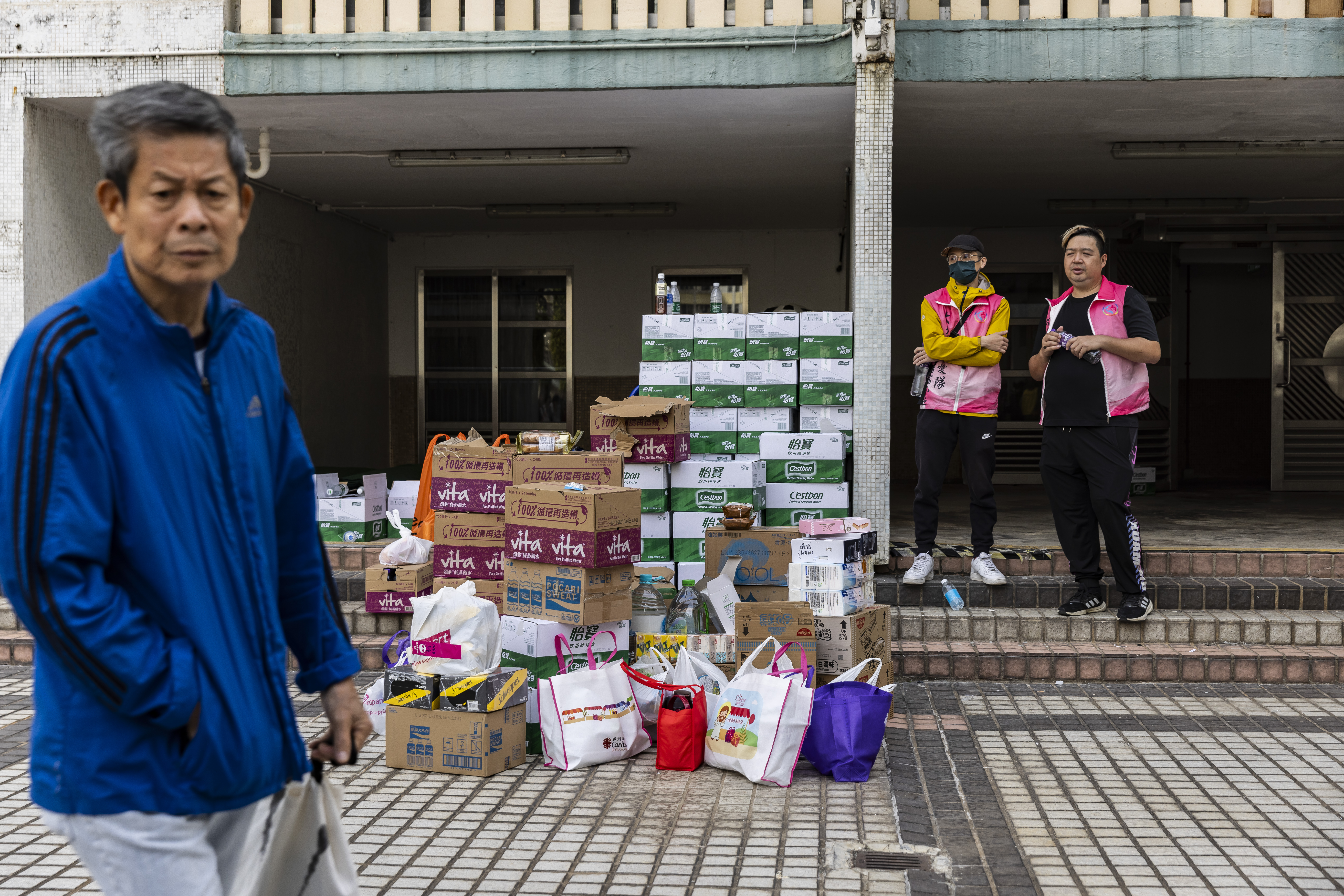
In place of local volunteer networks, the government quickly deployed “Care Teams” (CTs; 關愛隊) to assume control of relief operations (Home Affairs Department, accessed December 9). First created in 2022 after the restructuring of district-level governance, CTs are composed largely of pro-government community figures and are designed to support the government’s district work while cultivating patriotic networks (YouTube/Green Bean Media, December 3). In practice, they serve as state-aligned and state-funded intermediaries that channel resources, organize activities, and extend political influence into local communities (The Collective, June 18).
Their activation at Wang Fuk Court displaced resident-led mutual-aid efforts and centralized relief under government supervision. This mirrors the PRC mainland’s grid-management system, which divides neighborhoods into sub-units staffed by politically reliable personnel responsible for social surveillance and stability maintenance (China Brief, June 18, 2021; Mittelstaedt, 2023; China Leadership Monitor, June 7, 2023). [1] The CTs represent the reliance on loyalists at the grassroots level, replacing organic civil society with a politicized, top-down model of social management (Ong & Luo, 2024; Ming Pao, November 29). [2]
Conclusion
The Wang Fuk Court fire highlights a central contradiction in Hong Kong’s post-2020 governance: enhanced national security measures were unable to prevent disaster. The official claim that Hong Kong is now on a new journey “from stability to prosperity” (由治及興) masks a reality in which information transparency, civic participation, and statutory accountability have been subordinated to political security (Hong Kong CEO, accessed December 11). Safeguarding the state through crisis management has eclipsed public safety.
The “Hong Kong model” of procedural autonomy and public accountability has faded. Disaster relief is monopolized by the state, information flows are restricted, and even advocating for lawful inquiry may constitute a security offence. Neighborhood administration is now integrated into the broader apparatus of the PRC’s comprehensive security concept (综合安全观), suggesting that preventive repression and surveillance will continue to shape the city’s political environment.
The fire also revealed that civic engagement persists. Residents mobilized rapidly to support victims, documented information, and pushed for accountability despite facing risks. These actions underscored a persistent civic agency that continues to adapt under repression. Understanding the evolving relationship between top-down repression and bottom-up resilience will be essential for interpreting Hong Kong’s trajectory. Domestic crises like the Wang Fuk Court fire expose how residents navigate and resist constraints, how the state recalibrates control, and how the struggle over information and accountability shapes the city’s future.
The Wang Fuk Court fire was both a human tragedy and a political watershed. It illuminated the extent to which Hong Kong’s governance has shifted toward a national security paradigm that prioritizes control over transparency, state-aligned mobilization over genuine civic action, and regime stability over public accountability. At the same time, it revealed the enduring capacities of Hong Kongers to mobilize, document, and advocate, highlighting a continuing contest between authoritarian consolidation and civic resilience.
Notes
[1] Mittelstaedt, Jean Christopher. “From Social Management to Mobilisation: The Evolving Grid Management System in Shenzhen”. China Perspectives, 133 (2023).
[2] Ong, Lynette H, and Kevin Wei Luo. “Stability Maintenance, Preventive Repression, and Contentious Politics in China under Xi Jinping’s Rule.” Issues & Studies 60, no. 4 (2024).