Bao Youxiang: Warlord of Largest, Pro-Junta Ethnic Militia in Myanmar Continues to Run Wa State at 75
Bao Youxiang: Warlord of Largest, Pro-Junta Ethnic Militia in Myanmar Continues to Run Wa State at 75
Executive Summary:
- Bao Youxiang is the architect of the United Wa State Army (UWSA), the armed wing of the United Wa State Party (UWSP). Bao has led the group since 1995 and has successfully modernized both the local economy and the ethnic Wa militia—the largest of its kind, pro- or anti-regime.
- Bao’s faction has enjoyed a ceasefire with the Burmese junta throughout both periods of its rule and relies today on Wa State’s close connections with the neighboring People’s Republic of China.
With most attention on Myanmar’s armed factions focused on armed anti-junta ethnic groups, the few independent groups which have a comparatively peaceful and stable relationship with the regime are often forgotten (Forces of Renewal for Southeast Asia, March 20). One of those groups is the United Wa State Army (UWSA), the armed wing of the United Wa State Party (UWSP) (Grey Dynamics, March 14, 2024). The UWSA, a predominantly ethnic armed grouping of Wa people with roots in China and Chinese culture, governs the Wa State, officially recognized as the Wa Self-Administered Division by the Tatmadaw (Burmese military). The Wa Self-Administered Division operates as a de facto state within Myanmar (Frontier Myanmar, May 15, 2019). Further, the UWSA has an entirely different set of economic, political, and social structures from Myanmar, including a 30,000-strong army—the largest of any of the ethnic armies, and well-armed to boot (The Irrawaddy, August 31, 2022). This is also believed to be a substantial number even compared to the junta’s forces (The Irrawaddy, August 26, 2023).
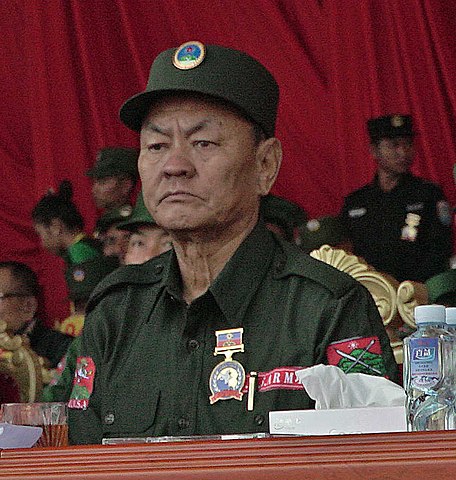
Bao Youxiang is the architect of the UWSA, a significant but overlooked non-state actor. He is also known by his Wa name, Tax Log Pang, and his Burmese name, Pau Yu Chang. At once both secretive and flamboyant, he is a de facto narco-king, warlord, and statesman all at the same time, and rarely receives any attention in the press (Myanmar Institute, March 20, 2020). Indeed, his enigmatic persona and visionary leadership make him one of the most influential figures in the Golden Triangle region, which encompasses the border areas of present-day Myanmar, Laos, and Thailand.
Bao’s Birth and Early Career
Born in 1949 in the Kunma Area of Shan State in present-day Myanmar, Bao loved playing with sharp weapons and self-made artisanal firearms. He started to show his skills when he formed the Kunma Guerilla Brigade to fend off Kuomintang factions that had relocated to his native areas after the Chinese Civil War (Time, December 16, 2002). In the meantime, he also fought against the repressive Burmese government forces. However, he financed his team through drug trafficking based on opium cultivation. He later became a member of the Communist Party of Burma (CPB) in 1969, which was the formal start of his political career (Myanmar Institute, March 20, 2020).
After that, Bao advanced from Battalion Commander to Brigade Commander of the 683 Brigade before joining the CPB Central Committee in 1985. Due to an internal power struggle with the Bamar- (ethnic Burmese) majority CPB and allegations that Wa and Kokang fighters were being used as cannon fodder against the junta forces of the time, Bao rebelled and left the CPB alongside notable Kokang warlord Peng Jiasheng (Nikkei Asia, March 29, 2022). The group of mutineers Bao led out of the CPB formed the core of the UWSP and UWSA.
Bao and the UWSA
The Wa rebels as a whole were originally led by Zhao Nyi Lai, who had founded the UWSP in 1989. Under Lai, Wa forces signed a peace treaty in 1989 with the junta which had at that point only recently seized control of the government. The Tatmadaw had taken power in response to then-Burma’s mass pro-democracy uprising in 1988, which they violently suppressed (UNHCR, May 21, 2023). Lai promoted Bao as Wa State’s sole and ultimate leader before he resigned from his post in 1995 due to health issues. Since then, Chairman Bao has made Wa state more autonomous and the UWSA more powerful. He has achieved this in no small part by allying with China, which subsequently provided Wa state crucial civilian and military aid (iNEWS, April 5, 2024).
Bao is a committed communist, due in no small part to his many years spent in service to the CPB’s People’s Liberation Army (iNEWS, April 5, 2024). As such, he adheres to the Hegelian concept of dialectical materialism, suggesting that he views events as subject to continuous change and reappraisal rather than static. Bao has argued for significant autonomy for the Wa people, as well as the construction of a resilient Wa community that is capable of defending itself (The Diplomat, May 28, 2019). It is in service to this goal that Bao has established the policies of conscripting at least one soldier from each family and mobilizing Wa women in the UWSA.
Bao has also modernized the UWSA into a competent and heavily armed defense group with armored personnel carriers, anti-tank guided missiles, and elite sniper troops (Pulse, April 17, 2019). Despite espousing communist ideology, Bao is still a strong proponent of democratic ideals. Marking the 30th anniversary of its 1989 ceasefire agreement with Myanmar’s military junta, [1] Bao called on his followers to, “Hold high the banner of peace and democracy on the one hand and armed self-defense on the other” (Frontier Myanmar, April 17, 2019). The Wa capital of Pangkham is an economically developed modern city and acts as a local tourist hub for the Chinese population in the neighboring provinces.
Conclusion
Bao believes the Wa people owe much of their continued success and autonomy to China (Firstpost, November 20, 2023). China served as a significant ally for him, providing weapons and economic assistance to the UWSA and Wa State. Bao’s legacy includes the removal of opium cultivation, which enables farmers to move into plain fertile lands to cultivate other crops; modernizing the UWSA; developing urban centers; and ensuring a long, if skeptical recognition from Myanmar’s various juntas (The Irrawaddy, January 15, 2024). Despite his retirement in 2005 due to health issues, he is still the de facto head of Wa State. At 75, Bao remains the architect of Wa’s destiny (The Malaysian Reserve, April 18, 2019).
Notes:
[1] This is not meant to imply that the Tatmadaw ruled Burma/Myanmar continuously through those years, given the decade of civilian rule from 2011 to 2021, nor that the junta in question was a static entity over a period of three decades. The Tatmadaw has been led by three different generals from 1989 to the present, each with their own policy outlook.