Benin Coup Plot Tests Cross-Border Counterterrorism Readiness
Executive Summary:
- On December 7, 2025, Nigeria and other members of the Economic Community of West African States (ECOWAS) helped Benin’s government thwart a military coup attempt, which the plotters justified as a response to escalating jihadist insecurity in the north.
- The intervention re-established Nigeria as a regional security guarantor and prevented Benin from falling under a junta that might have pivoted toward Russia’s sphere of influence.
- Preserving Benin’s stability allows for continued cross-border counter-terrorism coordination with Nigeria against the expanding presence of the Group for the Supporters of Islam and Muslims (JNIM) and Islamic State in Greater Sahara (ISGS) militants in the region.
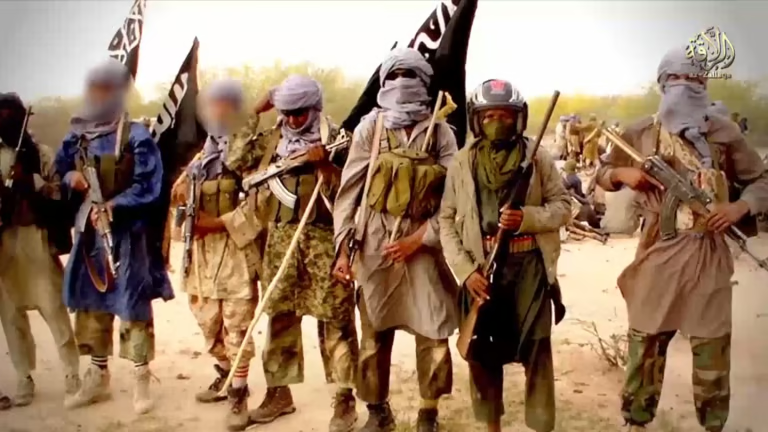
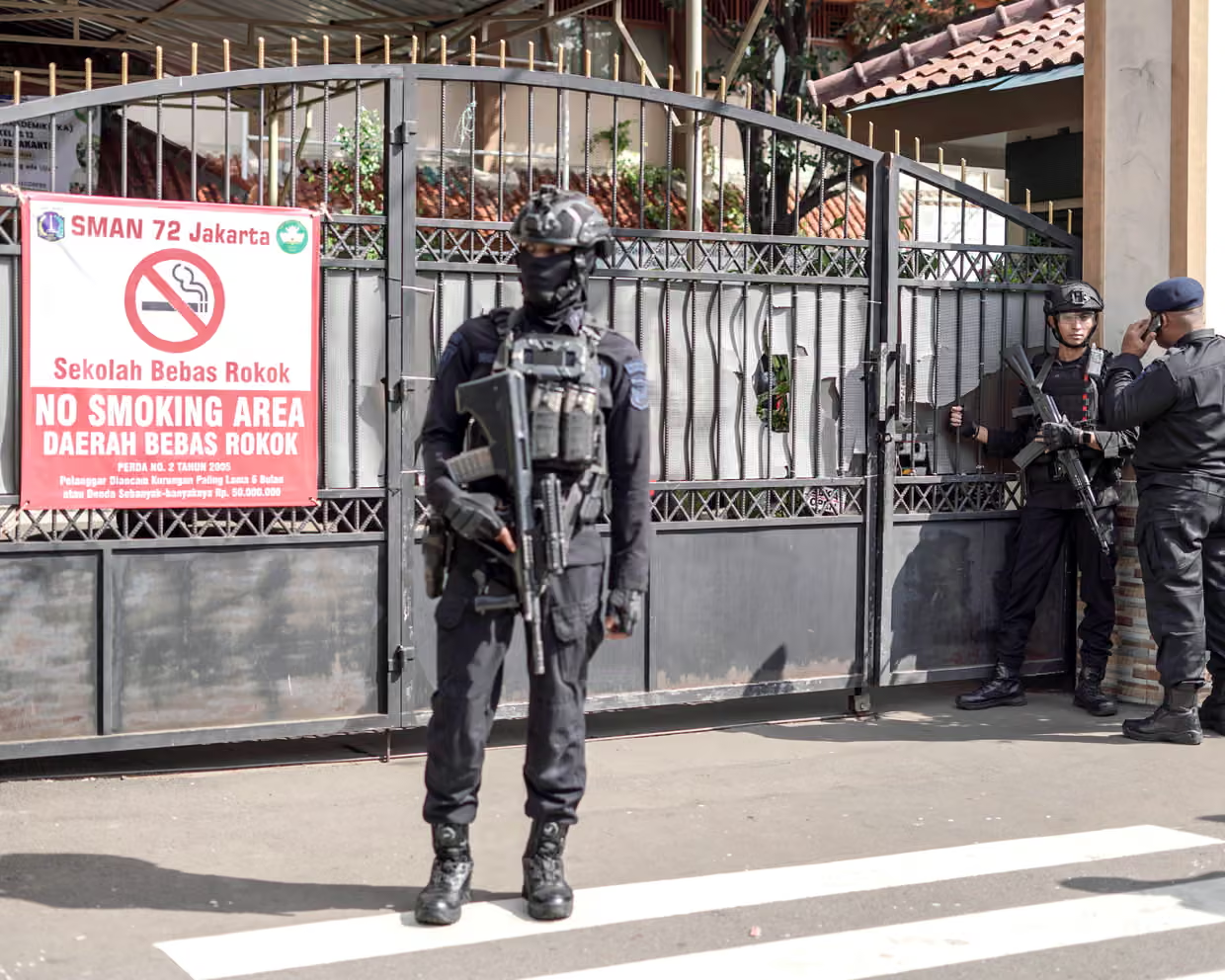
On December 7, 2025, Benin nearly became the latest country in Africa’s expanding “coup belt” to experience an overthrow of the country’s leadership (African Business, December 13, 2025). During the coup attempt, soldiers under Lt. Col. Pascal Tigri’s leadership seized control of the state broadcaster and claimed they had ousted President Patrice Talon from power. Like other Sahelian putschists, the coup plotters’ justification highlighted their desire to quell insecurity caused by jihadist groups operating in the north of the country (ghanaweb.com, December 14, 2025). The two main groups threatening Benin are Islamic State in Greater Sahara (ISGS) and Jama’at Nusrat ul-Islam wa al-Muslimin (JNIM), the latter of which expanded aggressively into Nigeria through Benin in the latter half of 2025.
Nigeria’s ability to deploy forces elsewhere in the region to combat terrorism, insecurity, or political conflict—as it did in Liberia and Sierra Leone in the 1990s—has declined in recent years as a result of Boko Haram’s violence in the country. Nonetheless, swift military support from Nigeria and the Economic Community of West African States (ECOWAS) in response to Benin’s request for foreign military assistance helped the Beninese government thwart the coup (punchng.com, December 12, 2025). This did not require boots on the ground from Nigeria or other ECOWAS partners, but Nigerian air support—if not also diplomatic statements—prevented the putschists from taking over Benin’s main airport and other key government and military installations (Le Monde, December 14, 2025).
Nigeria’s airstrikes reportedly killed several coup-plotters, immobilized their armored vehicles, and disrupted their escape routes (X/@ZagazOlaMakama, December 7, 2025). These strikes re-established Nigeria’s confidence as a regional security guarantor while also defending another democracy in the region from succumbing to a junta that would likely have followed Mali, Niger, and Burkina Faso into Russia’s orbit (prnigeria.com, December 11, 2025). Any coup and ensuing political instability, moreover, would have further increased insecurity in Benin, thereby jeopardizing Nigerian security along their porous mutual border.
The Benin–Nigeria border is the latest flashpoint in West Africa (see Terrorism Monitor, October 22, 2025). JNIM has claimed responsibility for attacks on the Nigerian side of the border since November 2025. This is a notable escalation in JNIM operations, indicating that it is not only active in engaging and allying with bandits but also in carrying out larger-scale attacks, as JNIM has now documented in publicly released video and photo propaganda materials. While ISGS is yet to claim an attack in Nigeria, its Nigerian ally, Islamic State in West Africa (ISWAP), has done so. Both ISWAP and the late Abubakar Shekau faction, moreover, have documented their followers’ presence in the region over the past five years (Terrorism Monitor, July 28, 2020).
Benin’s ability to maintain political stability will allow it to continue counter-terrorism coordination with Nigeria, which may have collapsed under a coup regime, let alone a newfound alliance with Russia. This does not mean that threats from JNIM and ISGS will diminish, however. Importantly, preventing the coup could provide impetus for Benin and Nigeria to deepen their security partnership and reconsider new strategies to counter the hitherto seemingly inexorable expansion of JNIM and ISGS into their territories.