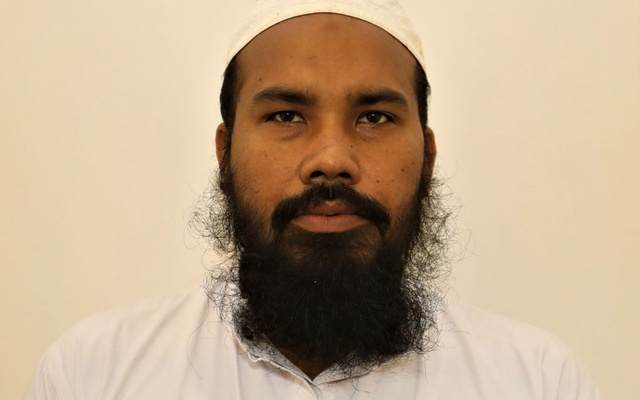
Dr. Aminul Haq: Osama bin Laden Associate Released from Prison in Pakistan
Dr. Aminul Haq: Osama bin Laden Associate Released from Prison in Pakistan
Executive Summary:- Top al-Qaeda leader Dr. Aminul Haq has been in and out of Pakistani prisons over the years. Most recently, he was released in April 2025 and deported to Afghanistan after having been arrested in July 2024. Officially designated as a terrorist by the United Nations as far back as January 2001, Haq has long been a crucial leader within al-Qaeda. His release could help catalyze a revival of al-Qaeda activity in the region.
- Haq also remains one of the group’s senior-most leaders, and one of the few remaining individuals who were closely associated with Osama bin Laden as far back as the 1980s. Haq had served as one of Osama bin Laden’s personal bodyguards and is believed to have escaped Tora Bora with him.
On July 19, 2024, Pakistan arrested Dr. Aminul Haq, a top leader of al-Qaeda in Gujrat, Punjab province. Shortly after, the Counter-Terrorism Department (CTD) of the Punjab Police registered a legal case against Haq for planning to sabotage key installations in the province. According to the authorities, he was also plotting a “large-scale terrorism project” in Pakistan (Dawn, July 19, 2021). The 15th report of the United Nations Security Council’s Islamic State/al Qaeda/Taliban Monitoring Team contradicted Pakistani reports. It states that Haq was arrested during a routine border security action, rather than a targeted counterterrorism operation. The report further claimed that Haq was arrested for the illegal possession of weapons while crossing from Pakistan to Afghanistan in March 2024, four months before the arrest was actually announced (WION, July 21, 2024). He was then deported back to Afghanistan in April 2025, when a Pakistani court ordered Haq’s release due to a lack of incriminating evidence (The Express Tribune, April 18). Haq was a crucial member of al-Qaeda and sustained the organization's global operations during a period of significant leadership losses. This led to him being designated a terrorist by the United Nations Security Council as early as January 25, 2001 (United Nations Security Council, accessed August 1). His contributions proved instrumental in maintaining al-Qaeda's operational capacity throughout South Asia (Amu TV, July 20, 2024). Haq was also arrested by Pakistan in 2008 in Lahore at the base of a different terrorist group, al-Qaeda-aligned Lashkar-e-Taiba (Amu TV, July 20, 2024). As would later be the case, Haq was released in 2011 by a Pakistani court, owing to a lack of evidence (ABP News, August 31, 2021). This suggests that Pakistan’s security forces have not been interested in keeping him detained in the long term. Associating With bin Laden A trained medical doctor who specialized in urology, Haq was born in 1960 in Nangarhar, eastern Afghanistan, and his family name was Saam Khan. He began his jihadist career as a member of Hizb-i-Islami Khalis (HIK), a faction of Hizb-i-Islami that was founded by Maulvi Mohammed Yunis Khalis. HIK was one of the many jihadist groups fighting the Soviet Union in Afghanistan, but the faction was particularly instrumental in welcoming bin Laden to Afghanistan after Sudan ejected him in 1996 (Firstpost, September 3, 2021). Haq grew close to bin Laden in the 1980s, when he worked with Abdullah Azzam in Maktab al-Khidmat. After this, Haq would emerge as one of bin Laden’s closest associates after his arrival in Afghanistan (India Today, August 30, 2021). Being a close associate of bin Laden, Haq was involved in the unit responsible for bin Laden's security. Haq helped bin Laden escape the U.S.-led Operation Anaconda in March 2002, when senior al-Qaeda leadership was holed up in the Tora Bora cave complex in Afghanistan. Three of Haq’s comrades also responsible for the escape had been members of HIK during its war against the Soviet Union (ThePrint, August 31, 2021). Return to Kabul After the Taliban’s takeover of Kabul in 2021, Haq returned to Afghanistan, where he was warmly welcomed (India Today, August 30, 2021). However, rumors circulated that he was living in Afghanistan the whole time after his first release from prison in Pakistan, suggesting he was merely appearing in public for the first time rather than returning to the country. Still, several sources claim that Haq was living in Pakistan using fake documents before returning to Kabul (Lead Pakistan, July 23, 2024). A video circulating on social media at the time of his alleged return showed a convoy transporting Haq from Pakistan to Nangarhar Province, where a small crowd of Taliban members surrounded Haq’s vehicle to shake his hand and take photos with him (ABP News, August 31, 2021). Hundreds of fighters were reportedly under Haq’s command at that time, who had allegedly harassed Afghans attempting to flee Kabul following the Taliban’s takeover of Afghanistan. Ultimately, the threat of being hit by a U.S. drone strike in Afghanistan—as had occurred with then-al-Qaeda head Ayman al-Zawahiri on July 31, 2022—pushed Haq to return to Pakistan, where he took refuge with friendly groups. Conclusion Although al-Qaeda was initially paralyzed by the killing of bin Laden in 2011, the organization's operational capacity in the region was not truly diminished until a decade later. The death of Ayman al-Zawahiri in July 2022 and the continued campaign to eliminate other top figures made the dwindling number of senior leaders who still lived increasingly vital to al-Qaeda’s survival. The arrest of Amin ul-Haq was yet another blow to al-Qaeda's already fragmented command structure. However, his release to Afghanistan in April could help once again revive al-Qaeda in the region if the Taliban fails to rein him in.