M23 Leverages Taxes and Minerals to Sustain DRC Operations
M23 Leverages Taxes and Minerals to Sustain DRC Operations
Executive Summary:
- The March 23 Movement’s (M23) capture of Goma and Bukavu in early 2025 has given it control over the eastern Democratic Republic of the Congo’s (DRC) most strategic provinces and mineral-rich territories.
- By dominating key coltan, gold, and 3T extraction sites and the transport routes linking them to regional markets, M23 has built a self-financing war economy. Its taxation, licensing, and labor systems mirror state administration.
- M23’s grip on critical-mineral supply chains is reshaping local governance and regional commercial networks. As global demand rises, this control will increasingly influence both the conflict and wider geopolitical competition.
The March 23 Movement (M23) launched a rapid offensive on a strategic hub for mineral exports in the eastern Democratic Republic of the Congo (DRC) in late January 2025. Goma, the capital and largest city of the DRC’s North Kivu province, serves as a major node in regional commerce and the mineral trade. Within hours, the rebel group had seized and occupied the city (Africa New Day, February 5). M23’s capture of Goma marked the apex of a renewed insurgency that began in late 2021 and accelerated through 2022, when the group re-emerged from years of relative inactivity to seize large swathes of land in North Kivu (African Insider, January 26, 2023). Less than a month after taking Goma, M23 pushed further south. Its fighters crossed into South Kivu and captured Bukavu, the provincial capital situated on the Rwandan and Burundian borders (The Africa Report, February 14).
The fall of Bukavu consolidated M23’s control over the two most economically and demographically significant provinces in the eastern DRC. The group now operates as the military backbone of a broader political coalition, the Congo River Alliance (French: Alliance Fleuve Congo, AFC), which administers territory with some of the most valuable mineral reserves in the world.
The eastern Congo contains minerals central to clean-energy supply chains and advanced military technologies (Discovery Alert, March 30). Resources in the region include extensive deposits of cobalt, copper, lithium, tin, tungsten, tantalum, gold, and diamonds. As significant parts of the global economy attempt the transition to renewable energy, critical minerals have increasingly become indispensable to global powers vying for these strategic resources (SFA Oxford, November 10).
Access to and control of the DRC’s vast mineral resources has long fueled cycles of armed conflict dating back to the First and Second Congo Wars. Dozens of militias and rebel movements have financed their operations through illegal extraction, transport, and taxation of minerals including gold, tin, tungsten, tantalum (collectively known as the “3Ts”), and other high-value minerals (Panzi, August 5).
M23 is no exception in its acquisition of Congolese mines. The group—and allied factions operating under the broader AFC umbrella—draw significant revenue from these activities. In Ituri Province alone, armed groups aligned with M23/AFC reportedly generate an estimated $140 million annually from illicit gold production and smuggling networks (UN Group of Experts, December 27, 2024).
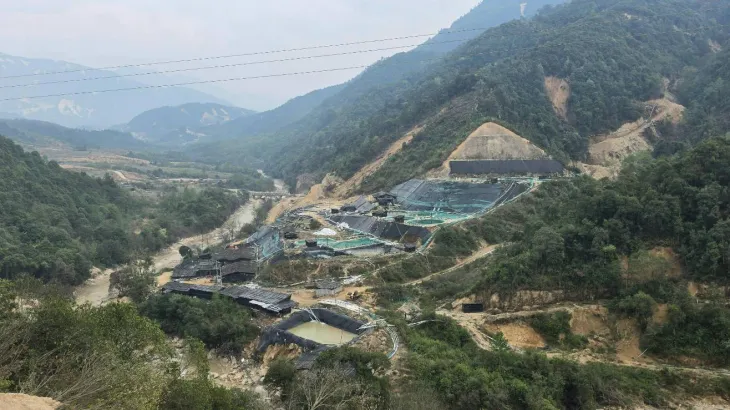
M23 has consolidated control over one of the most strategic coltan mines in the world. Since 2014, the group has controlled the Rubaya mines (also called the Bibitama Mining Concession), which account for roughly 15 percent of global coltan extraction. A critical input for electronic devices and advanced weapons systems, coltan is processed into tantalum, which can fetch up to $140 per pound on international markets (Reuters, August 13). Following its takeover, M23 established a state-like administration that oversees extraction, regulates trade, and controls the transport of minerals out of the area, which sees approximately 120 tons of coltan transported and sold each month.
M23 has systematically taken over the region’s mineral trade and the key transportation corridors connecting North and South Kivu to regional markets. Historically, eastern Congo’s commercial routes have been deeply integrated into wider East African Community (EAC) networks, connecting the region to major EAC states including Uganda, Rwanda, Burundi, Tanzania, and Kenya (IPIS, February 6). Control of these corridors has provided M23 with lucrative outlets for 3T minerals and gold, both through formal trade and well-established smuggling channels that feed into regional and global markets.
M23 has prioritized securing key trade and transport routes to ensure steady mineral export flows and access to external markets. By controlling both the extraction sites and the export routes, M23 has positioned itself not simply as an armed actor, but as a parallel authority embedded within regional commercial networks.
M23 has imposed a local form of forced communal labor (Lingala: salongo) on residents living in territories under its control. Salongo is utilized primarily for road maintenance along key mineral-transport corridors, enabling faster and more reliable movement of coltan and other high-value minerals. Notably, some factions that were once hostile to M23, such as the Coalition des Patriotes Résistants Congolais–Force de Frappe (from French: Coalition of Congolese Patriotic Resistance Fighters–Strike Force, PARECO–FF), now cooperate with the movement in extracting, taxing, and transporting coltan from the Rubaya mining area (The Africa Report, February 6). While salongo is not unique to M23—its use is widespread among state institutions and numerous armed groups in the DRC—M23 has institutionalized it as part of its governance and revenue-generation model (Wiley, November 8, 2016).
M23 has further instituted a structured taxation system for minerals. The rebel group levies a $7 tax per kilogram of coltan, generating roughly $300,000 in revenue monthly. Combined with taxes on tin, tungsten, tantalum (the “3Ts”), and manganese, M23 extracts an estimated $800,000 per month from the Rubaya mines and surrounding supply chains (UN Group of Experts, December 27, 2024). As a result, these mechanisms have allowed the movement to consolidate control over the local economy, position itself as the dominant administrative authority within cross-border mineral networks, while displacing state structures and leveraging mineral wealth to sustain its insurgency. M23 raises further revenue through issuing licenses to miners and traders, with annual fees reportedly set at $25 and $250 respectively (BBC, February 5).
M23’s taxation strategy is multipronged and not limited to mineral extraction. The movement has also institutionalized a taxation regime that includes household taxes, business levies, checkpoint fees, and harvest contributions (The Conversation, October 24, 2024). Further, M23 has displaced state administrators in several zones of North and South Kivu, replacing them with loyalists, and enabling more predictable access to mining sites and smoother control of local commerce.
These systems collectively generate substantial revenue that sustains M23’s military operations and perpetuates the broader conflict in eastern DRC. Commercial infrastructure around the mineral trade forms an integrated political economy that blurs the line between insurgency and governance. By controlling extraction sites, transport corridors, cross-border commercial networks, and local taxation, M23 has embedded itself within the economic arteries of eastern Congo in a way that mirrors the functionality of a de facto state. This model not only finances sustained military operations but also gives the group leverage over regional actors dependent on mineral flows from North and South Kivu. As international competition for critical minerals deepens, M23’s ability to command these supply chains will increasingly shape both the trajectory of the conflict and the geopolitical stakes tied to the DRC’s resource wealth.