Satoshi Kirishima and Daniela Klette: German and Japanese Left-Wing Militants Found After Almost 50 Years
Satoshi Kirishima and Daniela Klette: German and Japanese Left-Wing Militants Found After Almost 50 Years
Executive Summary:
- Recently, Satoshi Kirishima and Daniela Klette were located in their respective home countries of Japan and Germany. Both Kirishima and Klette were radical left-wing militants in the 1970s who managed to use clever tactics and false identities to evade identification and prosecution for almost 50 years.
- Satoshi Kirishima was a member of the East Asia Anti-Japan Armed Front (EAAJAF), which bombed a number of buildings in the mid-1970s, most famously the headquarters of Mitsubishi Heavy Industries in Tokyo. He was located due to a confession he made on his deathbed. Two of his former comrades now well into their 70s, Ayako Daidoji and Norio Sasaki, are still believed to be on the run.
- Daniela Klette, 65, was a member of the Red Army Faction in West Germany, which was responsible for 34 deaths before it officially dissolved itself in 1998. Her arrest in February 2024 prompted a manhunt for former associates Ernst-Volker Staub and Burkhard Garweg, who are 69 and 55, respectively.
On January 25, a Japanese man on his deathbed declared that he wanted to admit something. To a nurse, the man using the name Hiroshi Uchida confessed to being a wanted terrorist: “In the end, I want to die as ‘Satoshi Kirishima.’” Japanese law enforcement officers subsequently rushed to the hospital in Kanagawa Prefecture to hear Kirishima repeat his confession before he died of complications arising from stomach cancer four days later (Asahi Shimbun, January 27, January 29).
Who was Satoshi Kirishima?
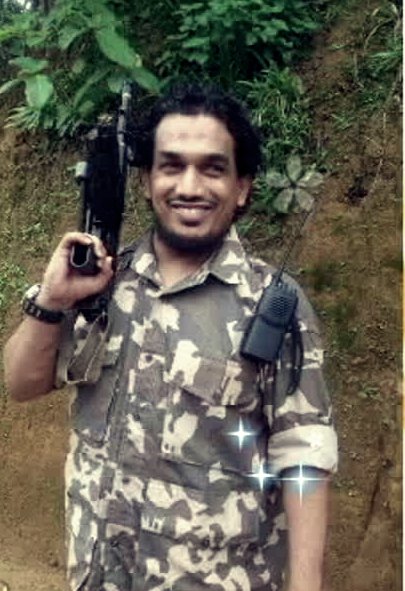
Kirishima had long been wanted on suspicion of planting and detonating a homemade bomb in a building in Tokyo’s Ginza district in April 1975. He was placed on a nationwide wanted list the following month and his face was a common sight on police boxes’ “wanted” posters for decades (Japanese National Police, March 1). Kirishima was a member of the “sasori” (scorpion) cell of the “East Asia Anti-Japan Armed Front” (Higashi Ajia Hannichi Busō Sensen, EAAJAF), which was a far-left militant group tied to a series of bombings in the mid-1970s. The group claimed responsibility for 12 bombings, targeting major construction companies, research institutes, and a trading company. Their most famous attack was a twin bombing in August 1974 at Mitsubishi Heavy Industries Ltd. which killed eight employees and bystanders and injured 380 people (Asahi Shimbun, January 27).
Kirishima was wanted specifically for his involvement in the bombing of the Economic Research Institute of Korea in Tokyo’s Ginza district on April 19, 1975. Kirishima was also guilty of conducting six other bombings between February and April 1975, which resulted in serious injuries. Kirishima denied to the police that he was involved in the Ginza bombing, although he hinted at having taken part in other bombings (Kyodo News, February 2). The Tokyo Metropolitan Police Department arrested eight communist militants connected to the series of bombings in the mid-1970s (Kyodo News, August 30, 1999).
Kirishima eventually disappeared and finally on his deathbed stated that he remained alone and on the run without any assistance for years. It seems Kirishima was isolated while the rest of the group was imprisoned or joined the “Japanese Red Army” (JRA). Two of Kirishima’s comrades, Ayako Daidoji and Norio Sasaki, were released as part of a deal demanded by the JRA after it hijacked a Japan Airlines plane in Dhaka, Bangladesh, in 1977. Both of them, who are now 75 years old, continue to be on the run from Japanese law enforcement authorities (Asahi Shimbun, January 29). Before his last breath, Kirishima acknowledged that he regretted his involvement in the bombings (Asahi Shimbun, January 29).
The German Red Army Faction Arrest
The sensational re-emergence of Kirishima was followed a month later by the arrest of the wanted Red Army Faction (Rote Armee Fraktion, RAF) terrorist, Daniela Klette, in Germany. On February 26, police officers arrested the 65-year-old in Berlin, which ended her three-decade-long run from the law. The arrest was followed by a nationwide manhunt for her two comrades who are still at large, 69-year-old Ernst-Volker Staub and 55-year-old Burkhard Garweg. The trio is suspected to have financed their life underground through a string of armed robberies (LKA Niedersachsen Press Conference, February 27).
Klette’s arrest resulted from a tip that the police received in November 2023. When police arrived at her door in the Berlin neighborhood of Kreuzberg, Klette surrendered without a fight. However, this was not before she sent a warning message to Burkhard Garweg to avoid capture. In her small rental apartment, authorities found two assault rifles, a pistol, a PG7 L-type rocket, hand grenades, ammunition, 40,000 euros ($43,000), and 1.4 kg of gold (worth roughly $110,000). In addition, police officers secured false Italian identity documents that she had used to pose as “Claudia Ivone” and “Claudia Bernadi” (Tagesspiegel, February 27).
Klette, Staub, and Garweg belonged to the so-called “third generation” of the RAF, which was active from 1983 until the group’s self-dissolution in 1998. Of the 34 victims killed by the RAF, 10 were killed by the third generation. Relatively few members of the third generation of the RAF have been caught, owing to extreme caution on the part of its members (Welt, July 6, 2012, March 4, 2024).
Klette, Staub, and Garweg are suspected of participating in three attacks from February 1990 to March 1993. One of these occurred on February 13, 1991, when Klette and other RAF militants carried out a gun attack on the U.S. Embassy in Bonn-Bad Godesber and fired at least 250 shots at the embassy building with automatic weapons. The attack did not lead to injuries, however. On March 27, 1993, RAF militants bombed the newly built Weiterstadt prison in Hesse, which was not in use at the time. Several guards present were captured by the group and released after the bombing. The detonation caused significant damage to the prison administration building and four cell buildings. Klette is also suspected of two attempted murders from the period following the RAF’s dissolution (Generalbundesstaatsanwalt, March 7).
It is possible that Garweg has fled from Germany (Tagesschau, March 8). The arrest of Klette and the ongoing manhunt for Staub and Garweg nevertheless led to other far-left sympathizers demonstrating on behalf of these RAF veterans in Berlin. Similarly, some have protested in front of the prison where Klette was held with slogans accusing the authorities themselves of “state terrorism” (Welt, March 11; Norddeutscher Rundfunk, March 18). It remains to be seen if the continued search for Staub and Garweg will re-energize the current German left-wing extremist milieu. However, the German Federal Police director Münch recently warned that left-wing extremists increasingly pose a threat in Germany (Welt, March 18).
Conclusion
The fact that Kirishima and Klette were able to live decades under pseudonyms in highly modern societies is a sign of how life in urban areas has become increasingly anonymous. For Kirishima, his evasion of the authorities is partly explained by the fact that he successfully avoided systems that would require him to register his identity—as a consequence, he lived without either a driver’s license or health insurance (Japan Times, January 28). Klette, in contrast, posed as an Italian migrant in multicultural Berlin. With the arrest of Klette, in particular, German authorities have shown how relentless investigation and search measures can still bring to justice the last ghosts from the heydays of left-wing terrorism.
Herbert Maack is an analyst who specializes in terrorism.