A Sketch of Michel Djotodia: In Power at Long Last in the Central African Republic
A Sketch of Michel Djotodia: In Power at Long Last in the Central African Republic
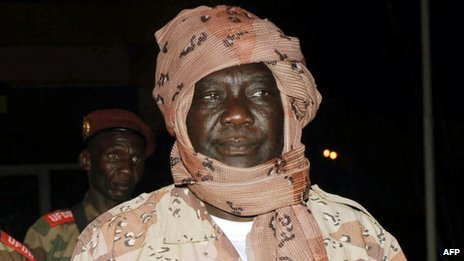
The president of the Central African Republic (CAR), Michel Djotodia, announced on Friday, September 13 that he had ordered the dissolution of the Séléka Coalition. In a presidential statement broadcast on the state–owned Radio Centrafrique, Djotodia, formerly the leader of the Séléka Coalition, warned that “Any individual or group of individuals who acts in the name of Séléka after the publication of the present decree… will incur the full sanctions under the law.”
Djotodia’s ascent to the presidency of CAR was a rapidly accomplished affair. Beginning in September 2012, Djotodia, along with a handful of other leaders of both older and newly formed rebel groups, coalesced under the banner of “Séléka,” meaning “coalition” in the local Sango language. Rallying around claims that then-President François Bozizé had failed to respect peace accords signed in 2007 and 2011, Séléka unleashed a lightning offensive on the capital of Bangui. Beginning with the capture of the city of N’Délé on December 10, 2012, Séléka ultimately succeeded in marching within 50 miles of the capital before Bozizé signed a ceasefire with the group in January 2013 (Cameroon Voice, April 14). This pact held only until March 24, at which point Séléka overtook the presidential palace and Djotodia was installed as the new president. Though little was known about him at the time of the coup, details about his life, ambitions, and personality have since begun to emerge.
Background
Djotodia was born Michel Am-Nondokro Djotodia in 1949, in CAR’s northeastern Vakaga province (situated between Chad and Sudan), which has been described as one of the country’s “most far-flung…where nobody adventures…except for thrill-seeking tourists and Sudanese traders looking for diamonds, coffee, and wood” (Le Figaro [Paris], March 26). Ethnically Gula and of Muslim upbringing, Djotodia attended primary school in Vakaga’s capital city, Birao, before relocating to Bambari for middle school (Jeune Afrique [Paris], April 8). Upon completing high school, Djotodia left for the Soviet Union, where he lived for the next 14 years, studying economic planning, eventually marrying a Russian woman and fathering two daughters.
Djotodia returned to CAR in the mid-1980s, splitting his time between the Vakaga province where he owned a business and Bangui, the capital city, where he began to work in various posts at the ministries of finance and planning. Djotodia’s attempts at climbing the bureaucratic ranks accelerated in the late 1990s when he requested to be named CAR’s Consul in Nyala, a city in the nearby Darfur province of Sudan. Though his request was denied under the regime of Ange-Félix Patassé (who served as CAR’s president from 1993 to 2003), Djotodia was ultimately granted the otherwise un-prestigious post upon the ascension of Bozizé to president in 2003, who he would ironically later depose (Jeune Afrique, April 8).
Djotodia’s connections with insurgent groups began to come together in 2006. While in Nyala, he became friends with rebels from Chad and formed the Union des Forces Démocratiques pour le Rassemblement (UFDR—Union of the Democratic Forces for Unity). He soon thereafter went to Benin to work with Abakar Sabone, the leader of the Le Mouvement des Libérateurs Centrafricains pour la Justice (MLCJ—Movement for Centrafricans Liberators for Justice), who had recently signed a peace accord of his own with Bozizé. There, at the request of Bangui, Djotodia was arrested and imprisoned for 18 months in Cotonou before being released in June 2008. Thereafter, he returned to present-day South Sudan, where he began raising the UFDR that would eventually help to put him in power in March 2013 (France Info, March 25).
As a man, Djotodia is known to be relentlessly ambitious. In addition to his self-appointment as the Consul in Nyala, Djotodia also ran two times, unsuccessfully, for legislative seats in local Birao elections in the late 1990s (Jeune Afrique, April 8). As one member of Séléka said of Djotodia: “He’s a very determined person. When he decides on something, he goes all the way” (AFP, August 18). His aspirant nature was further underlined by CAR expert Louisa Lombard. She said that, although most people were unaware of Djotodia in interviews she conducted in 2009 and 2010, “if they knew one thing, it was that he was a man with major political ambition and very little to show for it” (African Arguments, April 2). Djotodia is also known as an intellectual. In addition to being an excellent student throughout his schooling in CAR, Djotodia is also multilingual, speaking French, Russian, Arabic and English as well as Sango, CAR’s vernacular language, and Gula, his ethnic language. Djotodia is also portrayed as a somewhat enigmatic character. Particularly in the Francophone African press, Djotodia is often described as “mysterious” and less frequently as “reserved” (Jeune Afrique, April 8; Cameroon Voice, April 14).
Looking Forward
Djotodia ordered the dissolution of the Séléka Coalition but has not provided details or an agenda to explain how the group will be disbanded. According to a Western diplomat in Bagui, Djotodia “has no way to intervene and restore order [and] controls only a fifth of the Séléka forces,” which is estimated to consist of twenty thousand rebels who report to their immediate leaders (Centrafrique Press, September 29).
Djotodia’s call for the Séléka Coalition’s dissolution suggests that the sheer acquisition of power likely supersedes any genuine commitments that Djotodia might have to a political agenda, or for that matter, to group loyalty. At the time of this writing, Djotodia had informed the international community that he would hold presidential elections in 2016, but with his penchant for political power combined with the country’s historical tendency to allow the flourishing of autocrats, it seems unlikely that Djotodia will soon give up the power he has fought so desperately to attain.
Jason Warner is a Ph.D. student in African Studies and Government at Harvard University. He has served as a consultant or researcher for the U.S. Department of Defense, the United Nations Development Program, and Freedom House, among others.