Beijing Accelerates Clearance of ‘Naked Officials’ from Top Ranks
Executive Summary
- In late 2025, Beijing initiated a systemic clearance of “naked officials”—those with spouses or children residing abroad—from senior leadership ranks, marking a decisive shift from previous restrictions to summary removal.
- This campaign aims to eliminate coercion vulnerabilities by compelling senior functionaries to repatriate immediate family members or face ouster, thereby neutralizing potential Western leverage.
- By prioritizing political security, Beijing is actively constructing a human capital firewall, accelerating its decoupling from the West, and signaling the end of the reform-era technocratic governance model.
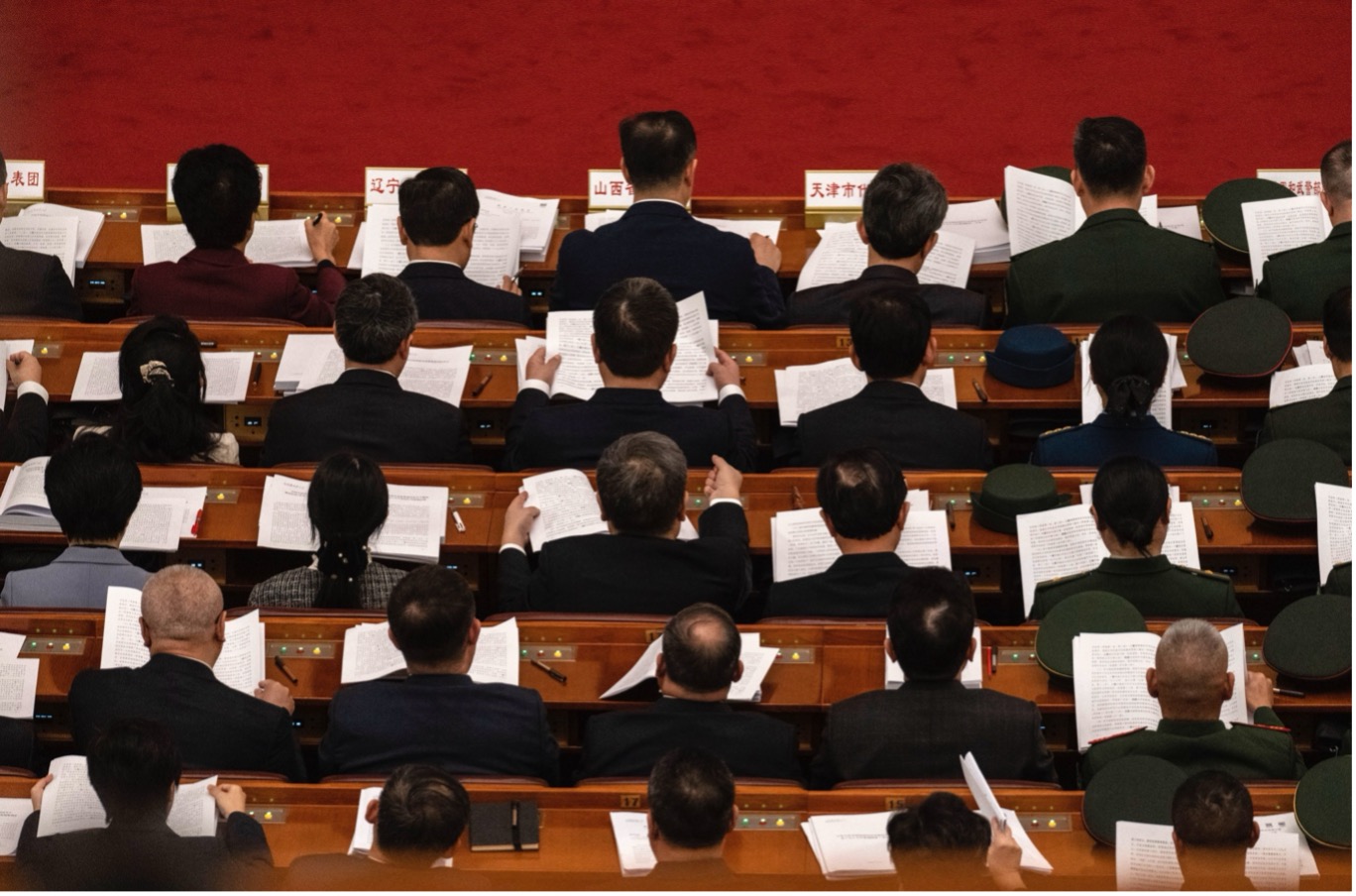
In November 2025, the 14th Session of the Standing Committee of the 14th National Committee of the Chinese People’s Political Consultative Conference (CPPCC), a top advisory body of the Chinese Communist Party (CCP), unexpectedly offered a window into the seismic shifts occurring within Chinese high-level politics. The official announcement of a sweeping personnel reshuffle included prominent figures such as Yi Gang (易纲), deputy director of the Committee on Economic Affairs (and former governor of the People’s Bank of China), and Wang Rong (王荣), deputy director of the Committee on Liaison with Hong Kong, Macao, Taiwan, and Overseas Chinese (former chairman of the Guangdong Provincial CPPCC) (Xinhua, November 1, 2025). They are among at least 20 officials who were removed from their primary positions in the latter part of 2025 (see Table 1).
The sudden exit of these heavyweights garnered significant attention. Their removal was unusual, as they had not reached the mandatory retirement age, nor were they implicated in any public corruption scandals. The phrasing used to describe their removal was that they “no longer held” (不再担任) their specific leadership roles—a distinction from the formal “dismissal” (免去) typically associated with disciplinary adjustments. That most of the officials targeted in the reshuffle retained their CPPCC membership (全国政协委员) suggests a nuanced political sidelining rather than a traditional purge.
This shift, initially visible at the periphery of Beijing’s power structure, was not an isolated incident but the visible tip of a broader overhaul. In the months surrounding the CPPCC’s actions, similar announcements stating that incumbents “no longer held” their posts or had “resigned” appeared across various regions and sectors. Prominent examples include Liu Duo (刘多), vice mayor of Shanghai (CPC News, September 26, 2025); Yan Aoshuang (闫傲霜), vice chairman of the Beijing Municipal People’s Congress Standing Committee (Beijing Daily, November 29, 2025); Lin Shangli (林尚立), president of Renmin University of China and former deputy director of the Central Policy Research Office (Ministry of Education, November 28, 2025), and Zhang Guangjun (张广军), former vice minister of Science and Technology and later party secretary of Huazhong University of Science and Technology (Ministry of Education, October 17, 2025).
These individuals all shared one commonality: significant overseas backgrounds and immediate family members residing abroad for extended periods. In other words, they were “naked officials” (裸官)—those whose spouses or children have emigrated. Analysis of these disparate personnel changes suggests that the CCP is recalibrating its organizational line through a campaign in which such officials are no longer carefully managed but actively excluded in pursuit of reinforcing national security (BBC Chinese, November 10). The imperative is to systematically excise elements vulnerable to Western sanctions or influence from critical nodes of national governance.
Regulatory Policy Shifts to ‘Zero Tolerance’
Over the past 15 years, relevant policies have progressed through three distinct phases, each corresponding to an escalation in Beijing’s perception of external threats. The evolution of the CCP’s regulatory framework concerning “naked officials” demonstrates the magnitude of the current clearance campaign.
Beijing’s regulation of “naked officials” began in the late Hu Jintao era. In the first phase (2010–2013), the policy tone was defined by “registration and management” (登记管理). The “Provisional Regulations on Strengthening the Management of State Functionaries Whose Spouses and Children Have Both Emigrated Abroad” (关于对配偶子女均已移居国(境)外的国家工作人员加强管理的暂行规定), issued in 2010, did not impose strict prohibitions on “naked officials” holding office (Xinhua, July 26, 2010). Instead, the focus was on information gathering to prevent asset flight and combat corruption. During this period, the system adopted a relatively tolerant attitude toward high-level intellectuals and technocrats with international connections, often viewing them as assets for connecting with the international community rather than security liabilities.
Under Xi Jinping, regulations tightened significantly. With the release of the “Measures for the Management of Posts Held by State Functionaries Whose Spouses Have Emigrated Abroad” (配偶已移居国(境)外的国家工作人员任职岗位管理办法) in 2014, the policy entered its second phase (2014–2024), characterized by “restriction and barring” (限制任职). These regulations explicitly list five categories of key positions barred to “naked officials,” including military, diplomatic, national security, confidential, and key leadership roles (Legal Daily, December 23, 2014). Having family abroad quickly became a glass ceiling for career advancement, though implementation retained considerable flexibility. High-ranking technical officials, particularly those outside core confidential departments, were often treated more leniently, especially if they adopted a “one family, two systems” (一家两制) arrangement where a spouse returned while children remained abroad.
Signs since early 2025 indicate that the policy has now entered a third phase: a “comprehensive clearance” (全面清理). Emerging enforcement patterns suggest that internal directives no longer distinguish between the sensitivity of positions nor tolerate compromise solutions. The current mandate reportedly presents bureaucrats of vice-ministerial rank or higher with a stark binary choice: repatriate family members or resign from office. The logic has shifted completely, from preventing corruption to preventing infiltration and ensuring political security. The ousters at the 14th CPPCC session demonstrate this zero-tolerance enforcement. Even second-tier political advisory roles or university presidencies are no longer admissible for senior-ranked officials with overseas family ties (Trivium China, November 6, 2025).
Traditional ‘Political Shields’ Fail Completely
The most striking feature of this clearance campaign is its indiscriminate intensity. To thoroughly eliminate potential internal vulnerabilities, the CCP leadership has established “political security” (政治安全) as the supreme imperative. Under this new logic, factors that previously served as political shields have been rendered ineffective.
Technocratic expertise, previously valued by the Party, no longer grants immunity. The forced departure of Yi Gang is perhaps the most indicative case. Yi had long been regarded as a quintessential “scholar-official” (学者型官员), holding a PhD from the University of Illinois and a tenured professorship at Indiana University. He spearheaded financial reforms, and international investors viewed him as a rational voice within the PRC’s economic decision-making circles (Caijing, March 12, 2023). Previously, despite restrictions, Yi successfully navigated his career due to his wife’s return to the PRC and his unique value to U.S.–PRC financial diplomacy. Under the zero-tolerance regime, however, the fact that his children remained overseas became an insurmountable obstacle (SingTao Headline, November 3, 2025). Yi’s fall sends a chilling signal that when political security overrides all other considerations, even internationally recognized professional value is no longer a defense against political scrutiny.
The clearance campaign also exposes the limits of factional patronage. Lin Shangli’s (林尚立) removal from the presidency of Renmin University of China illustrates the limitations of factional protection. Lin had a long tenure at the Central Policy Research Office, an organ under the CCP Central Committee, and was known as a close associate and core strategist for Wang Huning (王沪宁), a current Politburo Standing Committee member (Lianhe Zaobao, November 17, 2020). Given Renmin University’s status as the CCP’s “second Party School” (第二党校), its executive tier is typically vetted with extreme care. Nevertheless, Lin’s early overseas experience as a visiting scholar and his resulting family ties abroad led to the abrupt termination of his career. This demonstrates that traditional patronage offers no immunity against the supreme directive of national security. Even associates of core leaders must submit to the organizational cleansing logic when fundamental security issues are at stake.
United front assets also have become security liabilities. This shift is exemplified by the sidelining of Sui Jun (隋军). As the incumbent vice chair of the All-China Federation of Returned Overseas Chinese, a key united front body, Sui was long considered a typical “American qiaojuan” (美国侨眷), a term that refers to PRC residents with a overseas Chinese family in the United States (Caixin, May 16, 2018). For years, such connections were considered significant political assets, serving as a bridge for the CCP to the diaspora. However, under the new criteria, this former asset has been redefined as a liability. Beijing seems willing to sacrifice even the convenience of united front channels to eliminate the risk of internal infiltration at the source.
Strategic Repatriation and the Survivorship Bias
Focusing solely on the roster of removed elites risks misinterpreting the full scope of this campaign as merely a loss of talent or a sign of instability. In reality, the list exhibits a clear survivorship bias, in which the individuals publicly displaced represent the minority who refused—or were objectively unable—to comply with the directive to repatriate their family members.
For the majority of senior cadres, especially those in critical positions, the choice was existential. Faced with a political ultimatum, most chose to compel their relatives to return to the PRC. By late 2025, continuing to keep family abroad was widely viewed as a deliberate act of defiance; thus, the return of families under these circumstances is fundamentally coerced. Through these high-pressure tactics, Xi Jinping has achieved a subtle but significant tactical victory: he has successfully “repatriated” the strategic loyalty of the elite.
The logic of the policy shift extends beyond anti-corruption to the elimination of vulnerabilities to coercion. With family members repatriated, the physical pathways for Western intelligence agencies to infiltrate, subvert, or exert leverage through spouses or children are limited. [1] For bureaucrats who choose to recall their relatives to remain in the system, cutting off their overseas retreat is not merely a physical relocation but a “political pledge of allegiance” (投名状). [2] This trend is reinforced by the broadening use of exit bans to impose greater “political discipline and ideological loyalty” on cadres (The New York Times, August 3, 2025). In future international conflicts, these agents of the state, having burned their bridges, will have no choice but to demonstrate absolute loyalty to the system. This policy shift will thus harden the cohesion of Beijing’s decision-making core, rendering it more monolithic in the face of external pressure.
Reshaping Bureaucracy for Long-term Confrontation
The 2025 clearance is not merely a personnel adjustment but a move in preparation for a more volatile future international environment. The shift was driven in part by Beijing’s profound reflection on Russia’s war in Ukraine. The devastating impact of Western sanctions on Russian elites was exacerbated by the extent to which their assets and families were located within Western jurisdictions, creating a “soft underbelly” (软肋) for the Russian state. Beijing has internalized this lesson (CSIS, May 3, 2022). By weeding out figures like Yi Gang and Wang Rong who could not (or would not) sever overseas ties, Beijing is constructing a bureaucracy without strategic vulnerabilities. This appears to be a typical “pre-war” preparation, ensuring that in a future Taiwan Strait crisis or other geopolitical conflict, the executive layer will not waver due to concerns over family safety or asset freezes abroad.
The clearance regulations reflect a “political purification” (政治纯洁化) of the bureaucracy, characterized by a shift from internationalization to localization under the conditions of long-term confrontation. By removing technocrats with deep Western backgrounds, Beijing is establishing a new screening standard in which international competence is no longer a bonus but a potential security risk. This aligns with a broader trend observed since the 20th Party Congress, where traditional economic technocrats have been systematically replaced by security-oriented cadres with backgrounds in national security and the military-industrial complex. [3] This may lead to “reverse selection” (逆向淘汰) within the intellectual elite, but it is a cost Beijing sees as necessary and is willing to pay.
The PRC’s push for repatriation embodies the ethos of decoupling. Many observers see decoupling as a U.S. containment strategy, but Beijing’s actions indicate it is actively constructing an organizational and human capital firewall. By severing the private ties between its decision-making elite and the West, Beijing is preparing for a reality of two parallel worlds. It is sacrificing connectivity to ensure the absolute autonomy and security of its political core, a strategy that aligns with the broader “managed confrontation” architecture formalized in recent Party plenums (China Brief, November 3, 2025).
Conclusion
The purges of late 2025, though conducted without fanfare, will have profound structural implications for the PRC’s political landscape. They signal the gradual but definitive decline of the technocratic model that characterized the reform and opening era, under which Western education and global perspectives fueled the country’s rise. The new personnel orientation, however, demands that individuals pick a side between career prospects and international connections. This process of political purification inevitably blocks the path for returned overseas Chinese elites to reach high political office, as foreign affiliations are now often viewed as security liabilities rather than assets (The Conversation, September 26, 2023).
The PRC’s future bureaucracy is likely to be dominated by two types of individuals: those who are homegrown with no international exposure but are politically reliable, and opportunists who, despite overseas experience, have completely severed ties to prove their loyalty. This will lead to an increasingly inward-looking decision-making layer, lacking the shared intellectual framework necessary for dialogue with the West. Western policymakers should not read these personnel shifts as simple anti-corruption news but as a clear signal that Beijing is hardening its organizational structure for a protracted struggle (China Leadership Monitor, November 30, 2023). As a result, traditional channels of influence through personal networks are rapidly closing.
Table 1: Timeline of ‘Naked Officials’ Clearance (Provincial-Ministerial Level, 2025)
| Name | Removal Date | Position Removed From | Notable Former Position |
| Liu Duo (刘多) | September 25 | Vice Mayor of Shanghai (上海市副市长) | Director, Dept. of Science & Technology, Ministry of Industry and Information Technology (工业和信息化部科技司司长) |
| Liao Pinhu (廖品琥) | September 25 | Vice Chairman, Guangxi Govt. (广西壮族自治区政府副主席) | Director, Guangxi Health Commission (广西壮族自治区卫健委主任) |
| Shu Lichun (舒立春) | October | Party Secretary, Chongqing Univ. (重庆大学党委书记) | Director, Chongqing Education Commission (重庆市教委主任、市委教育工委书记) |
| Zhang Guangjun (张广军) | October 17 | Party Secretary, Huazhong Univ. of Sci. & Tech. (华中科技大学党委书记) | Vice Minister of Science and Technology; President, Southeast Univ. (科学技术部副部长;东南大学校长) |
| Yi Gang (易纲) | November 1 | Deputy Director, CPPCC Committee on Economic Affairs (Ministerial Level) (全国政协经济委员会副主任 [正部级]) | Governor, People’s Bank of China (中国人民银行行长) |
| Wang Rong (王荣) | November 1 | Deputy Director, CPPCC Committee on Liaison with Hong Kong, Macao, Taiwan and Overseas Chinese (Ministerial Level) (全国政协港澳台侨委员会副主任 [正部级]) | Chairman, Guangdong CPPCC; Party Secretary of Shenzhen (广东省政协主席;深圳市委书记) |
| Zhang Taolin (张桃林) | November 1 | Deputy Director, CPPCC Committee on Agriculture and Rural Areas (全国政协农业和农村委员会副主任) | Vice Minister of Agriculture; Vice Governor of Jiangsu (农业部副部长;江苏省副省长) |
| Zhang Jie (张杰) | November 1 | Deputy Director, CPPCC Committee on Education, Science, Health and Sports (全国政协教科卫体委员会副主任) | Vice President, Chinese Academy of Sciences (CAS); President, Shanghai Jiao Tong Univ. (中国科学院副院长;上海交通大学校长) |
| Cao Weixing (曹卫星) | November 1 | Deputy Director, CPPCC Committee on Education, Science, Health and Sports (全国政协教科卫体委员会副主任) | Vice Minister of Natural Resources; Vice Governor of Jiangsu (自然资源部副部长;江苏省副省长) |
| Sui Jun (隋军) | November 1 | Deputy Director, CPPCC Committee on Foreign Affairs (全国政协外事委员会副主任) | Vice Governor of Fujian Province (福建省副省长) |
| Chen Guoqing (陈国庆) | November 1 | Deputy Director, CPPCC Committee on Social and Legal Affairs (全国政协社会和法制委员会副主任) | Deputy Procurator-General, Supreme People’s Procuratorate (最高人民检察院副检察长) |
| Zhang Junkuo (张军扩) | November 1 | Deputy Director, CPPCC Committee on Proposals (全国政协提案委员会副主任) | Deputy Director, Development Research Center of the State Council (国务院发展研究中心副主任) |
| Chen Yuanfeng (陈元丰) | November 1 | Deputy Director, CPPCC Committee on Liaison with Hong Kong, Macao, Taiwan and Overseas Chinese (全国政协港澳台侨委员会副主任) | Deputy Director, Taiwan Affairs Office of the State Council (中央台办/国台办副主任) |
| Meng Qinghai (孟庆海) | November | Vice Chairman, China Association for Science and Technology (中国科协副主席、书记处书记) | Vice Governor of Liaoning Province (辽宁省副省长) |
| Shao Zhiqing (邵志清) | November | Vice Chairman, Shanghai CPPCC (上海市政协副主席) | Deputy Director, Shanghai Economy and Informatization Commission (上海市经信委副主任) |
| Guo Jianchun (过建春) | November 27 | Vice Chairperson, Hainan Provincial People’s Congress Standing Committee (海南省人大常委会副主任) | President, Hainan Normal University (海南师范大学校长) |
| Lin Shangli (林尚立) | November 28 | President, Renmin University of China (中国人民大学校长) | Deputy Director, Central Policy Research Office (Secretary-General) (中央政策研究室副主任、秘书长) |
| Yan Aoshuang (闫傲霜) | November 28 | Vice Chairperson, Beijing Municipal People’s Congress Standing Committee (北京市人大常委会副主任) | Director, Beijing Municipal Science & Technology Commission (北京市科委主任) |
| Zhang Zongyi (张宗益) | November 28 | President, Xiamen University (厦门大学校长) | President, Chongqing University (重庆大学校长) |
| Su Xiaohong (苏晓红) | December 4 | Vice Chairperson, Henan Provincial People’s Congress Standing Committee (河南省人大常委会副主任) | President, Pingdingshan University (平顶山学院院长) |
(Source: Compiled by the author)
Notes
[1] The Ministry of State Security was very vocal about such risks in 2025, warning that foreign intelligence agencies are actively targeting PRC nationals abroad and those with foreign connections for recruitment (China Brief, November 14, 2025).
[2] The term toumingzhuang (投名状) historically refers to a pledge of allegiance, often requiring an individual to commit an incriminating act or cut off their retreat to prove loyalty. For analysis of how the CCP’s disciplinary apparatus enforces political loyalty, see Ling Li, “Politics of Anticorruption in China: Paradigm Change of the Party’s Disciplinary Regime 2012–2017,” Journal of Contemporary China 28(2019): 47-63.
[3] For an analysis of the diminishing role of Western-trained technocrats under Xi Jinping, see Tai Ming Cheung, “New Leaders in ‘National’ Security after China’s 20th Party Congress,” UCSD Forum on U.S.-China Relations, November 30, 2022.