Harnessing the People: Mapping Overseas United Front Work in Democratic States
Executive Summary:
- The Chinese Communist Party (CCP) has created a global network of individuals and organizations as part of its united front system. In four democratic states—the United States, Canada, the United Kingdom, and Germany—this network includes more than 2,000 organizations. These constitute latent capacity that the Party can mobilize to advance the Party’s agenda.
- Beijing’s network is the product of protracted co-optation of existing civil society organizations overseas and the global expansion of domestic united front elements. The Party has spent decades assiduously cultivating overseas Chinese community organizations, co-opting local leaders and institutions to embed its preferences within civil society. Even groups that previously spent decades supporting the Republic of China (Taiwan) now fly the flag of the People’s Republic of China (PRC).
- The Party leverages this global network to support its primary goal of national rejuvenation. According to the Party’s definition, rejuvenation entails unification with Taiwan and making the PRC the global leader in terms of national power. United front work supports this goal by contributing to the PRC’s diplomatic, economic, scientific, and even military development, as well as the Party’s ability to respond to crises, such as the COVID-19 pandemic.
- This includes engaging in malign and illegal activities in foreign countries. Overseas groups with ties to the united front have directly supported illicit technology transfer, espionage, talent recruitment, and voter mobilization on Beijing’s behalf. These groups also engage in transnational repression, monitoring, harassing, and/or intimidating dissidents, ethnic minorities, and other critics of the Party.
- In democratic countries, these groups influence political decision-making by conditioning stakeholders to consider Beijing’s interests and sensitivities. United front organizations have been instrumental in shaping the approaches of local governments and political actors, particularly where oversight is weak. They have influenced legislation and public statements, and managed official engagements with the PRC.
- Where the CCP encounters opposition, the united front functions as a political weapon to isolate, neutralize, or counter Beijing’s critics. The united front system leverages its network of organizations to remove impediments to the achievement of core CCP ambitions through influence, subversion, co-optation, and coercion. These goals include building support for and neutralizing resistance to the annexation of Taiwan.
- Constraining the CCP’s ability to interfere in democracies requires active transparency. Much of the CCP’s united front activity is at least partially visible in democratic societies. Better education and information sharing could help officials and the general public recognize risks and avoid entanglement. United front groups are rarely listed in existing foreign agent registration systems, limiting the ability of governments to monitor or investigate them.
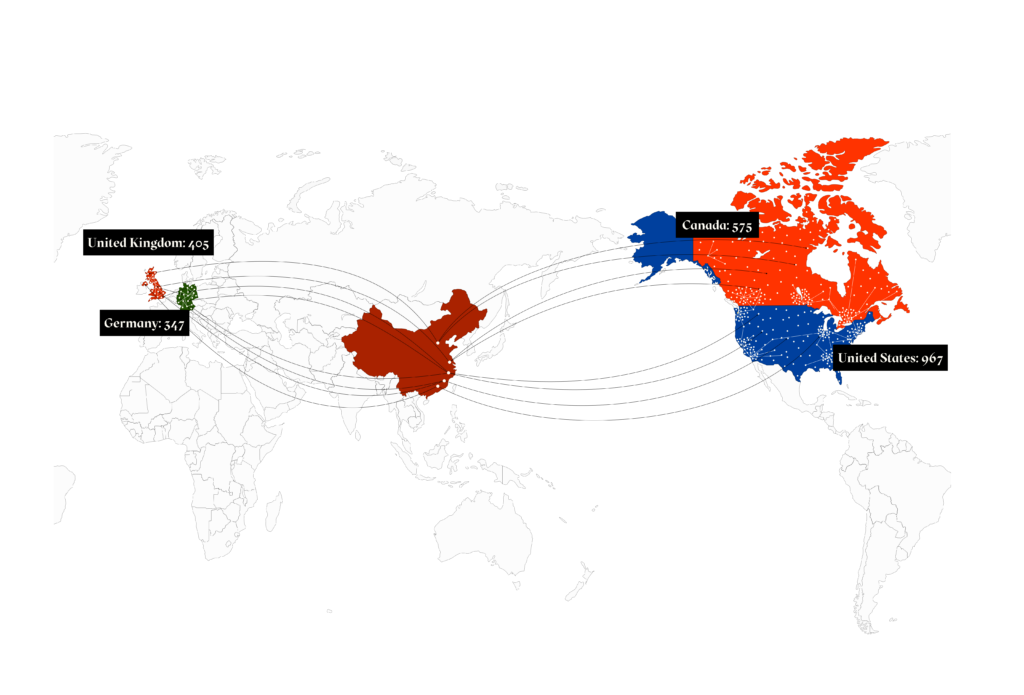
United Front-Linked Organizations Identified by Country
Introduction
Today, over 2,000 groups are helping the Chinese Communist Party (CCP) achieve its goals across the United States, Canada, Germany, and the United Kingdom.[1] These are part of a global network that likely numbers in the tens of thousands, according to some CCP sources.[2] Their efforts help shape a global environment that is more hospitable to CCP interests. The United Front Work Department (中共中央统一战线工作部), a functional department under the Party’s Central Committee, directs these efforts.[3] Internationally, it coordinates and carries out work in power centers outside the Party’s direct purview, including by mobilizing groups to further the Party’s ambitions. Foremost among these ambitions is “the great rejuvenation of the Chinese nation” (中华民族伟大复兴).
According to the Party, achieving national rejuvenation includes replacing the United States as the dominant global power. In the words of a 2021 People’s Daily editorial, “the key to national rejuvenation lies in winning the initiative in the competition for comprehensive national power” (在综合国力的竞争中赢得先机是民族复兴的关键).[4] This sentiment has been echoed by other academics and political advisors in the People’s Republic of China (PRC).[5] National rejuvenation also entails securing the CCP’s territorial claims by annexing Taiwan.[6]
Former Party general secretary Mao Zedong described united front work as “unifying our real friends to attack our real enemies” (团结我们的真正的朋友,以攻击我们的真正的敌人).[7] Deng Xiaoping later expanded the definition, framing united front work as “unifying those who can be unified, neutralizing those who can be neutralized, and dividing those in the enemy camp who can be divided” (团结一切可能团结的人,中立一切可能中立的人,分化敌人营垒中一切可能分化的人).[8]
In democratic countries, the Party has assiduously cultivated a network of organizations that act in ways that align with the fundamental principles of united front work. These organizations—mainly overseas Chinese community organizations—have ties to the united front system, a network of party and state agencies responsible for influencing groups outside the Party.[9] While they have vertical connections to the united front system, they do not necessarily have horizontal connections to each other. In important ways, these groups represent the voice of the Party.
The Party’s process for co-opting overseas organizations into the overseas united front system typically starts with identification by the United Front Work Department. Once an organization is identified as a target, officials within the united front system initiate contact, set up meetings, and invite the organization’s leadership to visit the PRC. Over several months or years, the Party builds stronger bonds with and increases its support for the organization. Gradually, Party narratives start to appear in the organization’s programming and materials, even if the organization’s stated objectives do not differ widely from its original aims. Party handlers then start to make requests, which escalate depending on the organization’s level of acquiescence. These could include asking the organization’s members to protest a visit by a Taiwanese president, or to harass those speaking out against CCP human rights abuses. These activities are framed externally as a local nonprofit organization exercising its rights to the freedoms of expression and assembly. The Party’s role is obfuscated.
The Party’s overseas mobilizational capacities were clear in August 2023, when hundreds of organizations voiced “strong opposition” as then-Taiwan vice president Lai Ching-te (賴清德) transited through the United States.[10] The protests that took place were not spontaneous. They were a result of a years-long process of building connections and influence. The Party tapped all of the groups that participated. These included “old friends of the Chinese people” (中国人民的老朋友), various elites, and the wider overseas Chinese community. The incident was not an isolated one, but rather a prominent and successful example of the Party’s ongoing overseas united front work in the United States.
This report proceeds in six sections. The first section outlines the history of the Party’s overseas united front work and traces its evolution, showing how it has expanded in scope and ambition over time. The following section explains the report’s research methodology. It discusses the open-source data collection process, the criteria used to identify united front organizations, and why the United States, Canada, the United Kingdom, and Germany were selected as the focus for this report. The third section presents an overview of the more than 2,000 organizations assessed to have connections to the Party’s united front system across these four democratic states. It categorizes them by type and function and examines how the Party views them and why they are useful. This is followed by an analysis section, which outlines four common characteristics of united front organizations, drawing on examples from the United States and Germany to illustrate key patterns. A series of case studies then illustrates how the Party builds and exploits its network of united front organizations. These include examples of the Party penetrating civil society organizations, influencing local governance, engaging in economic espionage, enforcing transnational repression, engineering emergency mobilizations, and collaborating with criminal groups. The report concludes by highlighting the importance of building transparency to better understand and counter malign influence in democratic states.
Historical Background
“Overseas united front work” appears, possibly for the first time, in a 1985 document titled Opinions of the CCP Central Secretariat on Strengthening United Front Work (中共中央书记处关于加强统战工作的几点意见).[11] This document states that the Party should, through united front work, “broaden its horizons, reach out to the world, make more friends, and foster friendships” (开阔眼界、走向世界,广交朋友、联络友谊). This is to be achieved by “going out and inviting others in, mobilizing all positive elements that can be mobilized, and effectively carrying out united front work for the tens of millions of overseas Chinese” (要走出去、请进来,调动一切可以调动的积极因素,做好几千万海外侨胞的统战工作).[12]
The Regulations on CCP United Front Work (中国共产党统一战线工作条例) also discuss overseas work. They list five primary tasks: enhancing people’s love for and understanding of the motherland and the Party, promoting Chinese culture, encouraging overseas Chinese to participate in the PRC’s development, promoting unification with Taiwan, and serving as a bridge in creating a favorable international environment for the Party. The regulationsalso reiterate Mao’s famous description of the united front as an “important magic weapon for realizing the great rejuvenation of the Chinese nation” (实现中华民族伟大复兴的重要法宝).[13]
In its overseas work, the united front’s targets have shifted as changing national conditions have led the Party to focus on different development requirements (see Table 1 below). In the early decades of reform, the Party began to target overseas Chinese with a view to “attracting trade and luring capital” (招商引资). When Deng Xiaoping reinstated overseas united front work in 1977 following the end of the Cultural Revolution, he argued that “overseas relations are a good thing” (海外关系是个好东西) that can “open up relations in various aspects” (打开各方面的局面). He also said that cultivating such relations was a key responsibility of the Party.[14] As the Party shifted its focus to economic development, Deng convened a National United Front Work Conference in 1979. He confirmed that “upper-class overseas Chinese” (华侨上层) were one of eight targets for united front work, a stance echoed in subsequent conferences.[15]
Two years later, at the 15th National United Front Work Conference, General Secretary Hu Yaobang (胡耀邦) began to widen the net, proposing “overseas Chinese compatriots” (国外侨胞 or 海外侨胞) as one of ten target groups.[16] The first official instance of the phrase “the unity of Chinese descendants both at home and abroad” (海内外全体中华儿女的团结) came at the 18th iteration of the conference in 1993. Li Ruihuan (李瑞环), chairman of the highest united front body, the Chinese People’s Political Consultative Conference (CPPCC), used it to imply that any foreign nationals of Chinese descent were targets for united front work.[17] This was based on an assessment that these people might share some affinity with the Party—or at least with China—and therefore would be easier to cultivate.
Targets of United Front Work Articulated by Different CCP Leaders
As economic reforms began to bear fruit, the focus of united front work pivoted toward “attracting talent and luring knowledge” (招才引智). This shift was motivated by a belief that competition based on economic and technological strength had become the “dominant aspect of international struggle” (国际斗争的主导方面). The Party unveiled a series of seven national development strategies starting in the 1990s, many of which focused on developing talent and, in particular, scientific and technical talent.[18] In 2000, General Secretary Jiang Zemin (江泽民) added students to a list of 12 target groups. By this point, the number of PRC citizens studying abroad had increased from fewer than one thousand in 1978 to nearly 40,000 per year.[19] No new targets have been added to the list since Xi Jinping (习近平) came to power in 2012, but he has repeatedly emphasized “unifying Chinese descendants both at home and abroad” (团结统一 … 海内外中华儿女).[20]
Overseas united front work goes beyond attempts to harness the wealth and knowledge of Chinese diaspora communities to support national development goals. It also seeks to further the Party’s interests, which are increasingly global. The country is currently the world’s top trader, accounting for over 14 percent of global exports in 2023.[21] It leads international institutions and forums with partners across the globe. And even its military is beginning to venture ever further afield and expand its international footprint. In Xi’s words, “with each passing day China moves toward the center of the world stage” (中国日益走近世界舞台中央).[22] Such deep integration with the international system has made it all the more critical to build international support, especially as it exhibits behavior that is contrary to the values that underpin the institutions of the so-called liberal international order.
The Party’s overarching objective, the “great rejuvenation of the Chinese nation,” entails surpassing the United States as the leading power in the global system. Under Xi, the Party has come to believe that building the institutions of an alternative international order is the best way to pursue this objective. It refers to this as being “actively involved in the reform and development of global governance” (中国 … 积极参与全球治理体系改革和建设).[23] Framing this emerging order as a “community of common destiny for mankind” (人类命运共同体),[24] Beijing is encouraging partner countries to buy into its vision by signing on to a series of global initiatives. These began with the One Belt One Road (一带一路) initiative but have expanded more recently to initiatives covering security, development, civilization, and governance.[25]
Beijing’s ambitions long predate Xi’s rise to power. Mao did much during his tenure to export revolution across the world in the 1950s, 1960s, and 1970s[26]. In 1988, Deng proposed establishing new international orders for politics and economics, stating that “China sees itself as a force for world peace” (中国把自己看成是维护世界和平的力量) and arguing that, as the country catches up with the developed world, its “weight and effect [in terms of its contribution to mankind] will be different” (分量和作用就不同了).[27] At the 16th Party Congress in 2002, Jiang proclaimed that national rejuvenation had been the Party’s solemn mission “since the day it was founded” (党从成立那一天起).[28] Ten years later, General Secretary Hu Jintao (胡锦涛) also articulated rejuvenation as the Party’s overall task, affirming that the Party planned to “push the international system to develop in a fair and reasonable direction” (推动 … 国际体系朝着公正合理的方向发展).[29]
The Party’s leadership has long seen overseas Chinese as essential to its efforts to reshape the international system. In December 1989, the PRC faced international censure for the Tiananmen Square massacre. Jiang Zemin made a speech to representatives of overseas Chinese, calling on them to “play an active role in helping people around the world understand China and establish an image of socialist China” (帮助世界人民了解中国,树立社会主义中国的形象,可以起到积极的作用).[30] The following year, Deng stated that the PRC still had “tens of millions of patriotic compatriots overseas who hope China will prosper and become developed” (还有几千万爱国同胞在海外,他们希望中国兴旺发达), and who he believed were a unique resource for supporting that development.[31] Xi Jinping has argued similarly that the Party must tap into the overseas Chinese community. In 2017, he said that “tightly uniting the vast overseas Chinese and returned overseas Chinese and their family members and harnessing their active role in the great rejuvenation of the Chinese nation is an important task for the Party and the state” (把广大海外侨胞和归侨侨眷紧密团结起来,发挥他们在中华民族伟大复兴中的积极作用,是党和国家的一项重要工作).[32]
Propaganda work is key to building connections and influencing these communities. In Jiang’s words, “propaganda efforts targeting overseas Chinese are a crucial component of the Party and the state’s external propaganda work. This constitutes an endeavor to enhance the understanding and emotional connection of the vast [numbers of] overseas Chinese toward China, striving to win hearts and minds. It also represents a profound and foundational task with significant strategic implications” (对华侨、华人的宣传工作,是党和国家对外宣传工作的重要组成部分。这是一项增进广大华侨、华人对中国的了解和感情、争取人心的工作,也是一项深层次的、基础性的工作,具有深远的战略意义).[33] The Party believes that, by building on this foundation, patriotic overseas Chinese will leverage their economic capacities and extensive networks to become “an important force in realizing the Chinese Dream” (是实现中国梦的重要力量).[34] This is in part why the United Front Work Department oversees the China News Service (中国新闻社), which has dozens of bureaus overseas.[35]
Methodology
This report is based on qualitative data collected through a review of policy documents, news reports, PRC government websites, and other publicly available information. All relevant information has been archived.
Organizations surveyed for this report are described as united front organizations if they have one or more connections to the CCP’s united front system. The united front system includes, but is not limited to, the Chinese People’s Political Consultative Conference (CPPCC), the Overseas Chinese Affairs Office (OCAO), the United Front Work Department (UFWD), the Chinese Overseas Exchange Association (COEA), the China Overseas Friendship Association (COFA), and the All-China Federation of Returned Overseas Chinese (ACFROC).[36] Various kinds of activities constitute a connection to the united front system. These can include overlapping personnel, such as delegates, advisors, or board members of organizations who also serve as members of organizations within the united front system. Alternatively, organizations may have held meetings with, or attended events alongside, representatives of the united front system.
This report also counts secondary organizations as united front organizations. These are organizations that are part of the network of a united front organization but may or may not have direct interactions with the united front system. A distinction should be made, however, between the individual members of these organizations and the united front system. Not all of the membership of the organizations discussed in this paper have direct contact with the CCP.
United front work takes place across the world, likely wherever the Party is present. In 2023, representatives from over 130 countries attended the 10th Conference for Friendship of Overseas Chinese Associations.[37] This implies that united front groups operate to varying degrees within all these countries at a minimum and may also operate in additional states and territories. Three reasons have informed the decision to limit the focus of this paper to four countries—the United States, Canada, the United Kingdom, and Germany. First, these four are powerful democracies whose statements and actions carry weight in the international system. Second, and as a result, any ability to influence these countries’ approach to the PRC is more likely to spill over to shape other countries’ approaches. Third, the Party believes it can benefit from these countries’ financial, technological, and educational institutions, or perhaps acquire some of the products of those institutions.[38]
The data presented in this report were gathered using only open-source materials. Information constraints therefore mean that the compiled dataset of united front organizations is unlikely to be exhaustive. The dynamic nature of organizations also means that the dataset constitutes a snapshot from late 2023. Since the research for this report was completed, it is possible that some organizations have ceased operations, or that new ones have been established. Analytic inferences derived from the data may contain minor inaccuracies as a result. Any shortcomings in the dataset do not undermine the value or relevance of the report. It is unlikely that the number of organizations across any of the four countries surveyed has changed dramatically in the last two years, and recent evidence indicates that the Party’s united front activities, especially in the United States, have continued unabated in 2025. Statements by Party leaders also have not suggested any shift in policy regarding overseas united front work. Moreover, the aim of this report is not to provide a comprehensive mapping of all active united front organizations across the four countries in question, but to give a sense of the scale of extant united front networks, a taxonomy of groups connected to the united front system, and an analysis of these groups’ activities on behalf of the Party.
The Data
The Party has been successful in cultivating relationships with overseas Chinese communities in the United States, Canada, the United Kingdom, and Germany. Across all four countries, this research has uncovered more than 2,000 organizations that have connections to the united front system. These are distributed as follows: 967 in the United States, 575 in Canada, 405 in the United Kingdom, and 347 in Germany.
All groups surveyed here serve similar purposes and act in similar ways, but they can be categorized into eight broad types based on their function and target membership. These eight include identity-based organizations, cultural promotion centers and friendship organizations, business associations and trade promotion organizations, educational organizations, student organizations, professional organizations, political party-focused and policy-focused groups, and media organizations.
United Front Organizations Based on Country and Type
The remainder of this section provides brief overviews of how the Party views each of these types of organizations and examples of the kinds of activities they undertake.
Identity-Based Organizations
Identity-based united front groups emphasize Chinese identity. The version of Chinese identity they promote is one that aligns with the CCP’s preferred definitions. At a conference for overseas Chinese organizations in 2014, Xi explained this identity as being rooted in the idea of the Chinese nation: “The united Chinese nation,” he said, “is the common root of Chinese descendants both at home and abroad; Chinese culture, which is profound and extensive, is the shared soul; and achieving the great rejuvenation of the Chinese nation is the collective dream of Chinese sons and daughters both at home and abroad” (团结统一的中华民族是海内外中华儿女共同的根,博大精深的中华文化是海内外中华儿女共同的魂,实现中华民族伟大复兴是海内外中华儿女共同的梦).[39]
Hometown associations, race-based groups, groups formed based on members’ shared last names, and groups with similar backgrounds, such as alumni associations, are all included in this category. The focus of these groups is to connect and engage with local Chinese communities. They often host holiday celebrations and festival-related events to bring people together. There are 697 such united front groups across the United States, the United Kingdom, Canada, and Germany. The United States contains the highest number, with 305 of these organizations scattered across the country.
The Coordination Council of Chinese-American Associations (CCCAA; 美国首都华盛顿地区同乡会联合会) is one example of an identity-based organization. This umbrella organization, comprising 36 hometown associations, was established in 2002. According to its website, it was formed to “unite Chinese-Americans of all walks of life and to assist them to become more successful in the American society [sic].”[40] The CCCAA aims to “provide services to enrich and invigorate the life of the Chinese community, enhance the status and image of the Chinese people, and provide services to promote U.S.-China friendship” (携手共同为丰富活跃华人社区生活,提升华人地位形象,促进美中友谊提供服务).[41] The organization hosts various events and activities to achieve its objectives, including a New Year’s Gala and exhibitions featuring Chinese calligraphy and paintings. It also hosts theatrical performances “dispatched” (派遣) by the OCAO and ACFROC—two of the five key united front bodies focusing on overseas Chinese.[42] At an event celebrating the 20th anniversary of CCCAA’s establishment, Qin Gang (秦刚), the PRC’s former foreign minister, applauded the organization for “uniting compatriots from various parts of the (ancestral) homeland, contributing to the prosperity of the Chinese diaspora community and the friendship between the people of the two countries” (团结来自祖(籍)国各地的侨胞,为华裔社团发展繁荣和两国民间友谊作出了贡献).[43] In the past, the organization has been led by individuals with direct connections to the Party’s united front system. These have included an overseas delegate to the CPPCC and a director of COEA.[44]
Cultural Promotion Centers and Friendship Organizations
Cultural promotion centers and friendship organizations are instruments of the PRC’s soft power. They exist to create a positive image of the PRC overseas. As Jiang Zemin told representatives of overseas Chinese organizations in 1999, they are “an important driving force for the development of international people-to-people friendship” (发展国际民间友好事业的重要促进力量).[45] These groups mainly target foreigners and those who are second- and third-generation descendants of PRC citizens. They host events such as art exhibitions, concerts, and calligraphy classes. In 2016, Ye Hongtao (叶洪涛), then-CEO of the China Cultural Center in Vancouver (温哥华中国文化中心), articulated the purpose of such organizations at the center’s opening ceremony. With the head of the Vancouver consulate in attendance, Ye said that the cultural center would “tell Chinese stories well, show the charm of Chinese culture, spread Chinese culture well, and strive to make it a platform for cultural exchanges and cooperation between China and Canada” (讲好中国故事,展示中国文化魅力,传播好中国文化,将努力使之成为中加文化交流合作的平台).[46] The China Cultural Center is one of 76 cultural promotion centers and friendship associations in Canada, the highest number across the four countries under consideration, out of a total of 216 such organizations.
A typical example of a friendship organization is the Canada-China Friendship Society of Edmonton (加拿大埃德蒙顿加中友好协会). Established in 1973, it aims to “carry out non-governmental economic, trade, technological, educational, and cultural exchanges and cooperation, strengthen the understanding and friendship between the peoples of the two countries, and promote the development of friendly relations between Canada and China” (开展民间的经贸丶科技丶教育丶文化等交流与合作,加强两国人民的了解与友谊促进加中两国友好关系发展).[47] The head of the organization has met with multiple officials who are part of the united front system. Most recently, its president, Ma Junqiang (马君强), attended the 10th Conference for Friendship of Overseas Chinese Association, co-hosted by OCAO and ACFROC, where Xi Jinping greeted the attendees.[48]
The society has hosted various community events. For example, in July 2018, it participated in the Intercultural Gathering of the “Our McCauley Initiative.” Through a qipao (旗袍) show, martial arts, and calligraphy, it sought to present aspects of Chinese culture. The organization also participated in conversations with the Canadian indigenous community, which “increased mutual understanding, spiritual communication, and cultural integration between Indigenous and Chinese communities” (增加了原住民与中国社团之间彼此之间的了解、心灵的沟通与文化的交融).[49] Later that year, the society co-hosted a series of events to celebrate the 40th anniversary of reform and opening up. This included a lecture titled “Insight into Chinese Economic Reform, Past, Present, and Future” in collaboration with the Centre for Chinese Studies of the Concordia University of Edmonton.[50] In 2019, it again collaborated with Concordia University, co-hosting an art exhibition. The English title of the show was “The Passion of Painting Across Cultures,” but the Chinese title hinted at its more political purpose: “Celebrating 70 Years of Diversity and Inclusion” (多元共融礼赞七十年). This explicitly linked the exhibition to the celebration of the 70th anniversary of the founding of the PRC. Representatives who spoke at its opening used the platform to eulogize the PRC’s material progress, its manufacturing strength, and its respect for ethnic minorities. The organization’s website described it as an opportunity to “let more international friends know the real China” (让更多的国际友人了解真实的中国).[51]
Business Associations and Trade Promotion Organizations
The Party has long seen business associations and its members as important resources for national development. While Western definitions tend to emphasize such institutions as private business networks designed to promote and protect the interests of their members, the Party ascribes public responsibilities to Chinese businessmen.[52] Not only do they represent “a unique opportunity” (独特机遇) and “the most economical method” (最节省的办法) to develop China but, as Deng Xiaoping pointed out in 1979, they also “come with the desire to care for and develop our socialist homeland” (都是带着爱护和发展社会主义祖国这个愿望来的).[53]
The focus of these groups is to promote economic connections with and bring foreign resources back to the PRC. They organize visits to the PRC to build relationships and work with local governments and companies. They also receive visits from PRC government officials. The research for this paper counted 322 business associations across the United States, the United Kingdom, Canada, and Germany. Canada contained the largest number of business associations, with 109 organizations.
The Canada Shandong Chinese Business Association (加拿大齐鲁华人总商会), established in 2015, is a representative example. It has contributed to local development in the PRC and facilitated economic and trade exchanges between the two countries. For instance, in 2016, it organized the Vancouver, Canada–Weihai, China Seminar on Investment & Trade (中国威海(温哥华)投资贸易交流会), where the Weihai Municipal Bureau of Commerce and the Burnaby City government signed a memorandum of cooperation on economics and trade.[54] In August 2017, the association hosted the Shandong Cultural Trade Promotion Conference in Toronto, bringing together over 60 officials and business leaders from the PRC and Canada.[55] The organization also co-chairs the Canadian Alliance of Chinese Associations, which actively participates in all OCAO and ACFROC events and organizes visits to the PRC to promote economic and trade exchanges with Canada.[56]
Educational Organizations
The Party views overseas Chinese language education as a key to “keeping the roots” (留根) of the Chinese nation.[57] Education allows second- and third-generation Chinese descendants to inherit Chinese culture and maintain an emotional connection to the nation (民族情感). Jiang Zemin argued in the early 2000s that overseas Chinese “attach great importance to Chinese education for future generations” (十分重视后代的华文教育). He believed this required promoting cultural and language education to “strengthen [the Party’s] contact with overseas Chinese and expand [the Party’s] influence” (密切我与海外华侨、华人联系,扩大我影响的重要途径).[58]
Chinese language schools and organizations that promote Chinese education are two different types of institutions with slightly different targets. The former mainly targets second- and third-generation Chinese immigrants, while the latter targets Chinese language teachers and institutions. At least 102 education organizations have been set up across the four countries studied here. The United States contains the highest number, with six organizations promoting Chinese education and 36 language schools.
Chinesische Sprachenschule in Bayern e.V. (巴伐利亚中文中心学校), established in Bavaria in 1995, offers children the opportunity to learn Mandarin while “spreading Chinese history and culture” (传播中国历史和文化).[59] According to its website, the school has over 900 students and 40 teachers, making it the largest of its kind in southern Germany. Beyond the usual functions of a school, it also has all the functions of a united front group.[60] The OCAO and the PRC Consulate General in Munich have generously supported the institution, providing funding, teacher training, and summer camps. They also have provided the curriculum, ensuring that the lessons taught are approved by the Party. To promote Chinese culture, the school also collaborates with the Confucius Institute in Munich. In 2011, the OCAO and COEA designated it a “Chinese Education Model School” (华文教育示范学校), an OCAO initiative to identify exemplary overseas Chinese-language schools for prioritizing support in teaching materials, teacher training, and institutional partnerships.[61] In 2018, during a meeting with a CPPCC delegation to Germany and the Consulate General in Munich, a CPPCC official advised the school’s vice-chancellor to “push Chinese language [teaching] into the German education system” (推动汉语进入德国教育体系中) so that the school can continue to develop sustainably.[62]
Beyond schools, Chinese language education promotional organizations host a variety of events to promote Party initiatives, such as “searching for roots” (寻根) summer camps in China for second or third generation Chinese descendants and teacher training courses. For example, in the 2000s, the Chinese Language Association of British Columbia (加拿大BC省中文协会) co-hosted seven “Searching for Roots” summer camps with OCAO for Chinese Canadian youth, taking them to Shanghai, Shandong, and Beijing. Across 23 days, participants toured cultural sites and studied Chinese language, folk arts, traditional dance, and Shaolin martial arts.[63] And in February 2022, the UK Association for the Promotion of Chinese Education (英国中文教育促进会) hosted a series of virtual teacher trainings, covering topics such as “telling China’s story well by teaching Mandarin” (用教授汉语来讲好中国故事). Over 1,200 Chinese language teachers from 90 schools across the United Kingdom attended.[64]
Student Organizations
Student organizations, whether on college campuses or in local federations, play a crucial role in bringing students and scholars together by hosting educational and cultural events. Convening these groups can be conducive to advancing CCP influence in academia, which is a highly valued sector. As Xi emphasized at the Central United Front Work Conference in 2015, overseas students are “an important part of the talent team and a new focus of united front work” (是人才队伍的重要组成部分,也是统战工作新的着力点).[65] The Party expects overseas students to “always keep the motherland and the people in [their] hearts” (要始终把祖国和人民放在心里) wherever they are.[66]
In the United Kingdom, one of the biggest united front groups is the Chinese Student and Scholars Association UK (CSSAUK; 全英中国学生学者联谊会). It hosts an annual Chinese New Year gala to celebrate the Lunar New Year, attended by several hundred people. It not only aims to protect the personal safety and enrich the cultural life of Chinese students and scholars but also vows to “make unremitting efforts to strengthen their patriotic enthusiasm and cohesion” (为增强中国学生、学者的爱国热情和凝聚力而不懈努力).[67] The organization is also an overseas board member of the Western Returned Scholars Association (WRSA; 欧美同学会),[68] a national association under the leadership of the Secretariat of the CCP Central Committee that is “managed” (代管) by the central United Front Work Department.[69] Over 539 student organizations were identified across the four countries surveyed for this report.
Professional Organizations
The Party views overseas ethnic Chinese experts as a valuable source of talent that can aid the PRC’s technological and economic development. It seeks to enlist these experts, either by recruiting them to come and work in the PRC or by using them to acquire technology from overseas. In the late 1970s, Deng Xiaoping described ethnic Chinese experts as “living treasures” (活的宝贝).[70] Jiang Zemin expressed similar sentiments, saying that they constitute “an important treasure trove of talent for the Chinese nation” (是中华民族一个重要的人才资源宝库). He encouraged overseas scientific and technological talents to return to the PRC to work “or serve the motherland in an appropriate way” (或以适当方式为祖国服务). In 1997, he spoke to the Chinese Association for Science and Technology USA (CAST-USA; 中国旅美科技协会), one of 49 united front professional organizations identified in the United States. He emphasized the significance of science and technology for the PRC’s modernization and hoped that overseas professionals would “contribute to the goal of surpassing the United States in various fields” (期望中国在不久的将来在许多领域能赶超美国).[71] Currently, CAST-USA has four offices in Shanghai, Beijing, Guangzhou, and Hangzhou. These are used to “promote technological exchanges and cooperation with domestic entities” (促进与国内的科技交流合作), “facilitate the implementation of technological achievements” (技术成果转化落地), and “serve as a bridge for CAST-USA on various exchanges and collaborations between the United States and China” (为旅美科协于中美之间的各种交流合作做好桥梁服务工作). It also has 16 chapters across the United States.[72]
Another example of the use of Chinese professionals abroad for talent transfer is through the Overseas Chinese Affairs Office (OCAO). For instance, in 2009, the OCAO hosted a forum on biomedicine with the Hubei government. Attendants included the Chinese-American Biomedical Association (美中生物医药协会), the Chinese Biopharmaceutical Association USA (美国华人生物医药科技协会), the Sino-American Biotechnology and Pharmaceutical Professional Association (美中生物技术与制药协会), the Chinese American Biopharmaceutical Society (北美华人生物医药协会), the Sino-American Pharmaceutical Professionals Association (美中医药开发协会), and BayHelix Group (北核协会). These organizations signed a memorandum of understanding with the Hubei Provincial Food and Drug Administration to establish an overseas Chinese biomedical professional database and to conduct in-depth cooperation in talent development.[73] There are at least 170 organizations of this kind across the United States, Canada, the United Kingdom, and Germany. The United States contains the highest number, with 71 organizations.
Political Party-Focused and Policy-Focused Groups
The Party encourages overseas Chinese to participate in politics. According to a former OCAO deputy director, such participation is a way for overseas Chinese to integrate into mainstream society and, crucially, “is conducive to the development of friendly relations between China and the host country” (有利于中国与住在国友好关系的发展).[74] United front organizations focused on political parties or on shaping policy often target local politicians and leaders to promote PRC interests. They openly advocate for PRC policies such as unification with Taiwan and the One Belt One Road initiative. They also support pro-PRC politicians and policies, and mobilize voters to vote for candidates most supportive of Beijing. Research for this report uncovered at least 86 political groups across the four democracies surveyed. The United States contained the highest number, with 51.
Each of the major political parties in the United States, Canada, and the United Kingdom have corresponding overseas Chinese organizations. In this sense, while the CCP does engage with political parties in host countries, it is non-ideological. This is because it is most beneficial for the CCP to be able to address all sides—including whichever party happens to be in power at any given time. Groups in the United Kingdom include Conservative Friends of the Chinese (英国保守党华人之友), Chinese for Labour (英国华人工党), and the Chinese Liberal Democrats (英国华人自民党). At a 2020 gala for the Conservative Friends of the Chinese—one of 12 identified political groups in the United Kingdom—Liu Xiaoming (刘晓明), the PRC ambassador at the time, told members to “encourage the Conservative Party and British political circles to view and develop the bilateral relationship from a strategic and global perspective, respect and accommodate each other’s core interests and major concerns, and properly handle differences” (推动保守党及英国政界从战略高度与全局角度看待和发展两国关系,尊重和照顾彼此核心利益和重大关切,妥善处理分歧).[75] Liu and his deputy at the embassy made similar remarks at events hosted by the Labour and Liberal Democrat counterpart organizations, respectively.[76]
Groups in the United States include the Chinese American Republican National Federation (全美华裔共和党联盟) and the Chinese American Democratic Club (华裔民主党协会). Canada, meanwhile, is home to the Chinese Canadian Conservative Association (加拿大华人保守党协会) and the Chinese Canadian Liberal Association (加拿大华人自由党协会).
Unlike the three other countries, in Germany, there are no party-specific organizations. This is probably because the CCP already has direct connections to Germany’s major political parties through German political foundations (parteinahe Stiftungen). These foundations are not legally affiliated with political parties but are closely connected. The state funds them based on their respective party’s electoral wins in national parliamentary elections over the past two electoral cycles.[77] For instance, the Konrad Adenauer Foundation (KAS), a think tank associated with the Christian Democratic Union, partners with organizations within the united front system, such as the Chinese People’s Association for Friendship with Foreign Countries (CPAFFC; 中国人民对外友好协会) and the Center for China & Globalization (CCG; 全球化智库), among others.[78]
The Friedrich Ebert Foundation (FES) similarly partners with the Party’s International Department and Sichuan’s provincial CPAFFC; the Hanns-Seidel Foundation (HSS) partners with CPAFFC; and both the Beijing offices of Heinrich Boll Foundation (HBS) and the Rosa Luxemburg Foundation (RLS) are supervised by CPAFFC.[79] Their supervisory authority and partners are all part of the united front system.
As a sign that the Party has been keen to work with these entities and preserve existing channels of influence, it exempted five of the six main German political foundations to continue their work in the PRC after the implementation in April 2017 of the Foreign NGO Law (境外非政府组织境内活动管理法).[80] The Party also uses these partnerships as a means to exert pressure on political foundations and parties, discouraging them from engaging with topics or activities it finds politically sensitive or undesirable.[81]
Media Organizations
The fundamental purpose of overseas Chinese-language media is to “tell China’s story well” (讲好中国的故事). In other words, to spread the Party’s propaganda worldwide. Overseas media organizations target both overseas Chinese and foreign mainstream media. At a meeting with Chinese-language media in the United States in 2008, then-premier Wen Jiabao (温家宝) argued that these organizations “play an important role in uniting overseas Chinese” (凝聚海外侨胞的重要作用).[82] Qiu Yuanping (裘援平), a former director of the OCAO, has stated that Chinese-language media content “offers spiritual sustenance for the Chinese diaspora” (提供着华裔族群的精神食粮).[83] The CCP has long held this view. During the Second World War, for example, Mao Zedong and Zhou Enlai (周恩来) used the newspapers Au Secours de La Patrie (救国时报) and Ta Kung Pao (大公报) to help mobilize overseas Chinese to take part in the war with Japan.[84]
Chinese-language media try to build strategic relationships with foreign media by “crafting a perception of representing the voice of the Chinese people” (打造‘中国民间声音’的形象), according to a long-time editor at the Europe Times (欧洲新报), a Chinese-language media company based in Germany. The Europe Times has claimed to have done this effectively, establishing a Sino-German Media Alliance (中德媒体联盟) with three mainstream German media outlets in which they published each other’s content.[85] The CEO of Ottawazine Globe Inc. (加国传媒), another overseas outlet, similarly has claimed to have collaborated with local mainstream media by providing the latest news about the Chinese community and creating multilingual content to enhance cultural dialogue.[86] As the Europe Times editornotes, media organizations must make sure to obscure any ties to the Party or government and be sure to not “sound too official” (声音不能太官方). Part of the strategy, he says, must be to “dare to attack” (要敢于出击), by refuting Western media stories that are critical of the PRC. There are at least 162 united front-linked Chinese language media organizations across the four countries covered in this paper. Almost half of these, 77, are located in the United States.
Analysis
The Party has spent years spreading propaganda and building connections to create an overseas united front network at the scale at which it exists today. The more than 2,000 organizations identified for this report likely constitute more than the tip, but not the whole, of the iceberg. But they provide more than enough data to construct a simplified model of how overseas organizations are co-opted into the united front system.
In an archetypal operation, the Party will first identify overseas Chinese groups and individuals that could be targeted to become part of the united front system.[87] Initial targets tend to be prominent and well-established Chinese individuals within business, other prominent fields and professions, or in local communities. Often, they are people who are known to be naturally aligned with the CCP. Once a connection is established, the Party will then use the individual’s network to expand, building relationships over several years. Tools that united front agencies have at their disposal to enhance such ties include inviting overseas organizations and their leadership to visit the PRC for events and meetings; sending united front workers to visit target organizations in foreign countries; and presenting individuals and organizations with honorary titles and awards. The goal of these efforts is to persuade the targets that the Party is a benign actor that can support the development of their organization. The Party also seeks to persuade targets to subscribe to its worldview. It does this by encouraging support for its propaganda narratives and a friendly and open attitude toward the Party.
All eight types of organizations detailed in the previous section share certain characteristics that indicate their status as united front organizations. First, the goals of these organizations and the remarks of their leaders often align with Party narratives. These emerge in the use of common phrases such as “hoping for the great rejuvenation of the Chinese nation” (祝愿中华民族伟大复兴), “telling China’s story well” (讲好中国故事), and “proudly acting as a bridge between China and the world” (骄傲地作为连接中国和世界的桥梁). The appearance of such language is the result of an ongoing process of influence from united front workers but does not necessarily mean that the individuals and organizations themselves are fully aware of their alignment with the Party. Second, these organizations host activities that tend to carry and amplify Party narratives. These could be school programs, art exhibitions, Chinese festivals, or other cultural and community events. Third, these organizations become voices and proxies for the Party during key moments. For instance, members of these organizations are deployed to harass and monitor Chinese dissidents and activists, interrupt events that are alleged to be “discrediting China” (抹黑中国), and come out to welcome and support visiting Party leaders. Fourth, they hold meetings or share personnel with organizations within the united front system, such as ACFROC, OCAO, CPPCC, the UFWD, and others.
Two good examples of organizations that meet all four of these conditions are the identity-based Chinese American Federation (美国南加州华人联合总会) and the politics-focused Germany Chinese Public Diplomacy Association (德国华侨华人公共外交协会; Association Verein für Öffentliche Diplomatie der Chinesen in Deutschland). Both protested against then-Taiwan vice president Lai Ching-te’s stopover in the United States on his way to Paraguay in August 2023.[88]
Chinese American Federation
The Chinese American Federation (CAF) was established in 2005 in Diamond Bar, California. According to its website, it aims to “unite like-minded associations and businesses in Southern California to form a collective force, elevate the social status and influence of the Chinese community, and contribute to broader exchanges and cooperation between the United States and China in the fields of economy, culture, technology, and education” (将志同道合的南加社团和企业联合起来,形成一股合力,为提高华人群体的社会地位,提高华人群体的影响力,促进美中两国的经济、文化、科技和教育各个领域更广泛的交流与合作贡献力量).[89] The Federation has grown over the last 20 years and now encompasses over 120 member organizations.[90] Its current chairman, Pang Fei (庞飞), was awarded the title of the “11th World Outstanding Young Chinese Entrepreneur” by OCAO and appointed a member of the ACFROC Youth Committee.[91]
Since its founding, the Chinese American Federation has been a target of the Party’s united front system. PRC consular officials attended its opening ceremony. One made a speech in which he said that he hoped the organization would contribute to the unification of China.[92] OCAO and other local overseas Chinese affairs offices also sent congratulatory messages. In 2009, the federation’s founding president, Cheng Yuan (程远), was hired as an overseas standing committee member (常务理事) by COEA.[93] Out of 210 events posted on the organization’s web page “CAF News Press” (总会大事摘要) between May 2013 and October 2025, 30 involved building connections with Party officials.[94]
The Federation hosts and participates in various activities. Its former president, Simon Shao (邵闻), who is also an ACFROC overseas committee member, has described his role as “to tell Chinese stories well, promote Chinese culture, build a bridge of Sino-U.S. friendship, and be a civilian ambassador of Sino-U.S. friendship” (讲好中国故事,推广中国文化,搭建中美友谊的桥梁,做中美友谊的民间大使). The federation has held community events such as a ping-pong competition and Lunar New Year celebrations. It has also hosted events engaging the local community, such as a “Golf Friendship Match” with the Los Angeles Police Department, and arranging donations of personal protective equipment (PPE) for the Los Angeles County Office of Education.
The CAF also engages in political activities that support the Party’s policy positions. In describing his role, Simon Shao went on to say that he would “actively participate in politics, discuss policies, and intervene in politics” (积极参政、议政、干政).[95] In August 2019, the organization coordinated events titled “Love China, Love Hong Kong, No Secession, No Riot Violence” (爱中国, 爱香港, 反港独, 反暴力). And in August 2022, its president wrote an open letter petitioning against U.S. House Speaker Nancy Pelosi’s visit to Taiwan.[96] At least seven events held between May 2013 and October 2025 were effectively proxy events that directly promoted the Party’s political views.
Figure 1: Activities Involving the Chinese American Federation, May 2013–October 2025[97]

Shao has drawn attention to two examples of what he believes is “the best approach” (最好途径) for the organization to “use mainstream platforms to promote Chinese culture and tell China’s stories” (利用主流平台传播中国文化,讲好中国故事). In one instance, he helped to arrange a collaboration with the Los Angeles Public Library. He was assisted in this project by City Librarian John F. Szabo, who is also a senior honorary advisor to the federation. Szabo allowed Nishan House (尼山书屋), an international brand launched by the Shandong Friendship Publishing House (山东友谊出版社), to station nearly one thousand Chinese books at the library.[98]
In the second instance, the federation hosted a discussion between Clayton Dube, Director of the U.S.-China Institute at the University of Southern California—also a senior honorary advisor to the federation—and Wang Meng (王蒙), former PRC culture minister and a CPPCC standing member.[99] The two discussed, among other things, the inheritance of Eastern and Western civilizations.
Germany Chinese Public Diplomacy Association
The Germany Chinese Public Diplomacy Association aims to “present a real China to the world” (将一个真实的中国展现给世界) and “guide Germany and western society to establish an objective, true, and comprehensive understanding of China” (引导德国和西方社会树立客观、真实、全面的“中国观”).[100] This phrasing echoes the language used by CCP General Secretary Xi Jinping and other united front officials. For example, at a Politburo study session in 2021, Xi called for the Party to present a “real, three dimensional, and comprehensive China” (真实、立体、全面的中国) to the world.[101] He similarly emphasized in 2024 that officials should use international platforms to “objectively, truthfully, and vividly report” (客观、真实、生动报道) on the country’s economic and social development, and on Chinese culture.[102]
Like the Chinese American Federation, the Germany Chinese Public Diplomacy Association has been a target of the united front system since its establishment in 2013. Zhejiang’s Overseas Chinese Affairs Office (浙江省人民政府侨务办公室), the Qingtian Overseas Friendship Association (青田县海外联谊会), and the Qingtian People’s Political Consultative Conference (青田县政协) all sent congratulatory messages to its launch event.[103] In June 2014, OCAO invited the association’s founding president Yang Qianghua (杨强华) to visit and experience the PRC, along with 16 other Europe-based overseas Chinese involved in public diplomacy. Qiu Yuanping (裘援平), the director of OCAO at the time, told the visitors that they were like the PRC’s “married daughters” (祖国嫁出去的“女儿”) who are “an important part of the Chinese nation” (是中华民族的重要组成部分). Qiu also urged those present to “tell real Chinese stories to overseas friends” (把真实的中国故事讲给海外的朋友们听), as the PRC “greatly needs a peaceful development environment, a friendly public opinion atmosphere, and friendly policies towards China” (十分需要和平的发展环境、友善的舆论氛围和友好的对华政策).[104] Within two years of the organization’s establishment, it had participated in several international forums and activities organized by the China Public Diplomacy Association (中国公共外交协会), the United Front Work Department, and the OCAO.[105] In 2023, Yang Qianghua attended the CPPCC as an overseas Chinese delegate.[106]
The association has focused its energies in three directions: serving the overseas Chinese community, expanding horizontal connections by forging relationships with foreign friends, and strengthening cooperation with the PRC.[107] For the first of these, it has attended other Chinese organizations’ events, commented on PRC governmental activities like the Two Sessions, and hosted cultural and artistic events. In terms of the second, it has participated in activities such as co-hosting the “2016 China-Germany Youth Exchange Culture and Art Exhibition” (2016 中德青少年交流年文化艺术展演) with the State Parliament of Berlin.[108] As for strengthening cooperation with the PRC, in 2018 the association organized a visit to the PRC for a delegation of 14 Germany-based Chinese businessmen looking for cooperation across 34 projects in technology, environmental protection, agriculture, and other areas.[109] The organization, despite being based in Germany, nevertheless petitioned against then-Taiwan vice president Lai Ching-te’s transit through the United States. It has also signed on to multiple pro-PRC policy statements and petitions, including one condemning Hong Kong pro-democracy activist Joshua Wong’s 2019 visit to Germany and another protesting Pelosi’s 2022 visit to Taiwan.[110] Based on available information, the association appears to have been more successful in hosting events for overseas Chinese communities and building relationships with the PRC than in making foreign friends.
United front organizations share many characteristics, but they also differ in important ways. Depending on the extent to which they are established within foreign societies, they may vary in their perceived value to the Party. For example, some organizations and individuals may be able to directly influence national leaders. This was the case for Tony Luk (陆炳雄), who took private jet flights to the PRC with three Canadian prime ministers in 2001, 2003, and 2015.[111] Others, meanwhile, may simply provide an extra signature to bolster a petition as a “Chinese voice.” Organizations also vary widely in terms of membership numbers. Some just have a president, while others count hundreds of members—though membership numbers do not necessarily correlate with the importance or potential impact of an organization.
Case Studies
United front work has a significant impact on democratic societies. It seeks to penetrate civil society, shape politics and policy outcomes, and compromise research security and national security. Operating through an extensive web of affiliated organizations, the united front system engages actors at every level from the national to the local. These connections facilitate technology transfer, government influence, transnational repression, emergency mobilization, and criminal activities such as human trafficking and money laundering. The following case studies highlight how these mechanisms function within a U.S. context to advance the Party’s interests.
Civil Society Influence
Well-established civil society organizations have considerable influence among local Chinese communities. This makes them key targets of the Party’s united front work. Through building relationships over time, the Party is able to nudge the organizations in favorable directions. This can be seen clearly in the evolution of the Hoy-Sun Ning Yung Benevolent Association in America (驻美台山宁阳总会馆), an identity-based organization that has now become a united front group. Established in 1854, the association historically has assisted overseas Chinese communities, carried out public welfare and charity work, promoted overseas Chinese education, and set up a cemetery for overseas Chinese who have passed away in the United States.[112]
For much of the twentieth century, the organization supported the Chinese republican government. In 1928, at its first congress, it passed a resolution to support the Nationalist government, then based in Nanjing. Half a century later, on the evening of December 15, 1978, U.S. President Jimmy Carter announced the establishment of diplomatic relations with the PRC. The association swiftly passed a resolution reiterating its firm support for the government of the Republic of China (ROC), placing advertisements in local newspapers. In June 1980, at its third congress, the organization passed another resolution. Again, it emphasized its unwavering and continued support for the government of the ROC. Throughout this period, each time the association’s chairman stepped down, a handover ceremony took place, hosted by the director general of the Taipei Economic and Cultural Office in San Francisco, at which the national anthems of both the ROC and the United States were sung. This tradition persisted all the way up to 2005. But then things started to change.[113] In 2006, the association took down the flag of the Republic of China (Taiwan). Then, in 2018, it officially passed a new resolution, deciding to raise the PRC flag in its stead.[114] For anyone following the organization’s evolution, the change came as no surprise.
Since 2000, and possibly earlier, the united front system had been cultivating ties with the organization. In February 2000, the Guangdong OCAO visited the association in San Francisco. This was the first official contact that it had received from the PRC government.[115] Later that year, the association hosted its first ever board meeting in the city of Taishan, which was “greatly supported” (大力支持) by the local and provincial government.[116] In November 2001, Thomas Ng (伍璇灿), who later proposed the resolution to raise the PRC flag, met with Tang Bingquan (汤炳权) alongside 19 other board members. At that time, Tang was the vice governor of Guangdong, and later became the vice chairman of the provincial people’s political consultative conference.[117] Engagement continued over the next decade. In 2005, a united front delegation from Taishan City headed by the chair of its people’s political consultative conference visited the organization in San Francisco. And in 2009, the association co-hosted its fourth international convention with Taishan’s Foreign and Overseas Chinese Affairs Bureau (台山市外事侨务局).[118]
United front work also involved cultivating key individuals within the association. In 1997, Wing Lau (刘荣浩), whose chairmanship oversaw the removal of the ROC flag, was hired as the member of the board of the Guangdong Overseas Exchange Association (广东省海外交流协会). He was also an advisor to the Guangdong Federation of Returned Overseas Chinese (FROC; 归国华侨联合会).[119] Lau was also an overseas advisor for Taishan City FROC.[120] Before shifting his support to the PRC, he had been involved in the ROC’s overseas community work, serving as an Overseas Chinese Affairs Advisor and in 1985 winning an Outstanding Overseas Youth Award for his efforts.[121] Lau is currently affiliated with six other united front organizations in the United States.[122]
Thomas Ng, mentioned above, became an overseas advisor to ACFROC in 2004, or possibly earlier. In 2010, he also served as an advisor to the board of the Jiang Men Youth Federation Of Overseas Chinese (江门侨界青年联合会).[123] After the visit to Guangdong in 2001, Ng maintained contact with multiple united front officials. He was invited by OCAO to visit Beijing in November 2004, where he expressed pride in the PRC’s development and described the PRC government as “truly remarkable” (非常了不起).[124] In May 2012, he again met with Tang Bingquan, who by that time had risen to the position of vice chairman of Guangdong’s people’s political consultative conference, as well with the head of the OCAO and several other united front officials.[125] The following year, the OCAO donated $100,000 to the Chinese Hospital Association in San Francisco, of which Ng was the board President.[126] Prior to his proposal to hang the PRC flag at the association’s offices in 2018, Ng had also proposed removing the ROC flag at a separate organization, the Chinese Consolidated Benevolent Association (驻美中华总会馆), in August 2016.[127]
Local Government Influence
One important line of effort for overseas united front work is using its networks to influence local governments. In 2012, OCAO director Li Haifeng (李海峰) wrote that this work must “serve the state’s diplomatic strategy” (为国家外交战略服务). She argued that this should be done by “guiding overseas Chinese organizations and leaders of overseas Chinese communities to strengthen connections with government officials and relevant leaders of the host country, and actively participating in local economic and social development, as well as in public affairs” (引导侨团和侨领与住在国政府官员和有关社会组织负责人加强联系,积极参加当地经济社会建设和公共事务). She continued by noting that it should also involve guiding overseas Chinese to “support the Chinese government’s positions and viewpoints on major issues such as Chinese territory, sovereignty, security, and human rights, and to express them to local governments and the public through appropriate means” (在涉及中国领土、主权、安全、人权等重大问题上,支持中国政府的立场和观点,以各种适当方式向当地政府和民众表达).[128]
One recent attempt to influence local government in the United States that has received little attention in English-language analysis took place in Utah in 2023. That spring, the Associated Press reported that the PRC had successfully influenced lawmakers and promoted PRC-friendly policies and narratives in the state of Utah.[129] The policies in question included establishing friendly relations with local governments in the PRC, organizing visits to the PRC, and passing resolutions on Chinese-language education and bills supporting friendly relations. These were made possible in large part due to the handiwork of the united front system operating behind the scenes.
Le Taowen (乐桃文) is a key individual influencing Utah’s state government. Le, who has a technical background, came to the United States in the 1980s as a state-sponsored graduate student at Brigham Young University.[130] He has remained within academia and is now a professor at Weber State University. When he first arrived, the PRC embassy signed him up to receive the overseas edition of the People’s Daily, which he later described as “his country and his home” (我的国、我的家).[131] Le has organized multiple visits to the PRC for Utah legislators, frequently joining the delegations himself.[132]
In 2002, Le became president of Chinese Association for Science and Technology in Utah (CAST-UT, 中国旅美科技协会犹他分会). In this role, he initiated the Utah Chinese New Year Celebration, which, over the years, has been attended by various Utah officials, including the governor, the president of the state senate, and the speaker of the house.[133] CAST-UT is a united front organization. It aims to “build relationships and exchange programs between China and the United States in the areas of culture, science, technology, business, trade, and education” (促进中美之间文化、科技、教育、经贸等领域的交流与合作).[134]
Between June 2002 and 2017, Le served in a number of roles for PRC political bodies. For instance, he spent time as the deputy director of Liaoning Province’s Department of IT Industry and Liaoning representative in the United States, alongside his academic position.[135] In 2008, he also served as an overseas Chinese delegate to the CPPCC. He has attended various other events hosted by the CPPCC and the United Front Work Department; has been an overseas director of COEA and standing overseas director of COFA; and holds advisory positions for FROCs in three separate localities—Liaoning, Shanxi, and Huanggang.
Le’s connections have paid off. He helped to delay the ban of Confucius Institutes in Utah and lobbied to block a resolution condemning Beijing’s crackdown on Uyghurs and other ethnic minorities.[136] He also engineered exchanges between the Utah State Legislature and the Liaoning Provincial People’s Congress in 2006, and supported the passage of a senate bill to fund dual-language immersion programs in 2008.[137] Most recently, in 2020, he helped establish a relationship between Davis, Utah and Huanggang, Hubei.[138] For his contributions to the friendly exchanges and cooperation between the United States and the PRC, Le said “the motherland has rewarded me with high honor” (祖国给予了我崇高的荣誉).[139]
Shawn Hu (胡向前) has also been a vector of PRC influence within the Utah state government. Hu has held various positions within the legislature, including serving as Utah’s trade representative in Beijing, as assistant to the governor, and more recently as the government’s senior advisor on China Affairs.[140] Hu was involved in setting up a sister province relationship with Qinghai in 2010, which followed a preparatory trip organized by the Qinghai Foreign Affairs Office.[141] In September 2019, in his capacity as chairman of Utah-Qinghai Industrial Technology Strategic Alliance (犹他-青海产业技术创新战略联盟), Hu met with the deputy director of Shanxi’s foreign affairs office and the vice president of its provincial people’s association for friendship with foreign countries (山西省人民对外友好协会) to discuss areas of cooperation.[142] Hu is also the honorary chairman of the Utah-Shanxi Association for Friendship, Cooperation and Exchange, which has signed an MOU with the Linfen Association for Friendship with Foreign Countries (临汾市对外友好协会), another united front organization.[143]
A third individual connected to the united front system in Utah is Peter Chan (陈尔岗). Chan is an adjunct associate professor at Brigham Young University. He is also the deputy director of the Utah Chinese Civic Center (盐湖城华助中心), a united front organization that aims to unite the strength of the Utah Chinese community.[144] The civic center is part of a larger network set up by OCAO in 2014.[145] In 2020 and 2021, Chan drafted a resolution honoring Helen Foster Snow’s contribution to Sino-American friendship. Snow was awarded the title of “Friendship Ambassador” in 1996 by the CPAFFC, an organization responsible for foreign influence operations.[146] The resolution passed in 2022.[147] The work of these three individuals has done much to shape the way in which the state government in Utah approaches the PRC, handling both its relationship and official disposition to Beijing. But it is just one example in one state of successful united front work.
While a number of additional cases in recent years have attracted considerable public scrutiny, such as the case in New York of Linda Sun, most efforts to shape local political environments and build long-term access to municipal and state institutions have occurred with far less visibility or public awareness.[148] This is often because oversight is weaker at the local level, and engagement often takes place under the banner of cultural exchange, diaspora service, or friendship diplomacy. This is a deliberate strategy by the united front system, which seeks to expand influence without provocation by obfuscating the role of the CCP.
Research Security
Awareness of how the united front operates is important for mitigating risks to research security. United front work does not just seek to influence people and policy and shape public opinion. It also supports national development in other ways. A core part of achieving the Party’s goals of national rejuvenation and Chinese modernization involves “seizing the commanding heights” in a set of critical and strategic technologies. In practice, this has often meant acquiring technology through licit and illicit means, including via espionage, theft, and forced technology transfer. The Party primarily targets professional organizations to achieve these ends. Business organizations are also used to develop relationships with individuals that have access to target technologies. The following two case studies show how the united front engages in economic espionage.
Yan Wengui (严文贵)
Yan Wengui (严文贵) was a research geneticist at the U.S. Department of Agriculture’s Dale Bumpers National Rice Research Center in Arkansas. In late 2013, he was charged alongside Weiqiang Zhang (张维强) for conspiracy to steal rice seeds from a Kansas research facility owned by the biotech firm Ventria Bioscience.[149] The theft took place during a visit to Arkansas by a PRC delegation that Yan helped organize.[150] Yan pleaded guilty in October 2016 and was sentenced to one year in prison.
Yan’s connection with the united front system started as early as 2008. In October that year, he was appointed as a member of OCAO’s Overseas Expert Consultant Committee (海外专家咨询委员会).[151] This Committee was established in July 2005 to implement two of the seven national development strategies enshrined in the Party Charter, the “rejuvenation through science and education development strategy” (科教兴国战略) and the “talent strong country development strategy” (人才强国战略).[152] At the time, OCAO director Li Haifeng (李海峰) told the organization’s members to “actively promote S&T and economic exchange and cooperation between China and the world … to make new and greater contributions to the realization of the vision of the great rejuvenation of the Chinese nation” (积极促进中国与世界科技经济的交流与合作 … 为实现中华民族的伟大复兴理想做出新的更大的贡献).[153] Yan was reappointed to the third iteration of the committee in 2011.[154]
In July 2010, Yan participated in the Overseas high-level talents Tianfu trip (海外高层次人才天府行), which was co-hosted by Sichuan’s OCAO. On the trip, he recommended that talents should be able to come and go from the PRC, and that agricultural technical cadres should go abroad for field research.[155] The same month, Yan attended the “Sixth World Overseas Chinese Forum” (第六届世界华人论坛), co-hosted by OCAO, the Ministry of Science and Technology, the Chinese Academy of Sciences, and the Guangdong Government.[156] Also in attendance were a number of high-ranking Party officials. These included Wang Yang (汪洋), then a Politburo member and later chairman of the CPPCC; Wan Gang (万钢), then a CPPCC vice chairman and minister of science and technology; and other united front officials.[157]
In 2011, Yan became the president of a U.S.-based united front organization, the Association of Chinese Soil & Plant Scientists in North America (ACSPSNA; 北美华人土壤和植物科学家协会).[158] This professional organization was founded in November 1985 in Atlanta, Georgia. Its launch event was attended by Li Peiwen (李沛文), a CPPCC member and then-vice president of South China Agricultural University.[159] Yan also appears to have received a certificate of appointment from the National Plant Breeding in Space Engineering Technology Research Center (国家植物航天育种工程技术研究中心).[160]
Huang Leping (黄乐平)
Huang Leping (黄乐平), also known as Nicole Huang, was charged in 2010 alongside her husband Chang York Yuan (张远) for violating U.S. export regulations. Huang and Chang, who served as the general manager and the vice president, respectively, of General Technology Systems Integration Corporation (GTSI), had illegally exported high-speed analog-to-digital converters to the PRC. The destination of these converters was the 24th Research Institute of the China Electronics Technology Corporation (CETC; 中国电科), which was established in 1968 by the PLA’s Commission of Science and Technology for National Defense.[161] In other words, Huang and Chang were sending U.S. technology to support PRC military modernization.
Huang appears to have got off lightly. According to the Bureau of Industry and Security’s (BIS) 2012 annual report to Congress, a settlement was eventually agreed. The terms included a civil penalty of $300,000, with $250,000 of that amount suspended for a two-year probationary period; a 12-year suspended denial of export privileges; and complete export compliance training on the Regulations within twelve months.[162]
Evidence of Huang’s relationship with the united front system stretches back to 1997. In March that year, she co-founded the U.S. Wenzhou Association (温州旅美同乡会), where she started as a board member before becoming its president in 2009. The aim of the organization is to bring together emigrants from Wenzhou in the United States. But it also focuses on assisting reform and opening up policies to support Wenzhou’s development.[163] The association’s founding president, Ye Kangsong (叶康松), was a CCP member. Before coming to the United States, Ye had served as the secretary of a county party committee, as well as a member of the Wenzhou Municipal People’s Congress Standing Committee.[164]
Huang is also a founding member of the U.S. Zhejiang Commerce & Culture Association (美国浙江经贸文化联合会), established in November 2003. The launch of the organization was attended by the PRC’s consul general in Los Angeles and praised by various united front agencies in the PRC.[165]
In 2003, Huang was invited to participate in the first World Wenzhounese Conference, a platform initiated by then Wenzhou Party Secretary and current PRC Premier Li Qiang (李强) as part of the city’s united front work.[166] Xi Jinping also commented on the conference in his capacity as Zhejiang party secretary. He said that he expected the conference would “connect more individuals of Wenzhou and Zhejiang heritage from home and abroad” (联络更多海内外温州籍和浙江籍人士), and called on attendees to “foster a bond with our homeland and contribute to our motherland” (情系故土,报效桑梓).[167]
In late October 2008, around the same time that Huang and Chang’s conspiracy began, they visited the PRC. Over three days in Chongqing, where the CETC 24th Research Institute is located, they met a delegation of U.S. CEOs, with Huang acting in her capacity as a board member of the Chinese American CEO Organization (美中工商协会), a united front organization.[168] They also met with multiple national and city-level united front officials, including the deputy director of the OCAO and the chairman of ACFROC.[169]
Several months later, when Huang became the president of the U.S. Wenzhou Association, the event to mark her appointment was attended by officials from the PRC consulate, and she was congratulated by officials from ACFROC, OCAO, and other united front agencies.[170] In late 2009, the Zhejiang FROC appointed Huang as an overseas member.[171]
Huang’s long-standing involvement in diaspora associations and commerce groups tied to united front entities demonstrates how these networks can serve as a platform for cultivating relationships that may eventually be used for broader political objectives. It also shows that commercial engagement and united front-linked community leadership roles can intersect with state-linked political goals.
The cases of Yan Wengui, Huang Leping, and their co-conspirators constitute two instances in which PRC citizens have been caught for violating U.S. law in their efforts to support the PRC’s national development. Despite their convictions, numerous other examples of united front involvement in technology theft have come to light in the more than a decade since. Other well-known cases include, as the researcher Alex Joske has highlighted, that of former Tesla employee Cao Guangzhi (曹光植), who stole the source code for Tesla’s autopilot technology. Cao also cofounded the Association of Wenzhou Ph.D.s—U.S.A. (全美温州博士协会), a united front group, as well as a talent recruitment station for Wenzhou and Luchen District.[172] There are likely other cases that are yet to be identified publicly.
Transnational Repression
The Party also uses its overseas united front networks to carry out transnational repression, by monitoring, harassing, and directly attacking those it considers to be threats. Its targets include Chinese dissidents, Taiwanese, Hong Kongers, Uyghurs, Tibetans, religious minorities like Falun Gong practitioners, and others.
A joint report published in 2024 by the Hong Kong Democracy Council (HKDC) and Students for A Free Tibet documents the Party’s use of overseas united front organizations and individuals to attack protesters in San Francisco in November 2023 during Xi’s visit.[173] One individual mentioned in the report is Chen Longkui (陈隆魁), also known as Michael, who allegedly coordinated efforts to intimidate and physically confront demonstrators. Chen has held multiple leadership and advisory positions in united front organizations in the United States, including the Chinese American Federation and the San Francisco Bay Area Committee to Promote the Reunification of China.[174] He attended an event to commemorate the “80th Anniversary of the Victory of the Chinese People’s War of Resistance Against Japanese Aggression and the World Anti-Fascist War” in September 2025 and was an overseas committee member of ACFROC.[175]
A separate investigation by the human rights NGO Safeguard Defenders in 2022 further highlighted how the Party operates “overseas police service stations” in dozens of countries, including in the countries that are the subject of this report. These service stations serve as extensions of the Party’s apparatus of transnational repression. They have been implicated in coercing PRC nationals abroad to return to the PRC, collecting intelligence on dissident communities, and intimidating activists and ethnic minorities. According to Safeguard Defenders, the Party’s overseas united front system and informal policing networks often overlap, forming a coordinated effort to suppress dissent and extend Beijing’s reach beyond its borders.[176]
Emergency Mobilization
One final way in which the Party leverages its extensive network of united front groups overseas is for mobilizing resources in the case of national emergencies.[177] For example, on January 25, 2020, in the early stages of the COVID-19 pandemic, the Fuzhou FROC and OCAO jointly announced a “Fuzhou Overseas Chinese Community Pandemic Prevention Initiative” (福州侨界防范疫情倡议书), in which they asked for medical supplies.[178] Within a few days, organizations in the United States had shipped hundreds of boxes and thousands of medical supplies back to the PRC. On January 30, the Fuzhou Langqi Association in New York alone secured a batch of 300 boxes of N95 masks to ship to the PRC.[179] Other Fujianese community groups in the United States, Canada, the United Kingdom, and Germany also donated over 100,000 N95 masks and procured other types of medical supplies such as advanced thermometers, gloves, and protective gear in response to the initiative.[180] Government agencies from other provinces also mobilized united front networks overseas to secure resources.[181]
Conclusion
The Chinese Communist Party has built a broad, multi-layered network of more than 2,000 overseas organizations across the United States, Canada, the United Kingdom, and Germany. These organizations may be activated to advance its political, economic, and other interests. Although many of these groups began as ordinary community, cultural, or professional associations—and in some cases spent decades supporting the government of the Republic of China—sustained engagement by the Party’s united front system has gradually encouraged them to align with Beijing’s narratives and priorities.
The groups’ activities range from shaping local politics and public opinion to facilitating technology transfer, mobilizing resources during crises, and enabling transnational repression. While not all members of these organizations are aware of their role as part of the united front’s broader ecosystem, the cumulative effect is a significant extension of the Party’s influence into democratic societies. Recognizing that this network exists and understanding how it functions is therefore essential for safeguarding research integrity, protecting civic spaces, and ensuring that engagement with diaspora communities remains transparent, pluralistic, and free from coercive foreign influence.
Building Transparency
A significant amount of the CCP’s united front work operates entirely in the open. Groups and relationships can be identified across a wide range of sectors, from academia and business to politics and media. These institutions, especially in democracies, offer a degree of transparency that allows united front groups to be identified and tracked. This means that entanglement is often avoidable. Information sharing and educational activities in the following areas would make it easier for decision-makers to understand the risks, see the warning signs, and make better decisions about how and with whom they engage. Transparency requires positive actions to be taken, such as actively sharing information, implementing foreign influence registration schemes, and ensuring access to expertise. The United States, like Canada and the United Kingdom, have decided as a matter of policy that foreign influence when it involves national security and sovereignty must be countered. None of these countries, however, has created a culture around transparency to ensures that civil society develops antibodies against malign influence and that government resources go toward countering the worst dangers.
Education Creates Shared Knowledge of Risks
Informing policymakers and the broader public in democratic societies about how the united front system works, the risks it poses, and indicators that local organizations have ties to the united front system is important. Absent clear communication of this contextual information, the public is unlikely to understand the scale or significance of the problems overseas united front work poses for Western societies—including the Chinese people living there. Communicating these risks also includes distinguishing between the CCP and the Chinese people and the wider Chinese diaspora. To date, some governments, think tanks, academics, and journalists have published research or reported on overseas united front activities. This work remains largely fragmented, however, and has not been followed up with coherent policies in response. A more coherent understanding of the problem and its attendant challenges can allow democracies to come up with solutions to counter CCP influence. This is also a precondition for truly supporting Chinese and immigrant communities. Only with the attendant understanding of how the CCP operates can members of Western societies navigate contacts with the PRC without legitimizing and facilitating united front work.
Community Engagement Can Counter United Front Work
The CCP’s relationship-building process is ongoing and can be countered. Just as some united front-linked organizations have in the past been anti-CCP and/or pro-Taiwan organizations before turning into ardent supporters of Beijing, actors in democratic countries can also work to win Chinese descendants’ hearts and minds. Today, community engagement with the Chinese diaspora is typically conducted by local officials through the framework of elections and mobilizing constituents to vote. Candidates often do not seem to understand what the united front is and often have become targets of the united front or unwitting tools of the Party. Well-educated policymakers and individuals are therefore a precondition for effective community engagement that avoids unintentionally promoting Party objectives.
Reporting Systems Currently Under-Used for United Front Organizations
The United States, United Kingdom, and Canada all have registration systems for individuals and organizations that act as foreign agents. Germany does not currently have such a law on the books. The United States, for instance, has passed the Foreign Agents Registration Act (FARA). This requires any person who acts as an agent for a foreign principal to register with the attorney general within ten days of establishing operations within the country. According to the historical list of all registrants by country, there are only 275 registrants for China to date.[182] This report identifies 967 united front organizations in the United States, of which none is currently registered under FARA. One organization, the United Chinese Associations of the Eastern United States Inc. (美东华人社团联合总会), was registered in September 2023, but denied that its foreign principal, COFA, was part of a foreign government or foreign political party. It has since been delisted. Such registration systems—when adequately enforced—create a line between those CCP-related organizations that are prepared to operate within the rules and those that are not. The former identifies those elements that warrant monitoring or can be addressed by civil society. The latter identifies those elements that warrant government investigation to counter and expose, because these organizations may be facilitating espionage, technology transfer, transnational repression, or any of the other harms detailed above.
Allies and Partners Rarely Collaborate on United Front Issues
The united front system operates on a global level. But when democratic countries recognize united front work as a problem, they rarely view it as a global issue. As a result, efforts to build information-sharing platforms or to work with allies and partners to combat CCP activities within democratic societies are minimal—if they exist at all. This includes cooperation at both the governmental and non-governmental levels. Civil society organizations frequently work to spread awareness internationally on salient issues, something that would be useful for building a better understanding of how the united front operates beyond the countries covered in this report. The attention paid to united front work in conferences and fora that focus on challenges posed by the CCP is disproportionately small given united front work’s negative impact on democratic societies. Raising the visibility of issues related to united front work helps build transparency and navigate the complex landscape of security challenges together while preserving democratic values.
Addressing the challenges posed by the CCP’s united front work is not simple. Warnings about the threats posed by united front groups can easily be misconstrued, leading to accusations of racism or racial profiling. This underscores the importance of distinguishing between the CCP and the Chinese people or those of Chinese heritage who live as valued members of our societies. This is likely to be exacerbated by the CCP itself, which frequently frames attempts to expose its overseas influence work as hostile acts against all Chinese people. Coordinating with international partners also presents its own set of challenges, as each country has a distinct approach to the PRC, and any approach on united front work is likely subordinated to a wider strategy. Until more serious, coordinated efforts materialize, CCP influence will continue to grow within Western societies, advancing the Party’s preferences and weakening the resilience of democratic institutions.
Country-Agnostic Rules Require Country-Specific Enforcement
Many of the laws and regulations in the United States and other democratic countries apply to all countries and do not single out the PRC or any other country. Institutions that conduct due diligence on their potential partnerships often rely on general databases and universally applicable policies to address risks and conflicts of interest. As the methodology and research of this report demonstrate, country-specific knowledge is required to investigate and uncover the base layer of CCP united front activities. Both Chinese-language skills and background knowledge are essential for this work. Institutions and organizations that wish to engage with the PRC need to ensure that they have access to such expertise, either on staff or from external vendors.
Citations
[1] Reference the map above for country counts
[2] For this figure, the paper cited here cites Ganbu xuexiao, Qiaowu gongzuo gailun, p. 57. Hong Liu and Els van Dongen, “China’s Diaspora Policies as a New Mode of Transnational Governance,” Journal of Contemporary China 25, no. 102 (2016): 805–21, https://doi.org/10.1080/10670564.2016.1184894.
[3] The United Front Work Department is a coordinating agency for united front work, authorized to manage overseas Chinese affairs, religious affairs, and ethnic affairs work. Beyond the central-level department, local united front work departments exist within party committees down to the district level. Alex Joske, The Party Speaks For You: Foreign Interference and the Chinese Communist Party’s United Front System, Policy Brief 32 (ASPI, 2020), https://ad-aspi.s3.ap-southeast-2.amazonaws.com/2020-06/The%20party%20speaks%20for%20you_0.pdf.
[4] “Why We Can Win [我们为什么能够成功],” People’s Daily [人民日报], September 27, 2021, https://archive.ph/U8ZCl.
[5] “Featured Excerpt from The Long Game: China’s Grand Strategy to Displace American Order,” China Leadership Monitor, September 1, 2021, Rush Doshi, https://www.prcleader.org/post/featured-excerpt-from-the-long-game-china-s-grand-strategy-to-displace-american-order.
[6] Peter Mattis, “The Party Congress Test: A Minimum Standard for Analyzing Beijing’s Intentions,” War on the Rocks, January 8, 2019, https://warontherocks.com/2019/01/the-party-congress-test-a-minimum-standard-for-analyzing-beijings-intentions/; Daniel Tobin, “The Persistent, Soaring Ambitions of Xi Jinping’s ‘New Era’ for China, Socialism, and the Globe,” The Asan Forum, May 7, 2025, https://theasanforum.org/the-persistent-soaring-ambitions-of-xi-jinpings-new-era-for-china-socialism-and-the-globe/; Eric Quam, “PRC Conceptions of Comprehensive National Power: Part 1,” Jamestown Foundation, September 5, 2025, https://jamestown.org/prc-conceptions-of-comprehensive-national-power-part-1/.
[7] “‘Three Great Magic Weapons’ — Why They Work [‘三大法宝’为什么灵验],” Beijing Daily [北京日报], March 23, 2021, http://www.xinhuanet.com/politics/2021-03/23/c_1127243145.htm.
[8] “Deng Xiaoping’s Theory of the United Front: The Powerful Ideological Weapon Driving the Development of the Patriotic United Front in the New Era [邓小平论统一战线 — 邓小平新时期统一战线理论是推动爱国统一战线不断发展的强大思想武器],” Southwest Petroleum University Party Committee Propaganda Department [西南石油大学党委宣传部], December 28, 2015, https://www.swpu.edu.cn/xctz/info/1069/1286.htm.
[9] Alex Joske, The Party Speaks For You: Foreign Interference and the Chinese Communist Party’s United Front System, Policy Brief 32 (ASPI, 2020), https://ad-aspi.s3.ap-southeast-2.amazonaws.com/2020-06/The%20party%20speaks%20for%20you_0.pdf.
[10] “Overseas Chinese in the U.S. East Coast: Strongly Protest and Vigorously Oppose Lai Ching-te’s ‘Transit’ Visit [美东华侨华人:强烈抗议、坚决反对赖清德‘过境’窜美],” China News Service [中国新闻网], August 13, 2023, https://archive.ph/OSvWc; “Overseas Chinese in Southern California Strongly Condemn Lai Ching-te’s ‘Transit’ Visit to the U.S. [美国南加州华侨华人强烈谴责赖清德‘过境’窜美],” China News Service [中国新闻网], August 14, 2023, http://www.chinaqw.com/hqhr/2023/08-14/362584.shtml; “Berlin Overseas Chinese Community Firmly Opposes Lai Ching-te’s Visit to the U.S.: Joint Statement [柏林侨界坚决反对赖清德窜访美国的联合声明],” Europe New Overseas Chinese Network [欧洲新侨网], August 14, 2023, https://archive.ph/cqwka; Zhong Wei [钟巍], “Greater Philadelphia Chinese Community and Student Associations Sternly Protest Lai Ching-Te’s Transit Through the United States [大费城侨学界华人社团严正抗议赖清德过境美国],” US-China Press [侨报网], August 14, 2023, https://web.archive.org/web/20231027163718/https://www.uschinapress.com/static/content/HS/2023-08-14/1140760132767330304.html.
[11] “Guangdong Provincial United Front Work Department of the CCP [中共广东省委统一战线工作部],” Tongxin [同心网], February 22, 2018, https://archive.is/KvrcR.
[12] Liu Fangbin [刘芳彬], “The Historic Position and Development Space for United Front Work in the New Era [新时代海外统战工作的历史方位与发展空间],” Overseas Chinese Affairs Study [海外统战工作研究], 2019, https://archive.ph/56Rpk.
[13] “CCP Central Committee Issues the ‘Regulations on United Front Work of the Communist Party of China’ [中共中央印发《中国共产党统一战线工作条例》],” Xinhua [新华社], January 5, 2021, https://archive.ph/LTDYR.
[14] “Live Recording: Tasks of the United Front and the People’s Political Consultative Conference in the New Era [实况录音:新时期的统一战线和人民政协的任务],” People’s Daily [人民日报], August 19, 2013, https://archive.ph/ajOc5.
[15] “Origins of the Targets and Scope of United Front Work [统战工作对象和范围的由来],” Henan China Democratic National Construction Association, July 24, 2019, https://archive.ph/MdSCB; “Theoretical and Policy Innovation Achievements from Previous National United Front Work Conferences [历次全国统战工作会议的理论与政策创新成果],” China United Front Magazine, May 16, 2015, https://archive.ph/MzU9i.
[16] “Theoretical and Policy Innovation Achievements from Previous National United Front Work Conferences [历次全国统战工作会议的理论与政策创新成果],” China United Front Magazine, May 16, 2015, https://archive.ph/MzU9i; Shi Xi [石希], “The 15th National United Front Work Conference [第十五次全国统战工作会议],” CCP United Front Work Department Website [中共中央统战部网站], accessed July 17, 2023, https://archive.ph/avOWU.
[17] “The Origin of the Concept of Great Unity among Chinese Sons and Daughters at Home and Abroad [海内外中华儿女大团结提法的由来],” Guangdong UFWD [中共广东省委统一战线工作部], January 22, 2018, https://web.archive.org/web/20231203145614/http://www.tongxin.org/llyj/tzll/content/post_134233.html.
[18] Hong Liu and Els van Dongen, “China’s Diaspora Policies as a New Mode of Transnational Governance,” Journal of Contemporary China 25, no. 102 (2016): 805–21, https://doi.org/10.1080/10670564.2016.1184894; Eric Quam, “Comprehensive National Power Part 2: Seven National Development Strategies,” Jamestown Foundation, September 26, 2025, https://jamestown.org/comprehensive-national-power-part-2-seven-national-development-strategies/.
[19] “Three Years of Rising Overseas Study in China with ‘Four Many’ Trends [中国三年来留学热持续升温 并呈现‘四多’趋势],” China News Service [中国新闻网], August 26, 2003, https://archive.ph/j5zi7; “Theoretical and Policy Innovation Achievements from Successive National United Front Work Conferences [历次全国统战工作会议的理论与政策创新成果-新华网],” China United Front Magazine [《中国统一战线》杂志], May 16, 2015, https://archive.ph/MzU9i; “A Magnificent Epic of Education Reform and Opening Up [一部教育改革开放的壮丽史诗],” China Education News [中国教育报], November 23, 2018, https://archive.ph/U3G2t.
[20] “Xi Jinping: Chinese Culture Is the Common Soul of Chinese People at Home and Abroad [习近平:中华文化是海内外中华儿女共同的魂-新华网],” Xinhua [新华社], June 6, 2014, https://archive.ph/AAmef.
[21] Jeongmin Seong, “The Global Economy Is Resetting, China Is Repositioning Itself to Export Innovative Technologies, and Its Trading Partners Are More Diverse,” Hong Kong Economic Times, April 22, 2024, https://www.mckinsey.com/mgi/media-center/the-global-economy-is-resetting-china-is-repositioning-itself-to-export-innovative-technologies-and-its-trading-partners-are-more-diverse.
[22] “China Is Increasingly Moving Toward the Center of the World Stage [中国日益走近世界舞台中央],” Economic Times [经济日报], October 22, 2017, https://archive.ph/pQPtv.
[23] “Xi Jinping: Achieving a Well-Off Society in All Respects and Securing the Great Victory of Socialism with Chinese Characteristics in the New Era — Report at the 19th National Congress of the CCP [习近平:决胜全面建成小康社会 夺取新时代中国特色社会主义伟大胜利——在中国共产党第十九次全国代表大会上的报告],” Xinhua [新华社], October 27, 2017, https://archive.ph/RDwMb.
[24] Official English translations now refer instead to a “community with a shared future for mankind.” This is seemingly due to concerns over potential interpretations of the phrase “common destiny” (See “Beijing’s Vision for a Reshaped International Order,” Jamestown Foundation, February 26, 2018; “Xi’s Vision for Transforming Global Governance,” Texas National Security Review 2, no. 1 (2018), http://dx.doi.org/10.26153/tsw/863 ).
[25] “Global Governance Initiative: China’s Proposal for Reforming and Improving the Global Governance System [全球治理倡议:改革完善全球治理体系的中国方案],” Study Times [学习时报], October 1, 2025, https://archive.ph/5R0ZB.
[26] For instance, see Lovell, Julia. Maoism: A Global History. Penguin Random House, 2019.
[27] “Deng Xiaoping’s Thoughts on Peace and Their Significance for the Times [邓小平的和平思想及其时代意义],” Marxism & Reality [马克思主义与现实], June 17, 2020, https://archive.ph/xN55p.
[28] “Jiang Zemin’s Full Report at the 16th Party Congress [江泽民同志在党的十六大上所作报告全文],” Consulate of the PRC in Laoag [中华人民共和国驻拉瓦格领事馆], November 18, 2002, https://archive.ph/CN93g.
[29] “Hu Jintao’s Report at the 18th National Congress of the CCP [胡锦涛在中国共产党第十八次全国代表大会上的报告],” Embassy of the PRC in the Republic of Namibia [中华人民共和国驻纳米比亚共和国大使馆], November 20, 2012, https://archive.ph/xfPas.
[30] “Speech by Jiang Zemin at the Fourth National Congress of Returned Overseas Chinese [在第四次全国归侨代表大会上 江泽民同志的讲话],” Xinhua [新华社], December 18, 1989, https://archive.ph/ECNwD.
[31] “Essence and Significance of Deng Xiaoping’s Thoughts on Overseas Chinese Work [邓小平侨务思想的精髓及其时代意义],” All-China Federation of Returned Overseas Chinese [中华全国归国华侨联合会], July 1, 2021, https://archive.ph/q0oob.
[32] “Xi Jinping Issues Important Instructions on Overseas Chinese Work; Li Keqiang Makes a Directive [习近平对侨务工作作出重要指示 李克强作出批示],” Xinhua [新华社], February 17, 2017, https://archive.ph/bPVmY.
[33] Chen Shuisheng [陈水胜], “From ‘Overseas Relations Are a Good Thing’ to ‘Three Great Achievements in Overseas Chinese Work’ [从‘海外关系是个好东西’到‘侨务工作三个大有作为’],” Overseas Chinese Affairs Study [海外统战工作研究], 2008, https://archive.ph/zJaP4.
[34] “Xi Jinping: Chinese Culture Is the Common Soul of Chinese People at Home and Abroad [习近平:中华文化是海内外中华儿女共同的魂-新华网],” Xinhua [新华社], June 6, 2014, https://archive.ph/AAmef.
[35] Alex Joske, The Party Speaks For You: Foreign Interference and the Chinese Communist Party’s United Front System, Policy Brief 32 (ASPI, 2020), https://ad-aspi.s3.ap-southeast-2.amazonaws.com/2020-06/The%20party%20speaks%20for%20you_0.pdf.
[36] CPPCC is “the organizational form of the people’s democratic united front (see “Common Program of the Chinese People’s Political Consultative Conference [中国人民政治协商会议共同纲领]”, Xinhua [新华网], September 29, 1949, http://www.cppcc.gov.cn/2011/12/16/ARTI1513309181327976.shtml). OCAO merged with the UFWD in 2017 (see Cheryl Yu and Peter Mattis, “Q&A: What was the Relationship Between the United Front System and the Overseas Chinese Affairs Office?” October 7, 2024, https://jamestown.org/qa-what-was-the-relationship-between-the-united-front-system-and-the-overseas-chinese-affairs-office/). COFA is headed by a UFWD minister and COEA has merged with COFA (see Alex Joske, “The Party Speaks For You: Foreign Interference and the Chinese Communist Party’s United Front System,” Policy Brief 32 (ASPI, 2020), https://archive.ph/mCSH8). ACFROC holds seats in the CPPCC and its leadership usually serve as CPPCC member (see “Overseas Leadership [僑聯領導],” All-China Federation of Returned Overseas Chinese [中华全国归国华侨联合会], accessed November 19, http://www.chinaql.org/BIG5/419626/419635/index.html).
[37] “Xi Jinping Meets Delegates from the 10th World Chinese and Overseas Chinese Associations Friendship Conference [习近平会见第十届世界华侨华人社团联谊大会代表],” Xinhua [新华社], May 8, 2023, https://archive.ph/hQx6u.
[38] This thinking lay behind the decision to prioritize sponsoring students to study abroad in these four countries in the first years of reform and opening up in the late 1970s (see Jiang Naiqiang [姜乃强] and Wan Yufeng [万玉凤], “Looking back over 30 years: Expanding overseas study has accelerated China’s pace towards the world [30年回望:扩大留学,加快了中国走向世界的脚步],” China Education Press [中国教育报], December 16, 2008, https://archive.ph/5kfCI; “A century-long wave of overseas study, a constellation of stars shining brightly over China [世纪留学潮,群星璀璨耀中华],” People’s Daily [人民日报], November 1, 2013, https://archive.ph/Fob80).
[39] “Xi Jinping: Chinese Culture Is the Common Soul of Chinese People at Home and Abroad [习近平:中华文化是海内外中华儿女共同的魂-新华网],” Xinhua [新华社], June 6, 2014, https://archive.ph/AAmef.
[40] “United States Washington Chinese Associations Federation — Introduction [美国华盛顿同乡会联合会 – 简介],” CCCAA [美国中华海外联谊会], accessed November 3, 2023, https://archive.ph/1WKEr.
[41] “Establishment of the Greater Washington Area Chinese Association [美国大华府地区同乡会协会成立],” China News Service [中国新闻网], May 29, 2002, https://archive.ph/xzqAY.
[42] “Community Arts Department [社区文艺部],” CCCAA [美国中华海外联谊会], accessed October 24, 2023, https://archive.ph/EnjRE.
[43] “Ambassador Qin Gang Sends Congratulatory Letter to the 20th Anniversary of the Washington Area Chinese Associations Federation [秦刚大使向华盛顿地区同乡会联合会20周年庆致贺信],” Embassy of the PRC in the United States [中华人民共和国驻美国大使馆], June 15, 2022, https://archive.ph/u0MGE.
[44] Note that CPPCC officials have previously held roles as directors of the COEA.
[45] “Jiang Zemin: Overseas Chinese Are an Advantage and Resource for China’s Modernization [江泽民:华侨华人是中国现代化建设的优势和资源],” China Overseas Chinese Net [中国侨网], August 31, 2007, https://archive.ph/cv9rN.
[46] “Vancouver China Cultural Center Opens [温哥华中国文化中心开业],” China Overseas Chinese Net [中国侨网], April 14, 2016, https://archive.ph/mhqrq.
[47] “Canada-China Friendship Society of Edmonton [加拿大埃德蒙顿加中友好协会],” Edmonton Canada-China Friendship Society [埃德蒙顿加中友好协会], accessed January 29, 2024, https://archive.ph/mCg1h.
[48] “Canadian Overseas Chinese Representatives Attend Association Friendship Conference: Integrating China and Abroad, Uniting Strength [加拿大侨界代表出席社团联谊大会有感:融通中外 凝心聚力],” China News Service [中国新闻网], June 14, 2023, https://archive.ph/8eD83.
[49] “July 2018: Edmonton Canada-China Friendship Society Participates in the ‘Our McCauly Intercultural Gathering’ Organized by City Government and Local Indigenous People [2018年7月 埃德蒙顿加中友好协会参与举办由市政府牵头的、与当地原住民一起的‘我们的麦考利跨文化联欢会’],” Canada-China Friendship Society of Edmonton [埃德蒙顿加中友好协会], April 30, 2019, https://web.archive.org/web/20240116060509/http:/ccfse.ca/page118?article_id=37.
[50] “October 2018: Co-Organizing Lecture on ‘Celebrating 40 Years of China’s Reform and Opening Up,’ ‘China Stories’ Calligraphy & Painting Exhibition, and ‘Friendly Charity Sale’ Series [2018年10月 共同主办《庆祝中国改革开放四十周年》主题讲座、《中国故事》书画展、《友好义卖》系列活动纪实],” Canada-China Friendship Society of Edmonton [埃德蒙顿加中友好协会], April 30, 2019, https://web.archive.org/web/20240116060528/http:/ccfse.ca/page118?article_id=39.
[51] “July 2018: Edmonton Canada-China Friendship Society Participates in the ‘Our McCauly Intercultural Gathering’ Organized by City Government and Local Indigenous People [2018年7月 埃德蒙顿加中友好协会参与举办由市政府牵头的、与当地原住民一起的‘我们的麦考利跨文化联欢会’],” Canada-China Friendship Society of Edmonton [埃德蒙顿加中友好协会], April 30, 2019, https://web.archive.org/web/20240116060509/http:/ccfse.ca/page118?article_id=37; “November 2019: Hosting the ‘Diversity and Inclusion Celebrating 70 Years’ Special Art Exhibition [2019年11月 主办“多元共融礼赞七十年“专题画展喜庆开幕],” Canada-China Friendship Society of Edmonton [埃德蒙顿加中友好协会], November 27, 2019, https://archive.ph/FuZsM.
[52] Adam Hayes, “Understanding Chambers of Commerce: Roles, Functions, and Revenue Sources,” Investopedia, October 9, 2025, https://archive.ph/BoJEx.
[53] “Analysis of Deng Xiaoping’s Emphasis on the Role of Overseas Chinese in the New Era [新时期邓小平重视海外华侨华人作用论析],” People’s Daily [人民日报], May 12, 2014, https://archive.ph/1BKJv; “Essence and Significance of Deng Xiaoping’s Thoughts on Overseas Chinese Work [邓小平侨务思想的精髓及其时代意义],” All-China Federation of Returned Overseas Chinese [中华全国归国华侨联合会], July 1, 2021, https://archive.ph/q0oob.
[54] “Weihai–Vancouver Investment and Trade Exchange Held with Great Success [中国威海(温哥华)投资贸易交流会隆重举行],” BCbay.Com [温哥华港湾], August 22, 2016, https://archive.ph/zNNSq.
[55] “Confucius Hometown Cultural and Trade Promotion Exchange Successfully Held in Toronto [孔子家乡文化贸易推介交流会在多伦多成功举办],” Sohu [搜狐], August 10, 2017, https://archive.ph/ueVT7.
[56] “Introduction to the Joint Committee [联席会简介],” Canadian Alliance of Chinese Associations [加拿大华人社团联席会], accessed January 29, 2024, https://archive.ph/kUhnP; “Contact Information for Co-Chair Units [共同主席单位联系方式],” Canadian Alliance of Chinese Associations [加拿大华人社团联席会], accessed January 29, 2025, https://web.archive.org/web/20240129172216/https:/www.ca-ca.ca/zh/about-us/389-%E5%85%B1%E5%90%8C%E4%B8%BB%E5%B8%AD%E5%8D%95%E4%BD%8D%E8%81%94%E7%B3%BB%E6%96%B9%E5%BC%8F.html; “Introduction to the Joint Committee [联席会简介],” Canadian Alliance of Chinese Associations [加拿大华人社团联席会], accessed January 29, 2024, https://archive.ph/jHQtT.
[57] Sun Guangjian [孙广见], “Director of the Overseas Chinese Affairs Office: Promoting Standardized, Formalized, and Professional Development of Overseas Chinese Education [国侨办主任:推动海外华文教育标准化、正规化、专业化发展],” Xinhua [新华社], September 28, 2017, https://archive.ph/mfcKs.
[58] “Review of Jiang Zemin’s Thoughts on Overseas Chinese Work [江泽民侨务思想述评],” Contemporary China History Studies [中共中央党史和文献研究院], March 4, 2013, https://archive.ph/C9Zjr.
[59] “Charter of the Bavarian Chinese Language School Association [巴伐利亚中文中心学校协会章程],” Bavarian Chinese School [巴伐利亚中文中心学校], accessed November 6, 2023, https://archive.ph/OA6jn.
[60] “School Introduction [学校简介],” Bavarian Chinese School [巴伐利亚中文中心学校], accessed October 9, 2023, https://archive.ph/s5rQX.
[61] “Overseas Chinese Affairs Office Publishes Second Batch of Overseas ‘Chinese Education Demonstration Schools’ [国侨办公布第二批海外‘华文教育示范学校’名单],” China News Service [中国新闻网], August 31, 2011, https://archive.ph/bWv1v.
[62] “National Committee of the Chinese People’s Political Consultative Conference Hong Kong, Macau, Taiwan, and Overseas Chinese Committee Delegation and Bavarian Overseas Chinese Delegation Successfully Held a Symposium in Munich [全国政协港澳台侨委员会代表团及巴伐利亚侨团代表座谈会在慕尼黑成功举办!],” Kaytrip [开元周游], accessed October 26, 2023, https://archive.ph/ZpQ3E.
[63] “Journey to the Roots [尋根之旅],” Mingpao [明报], July 12, 2007, https://archive.ph/2KMwS.
[64] “Teacher Training [教师培训],” UK Association for the Promotion of Chinese Education [英国中文教育促进会], February 10, 2022, https://archive.ph/qHTXg.
[65] “Xi Jinping: Consolidate and Develop the Broadest Patriotic United Front [习近平:巩固发展最广泛的爱国统一战线],” Xinhua [新华社], May 20, 2015, https://archive.ph/DI6Qw.
[66] Western Returned Scholars Association Party Group [欧美同学会党组], “Gather the Mighty Strength of Overseas Students to Forge Ahead on a New Journey [凝聚留学人员磅礴力量奋进新征程],” Red Flag Magazine [红旗文稿], June 10, 2022, https://archive.is/CCohR.
[67] “About the Student Association [关于学联],” CSSAUK [全英中国学生学者联谊会], accessed August 12, 2023, https://archive.ph/d35ev#selection-549.163-549.188.
[68] The Western Returned Scholars Association is also known as the Overseas-educated Scholars Association of China, or by the Chinese name “China Overseas Scholars Friendship Association” (中国留学人员联谊会).
[69] “Introduction to the Western Returned Scholars Association [欧美同学会(中国留学人员联谊会)简介],” Western Returned Scholars Association [欧美同学会], January 2, 2018, https://archive.ph/5W6Ks.
[70] “Essence and Significance of Deng Xiaoping’s Thoughts on Overseas Chinese Work [邓小平侨务思想的精髓及其时代意义 – 中华全国归国华侨联合会],” All-China Federation of Returned Overseas Chinese [中华全国归国华侨联合会], July 1, 2021, https://web.archive.org/web/20210812222325/http:/www.chinaql.org/n1/2021/0701/c420285-32145874.html.
[71] “Review of Jiang Zemin’s Thoughts on Overseas Chinese Work [江泽民侨务思想述评],” Contemporary China History Studies [中共中央党史和文献研究院], March 4, 2013, https://archive.ph/C9Zjr.
[72] “Establishment of the Hangzhou Office of the Chinese Association for Science and Technology (USA) [旅美科协杭州办事处在杭成立],” Chinese Association for Science and Technology (USA) [旅美科技协会], accessed October 26, 2023, https://archive.ph/EJCFR; “Introduction to the Chinese Association for Science and Technology (USA) [旅美科技协会介绍],” Chinese Association for Science and Technology (USA) [旅美科技协会], accessed October 26, 2023, https://archive.ph/cOXvi.
[73] “Overseas Chinese Deepen Exchange and Cooperation with Domestic Biomedicine Field [海外华人华侨加深与国内生物医药领域交流合作],” Overseas Chinese Affairs Office [国务院侨务办公室], October 18, 2009, https://archive.ph/KT783.
[74] “Overseas Chinese Begin to Understand the Power of the Vote [华人开始懂得选票的力量],” Office of Chinese Affairs Study [侨务工作研究], 2007, https://archive.ph/I7yub.
[75] “Ambassador Liu Xiaoming Attends the 2020 Spring Gala of the UK Conservative Party ‘Friends of the Chinese’ and Delivers Keynote Speech [刘晓明大使出席英国保守党‘华人之友’2020年新春晚宴并发表主旨演讲],” Embassy of the PRC in the United Kingdom [中华人民共和国驻大不列颠和北爱尔兰联合王国大使馆], February 13, 2020, https://archive.is/TyaA7.
[76] “Deputy Chief of Mission Ma Hui Attends the UK Chinese Liberal Democrats ‘Belt and Road’ Seminar [马辉公使出席英国华人自民党‘一带一路’研讨会],” Embassy of the PRC in the United Kingdom [中华人民共和国驻大不列颠和北爱尔兰联合王国大使馆], October 20, 2017, https://archive.ph/YsKAe; “Ambassador Liu Xiaoming Attends the UK Labour Party Spring Festival Dinner [刘晓明大使出席英国工党春节晚宴],” Embassy of the PRC in the United Kingdom [中华人民共和国驻大不列颠和北爱尔兰联合王国大使馆], March 2, 2018, https://archive.ph/tB67p.
[77] An Jing [安静], “German Political Foundation Approved for Registration? Good News Comes Suddenly [德政治基金会获准登记?好消息来得突然],” DW Chinese, April 27, 2017, https://archive.ph/qVkXj; “How German Think Tanks Emerged and Where They Are Heading,” MERICS, March 14, 2023, https://archive.ph/Bt3NE.
[78] “Partner Organizations [伙伴],” Konrad-Adenauer-Stiftung China Office[德国阿登纳基金会中国办公室], accessed September 19, 2023, https://archive.ph/kZs1g.
[79] “Law on the Administration of the Activities of Overseas Non-Governmental Organizations within Mainland China [中华人民共和国境外非政府组织境内活动管理法],” National People’s Congress [中国人大网], November 28, 2017, https://archive.is/domVd; “Representative Agency Information Disclosure, Issue 4 [【代表机构信息公示】第4期],” Beijing Public Security Bureau [北京市公安局], July 20, 2018, https://archive.ph/eIHAb; “Partners [合作伙伴],” Hans Seidel Stiftung, accessed June 5, 2022, https://web.archive.org/web/20220605033936/https:/china.hss.de/zh/%E5%90%88%E4%BD%9C%E4%BC%99%E4%BC%B4/; “Heinrich Böll Foundation (Germany) Beijing Representative Office [海因里希.伯尔基金会(德国)北京代表处],” Foreign NGO Service Work Platform [境外非政府组织办事服务平台], September 20, 2023, https://archive.ph/bOWz5.
[80] The full title of this law is the Law of the People’s Republic of China on the Administration of Activities of Overseas Nongovernmental Organizations in Mainland of China (中华人民共和国境外非政府组织境内活动管理法). The Friedrich Naumann Foundation (FNS) had a Hong Kong office but had to relocate to Taipei after the 2020 National Security Law (Lin Yu-li and Frances Huang, “German think tank to move office to Taipei from Hong Kong,” Focus Taiwan, November 4, 2020, https://archive.ph/GNZdf).
[81] Fulda, Andreas. Germany and China: How Entanglement Undermines Freedom, Prosperity and Security. London: Bloomsbury Academic, 2024.
[82] “Wen Jiabao Meets with Local Chinese-Language Media in the U.S. on September 24 in New York [温家宝24日在纽约与美国当地华文媒体负责人座谈],” Xinhua [新华社], September 26, 2008, https://archive.ph/BLLpP.
[83] Yong Guang [勇广], “Focus on the Belt and Road: Telling the China Story Well [聚焦‘一带一路’ 讲好‘中国故事’],” Overseas Chinese Affairs Study [海外统战工作研究], 2017, https://archive.ph/fyqCm.
[84] “The Overseas United Front Is an Important Lever to Strengthen and Improve Overseas Chinese Work [海外统一战线是加强和改进侨务工作的重要抓手],” Yangcheng Evening News [羊城晚报], March 1, 2023, https://archive.ph/we0Ns#selection-321.0-327.16.
[85] “How to Tell China’s Story Well Overseas? [如何在海外讲好中国故事?],” People’s Daily [人民日报], October 21, 2021, https://archive.ph/nigzc.
[86] Guangdong Overseas Exchange Association [广东省海外交流协会], “Updating Concepts, Boldly Innovating to Expand New Horizons for Overseas Exchanges [更新观念大胆创新拓展海外交流新局面],” Overseas Chinese Affairs Study [侨务工作研究], 2006, https://archive.ph/WWwWv.
[87] This targeting is based on recommendations from OCAO, its affiliated organizations, PRC embassies and consulates, and relationships built through united front system organizations like COEA and COFA at all levels.
[88] “Overseas Chinese in Southern California Strongly Condemn Lai Ching-te’s ‘Transit’ Visit to the U.S. [美国南加州华侨华人强烈谴责赖清德‘过境’窜美],” China News Service [中国新闻网], August 14, 2023, https://archive.ph/Z316B.
[89] “Chinese American Federation Established; Hundreds of Groups and Enterprises Join [南加州华人联合总会成立 近百社团企业加入],” China News Service [中国新闻网], April 13, 2005, https://archive.ph/NrJWg.
[90] “About us [关于我们],” Chinese American Federation [美国南加州华人联合总会], Accessed November 6, 2023, https://archive.ph/4EQal.
[91] “The Chinese American Federation held its 10th leadership inauguration; Meizhou-born community leader Xiong Wensheng became president [美国南加州华人联合总会举办第十届领导机构就职典礼 梅州籍侨领熊文胜就职会长],” Meizhou Federation of Returned Overseas Chinese [梅州市归国华侨联合会], July 31, 2023, https://archive.ph/lUOa8; “Election for the 11th-Term Leadership of the Chinese American Federation Concludes Successfully [南加州美国华人联合总会第十一届领导团队选举大会圆满成功],” Chinese American Federation [美国南加州华人联合总会], May 22, 2025, https://archive.is/vzJbO.
[92] “Chinese American Federation Established; Hundreds of Groups and Enterprises Join [南加州华人联合总会成立 近百社团企业加入],” China News Service [中国新闻网], April 13, 2005, https://archive.ph/NrJWg.
[93] “List of Standing Committee Members of the Fourth Council of the China Overseas Exchange Association [中国海外交流协会第四届理事会常务理事名单],” OCAO [国务院侨务办公室], accessed February 16, 2019, https://archive.is/uIjgz.
[94] “Summary of Major Events of the Association [总会大事摘要],” Chinese American Federation [美国南加州华人联合总会], accessed October 30, 2025, https://archive.is/oJEmH.
[95] “Message from the 8th-Term Leadership of the Association [第八届本会干部寄语],” Chinese American Federation [美国南加州华人联合总会], accessed October 30, 2023, https://archive.ph/AvjLu.
[96] “Chinese American Federation Participated in and Supported the ‘Love China, Love Hong Kong, Oppose Hong Kong Independence, Oppose Violence’ Activities [美国南加州华人联合总会积极参与支持 ‘爱中国、爱香港、反港独、反暴力’活动],” Chinese American Federation [美国南加州华人联合总会], August 27, 2019, https://archive.ph/e7ZhQ;
“The Chinese American Federation Noted Speaker Pelosi’s Visit to Taiwan and Issued an Open Letter Expressing Its Concerns [美南华总关注佩洛西议长访台,发表公开信表达关切],” Chinese American Federation [美国南加州华人联合总会], August 12, 2022, https://archive.ph/SCDUz.
[97] Out of the 210 events listed, 30 were dedicated to building connections with the PRC, 29 were internal activities such as board meetings or votes, 71 were community events, nine were activities held to raise money for Covid-19 or disaster relief in the PRC, and 71 were U.S. impact activities.“Summary of Major Events of the Association [总会大事摘要],” Chinese American Federation [美国南加州华人联合总会], accessed October 30, 2025, https://archive.is/oJEmH.
[98] “Nishan Bookstore Opens in Los Angeles, Creating a New Platform for Literary Exchange [美国洛杉矶尼山书屋揭牌 打造图书交流平台],” People’s Daily Online [人民网], May 29, 2015, https://archive.ph/EmwF5;
“Nishan Bookstore Launches at Kazakhstan National Library [’尼山书屋’落地哈萨克斯坦国家图书馆],” PRC Consulate General in Almaty [中华人民共和国驻阿拉木图总领事馆], September 25, 2023, https://archive.ph/h9Una;
“Message from the 8th-Term Leadership of the Association [第八届本会干部寄语],” Chinese American Federation [美国南加州华人联合总会], accessed October 30, 2023, https://archive.ph/AvjLu.
[99] Ibid.; “Chinese American Federation Unveils 8th-Term Leadership Team [美国南加州华人联合总会第八届组织机构],” Chinese American Federation [美国南加州华人联合总会], accessed November 1, 2023, https://archive.ph/yMtFe.
[100] “German Association of Overseas Chinese and Chinese Nationals for Public Diplomacy Officially Established [德国华侨华人公共外交协会正式成立],” Zhejiang Federation of Returned Overseas Chinese [浙江省归国华侨联合会], April 8, 2013, https://archive.ph/8cvt0.
[101] “Xi Jinping: Tell China’s Story Well, Spread China’s Voice Effectively [习近平:讲好中国故事,传播好中国声音],” Qiushi [求是网], June 2, 2021, https://archive.ph/sML1O.
[102] “Enhancing the Reach and Influence of Chinese Civilization [增强中华文明传播力影响力],” Red Flag Magazine [《红旗文稿》杂志], July 24, 2024, https://archive.ph/Ed4zv.
[103] “German Association of Overseas Chinese and Chinese Nationals for Public Diplomacy Officially Established [德国华侨华人公共外交协会正式成立],” Zhejiang Federation of Returned Overseas Chinese [浙江省归国华侨联合会], April 8, 2013, https://archive.ph/8cvt0.
[104] “Overseas Chinese Affairs Office Invites ‘European Overseas Chinese Public Diplomacy Delegation’ to Visit China [国侨办邀请‘欧洲侨务公共外交人士访问团’访华],” Qingtian Media Group [青田传媒集团], June 29, 2014, https://archive.ph/VbAEO.
[105] “Overseas Chinese Affairs Office Invites ‘European Overseas Chinese Public Diplomacy Delegation’ to Visit China [国侨办邀请‘欧洲侨务公共外交人士访问团’访华],” Qingtian Media Group [青田传媒集团], June 29, 2014, https://archive.ph/VbAEO;
“German Association of Overseas Chinese and Chinese Nationals for Public Diplomacy Holds 2nd Session of Its First Council Successfully [德国华侨华人公共外交协会成功召开一届二次理事大会],” Qingtian Media Group [青田传媒集团], February 11, 2015, https://archive.ph/jE5vV.
[106] “Six Overseas Chinese from Qingtian Attend National CPPCC Meeting [6名青田籍侨胞列席全国政协会议],” Qingtian Media Group [青田传媒集团], March 9, 2023, https://archive.ph/lZLQb.
[107] “German Association of Overseas Chinese and Chinese Nationals for Public Diplomacy Holds 2nd Session of Its First Council Successfully [德国华侨华人公共外交协会成功召开一届二次理事大会],” Qingtian Media Group [青田传媒集团], February 11, 2015, https://archive.ph/jE5vV.
[108] “2016 China-Germany Youth Exchange Year Cultural and Arts Exhibition Held in Germany [2016中德青少年交流年文化艺术展演在德举行],” People’s Daily Online [人民网], August 8, 2016, https://archive.ph/cPsvY.
[109] “Qingtian Chinese Entrepreneurs in Germany Bring High-Tech Projects Back Home for ‘Partnerships’ [青田县旅德华商携高新项目回乡‘联姻’],” Qingtian Overseas News [青田侨报], April 2, 2018, https://archive.ph/AATy0.
[110] “Chinese Community in Germany Strongly Condemns Visit by Hong Kong Separatist Activists [旅德华侨华人强烈谴责香港分裂分子窜访德国],” Xinhua [新华], September 12, 2019, https://archive.is/kul16;
“Representatives of Chinese Associations Across Germany Strongly Condemn Pelosi’s Visit to Taiwan [全德华人华侨社团代表强烈谴责佩洛西窜访台湾],” PRC Embassy in Germany [中华人民共和国驻德意志联邦共和国大使馆], August 10, 2022, https://archive.ph/pP8Tc.
[111] “Patriotic Chinese Entrepreneur: Lu Bingxiong [华人爱国企业家 陆炳雄],” Global Influence Times Chinese Network [全球影响力时代华人网], August 1, 2023, https://archive.ph/Iz88O.
[112] “Hoy Sun Ning Yung Benevolent Association [台山寧陽總會館],” Chinatown History & Culture Association [華埠歷史文化協會], accessed February 6, 2024, https://archive.ph/4TqgJ.
[113] “Wing Lau Assumes Role as New President of San Francisco Ningyang Association [刘荣浩接大印担任旧金山宁阳会馆主新主席],” The Epoch Times [大纪元], January 5, 2006, https://archive.ph/qAXdC.
[114] “San Francisco Ningyang Association Flies Five-Star Flag; OCAC: Chinese United Front Effort [傳舊金山寧陽總會館掛五星旗 僑委會:中國統戰],” Central News Agency [中央社], September 29, 2018, https://archive.ph/HV4ls; “Century-Old Taishan Ningyang Overseas Chinese Association Raises PRC Flag for the First Time [百年侨社台山宁阳总会馆首次升起五星红旗],” Taishan City Radio and Television Station [台山市广播电视台], October 3, 2018, https://archive.ph/rc8bR.
[115] “Outstanding Achievements of the Overseas Chinese Affairs Office of the Guangdong Provincial People’s Government [广东省人民政府侨务办公室先进事迹],” OCAO [国务院侨务办公室], accessed February 6, 2024, https://archive.ph/4BLzL.
[116] “Yan Xiaopei Attends 2018 Annual Meeting of the Taishan Ningyang Association in the U.S. [闫小培出席驻美台山宁阳总会馆2018年度年会],” China Internet Information Center [中国网], November 12, 2019, https://archive.ph/UpEvh; “The Vice Governor of Guangdong met with the business directors of the American Hoy-Sun Ning Yung Benevolent Association [广东副省长会见美国台山宁阳总会馆商董],” Zhongguo Wang [中国网], November 10, 2001, https://archive.org/details/screen-shot-2024-02-07-at-3.41.31-pm.
[117] “Tang Bingquan [汤炳权],” Baidu Baike [百度百科], accessed November 18, 2025, https://archive.ph/6bTEO.
[118] “Taishan CPPCC Delegation Visits the U.S. and Canada to Promote Their Hometown to Overseas Chinese [台山市政协出访美加向海外乡亲宣传家乡],” China Overseas Chinese Net [中国侨网], September 20, 2005, https://archive.ph/JstDq#selection-859.0-859.4; “Planning for the Future: 4th World Taishan Ningyang Association Fellowship Conference Held [谋划未来 第四届世界台山宁阳会馆联谊大会召开],” China News Service [中国新闻网], November 9, 2009, https://archive.ph/hIfem.
[119] “Wing Lau to Succeed as Rotating Chairman of San Francisco Chinese Consolidated Benevolent Association [刘荣浩将接任旧金山中华总会馆轮值总董],” The Epoch Times [大纪元], December 30, 2005, https://archive.ph/hf7l5; “Political Divisions in San Francisco’s Traditional Overseas Chinese Communities Over the Past Decade (Part 1) [旧金山传统侨社近十几年来的政治分裂(一)],” Radio Free Asia [自由亚洲电台], October 25, 2012, https://archive.ph/n3CEe. A separate report, from Sing Tao Daily, claims that Lau was hired in 2003, not 1997 (see “Wing Lau, a prominent overseas Chinese leader, has served the overseas Chinese community for forty years, showing care for overseas Chinese, fostering harmony among clan members, and supporting youth participation in sports [知名僑領劉榮浩 服務僑社四十年 關愛僑胞 和諧宗親 支持青少年參與體育運動],” Sing Tao Daily [星島日報], July 31, 2021, https://archive.ph/7U4fX.
[120] “Renowned Overseas Chinese Leader Wing Lau: 40 Years of Serving the Community, Caring for Fellow Overseas Chinese, Promoting Family Harmony, and Supporting Youth Sports Participation [知名僑領劉榮浩 服務僑社四十年 關愛僑胞 和諧宗親 支持青少年參與體育運動],” Sing Tao Daily [星島日報], July 31, 2021, https://archive.ph/lcBdp.
[121] “Wing Lau to Succeed as Rotating Chairman of San Francisco Chinese Consolidated Benevolent Association [刘荣浩将接任旧金山中华总会馆轮值总董],” The Epoch Times [大纪元], December 30, 2005, https://archive.ph/hf7l5.
[122] “Renowned Overseas Chinese Leader Wing Lau: 40 Years of Serving the Community, Caring for Fellow Overseas Chinese, Promoting Family Harmony, and Supporting Youth Sports Participation [知名僑領劉榮浩 服務僑社四十年 關愛僑胞 和諧宗親 支持青少年參與體育運動],” Sing Tao Daily [星島日報], July 31, 2021, https://archive.ph/lcBdp.
[123] “Reflections on National Day [国庆抒怀],” People’s Daily Online [人民网], September 14, 2004, https://archive.ph/R35Ia; “List of Members of the 2nd Council of the Jiangmen Overseas Chinese Youth Federation [江门侨界青年联合会第二届理事会组成人员名单],” Jiangmen Youth Federation of Overseas Chinese [江门侨界青年联合会], March 16, 2010, https://archive.ph/EFJPS.
[124] “San Francisco Chinese Consolidated Benevolent Association Delegation Visits Beijing [旧金山中华会馆访问团北京行],” OCAO [国务院侨务办公室], November 30, 2004, https://archive.ph/vCnyo.
[125] “Provincial Leaders Meet with Overseas Chinese Wuxuan Can in the U.S. [省领导会见美华侨伍璇灿],” Guangzhou Daily [广州日报], May 19, 2012, https://archive.ph/QI9sh; “Li Haifeng Meets with the Delegation from the San Francisco Chinese Consolidated Benevolent Association Presidium [李海峰会见旧金山中华总会馆主席团访问团],” China News Service [中国新闻网], May 10, 2010, https://archive.ph/9e2nW;
“San Francisco Chinese Consolidated Benevolent Association Delegation Visits Guangdong Overseas Chinese Museum [旧金山中华总会馆访华团参观广东华侨博物馆],” China News Service [中国新闻网], May 22, 2012, https://archive.ph/8aZdE.
[126] “Consul General Yuan Nansheng Visits Tung Wah Hospital to Deliver Donation from the Overseas Chinese Affairs Office [袁南生总领事赴东华医院转交国侨办捐款],” PRC Consulate-General in San Francisco [中华人民共和国驻旧金山总领馆], May 24, 2013, https://archive.ph/cYW9x.
[127] “Eyewitness Account of the San Francisco Chinese Consolidated Benevolent Association Flag Removal Incident [亲历旧金山中华总会馆撤旗风波],” Xiangchao [湘潮], June 5, 2017, https://archive.ph/YuMB2.
[128] “Li Haifeng Writes in Qiushi on Overseas Chinese Affairs: Forge Ahead and Create a New Chapter [李海峰《求是》撰文谈侨务:锐意进取开创新局面],” Sichuan Provincial Returned Overseas Chinese Federation [四川省归国华侨联合会], January 16, 2012, https://archive.ph/3MIvy.
[129] “Amid Strained US Ties, China Finds Unlikely Friend in Utah,” Associated Press, March 27, 2023, https://archive.ph/afX5Z.
[130] “‘Special Focus’ Shuai Youlong: Patriotic Overseas Chinese Leader from Siwang, Le Tao Wen, Invited to State Events Five Times [特别关注] 帅又龙:四望籍爱国侨领乐桃文 五次应邀国事活动,” Sohu [搜狐], October 11, 2018, https://archive.ph/OzeiL.
[131] “Earn Respect Through Self-Respect, Foster Exchanges with Sincerity [自敬赢尊重 真诚促交往],” People’s Daily Overseas Edition [人民日报海外版], October 10, 2019, https://archive.ph/YxSYm.
[132] “‘These Five Years: Me and China’: Staying True to My Mission, Joyfully Serving as an Ambassador of China-U.S. Friendship [’这五年·我与中国’:不改初心,乐为中美友好使者],” China Overseas Chinese Net [中国侨网], August 10, 2017, https://archive.ph/4aGUm.
[133] “Organizing Committee Holds First General Meeting for 2024 Utah Chinese New Year Gala [’2024犹他华人春节联欢晚会’组委会举行第一次全体会议],” Utah Chinese Civic Center [美国盐湖城华助中心], December 7, 2023, https://archive.ph/Ew0W9.
[134] “About Us [关于我们],” CAST-UT [中国旅美科技协会犹他分会], accessed March 9, 2025, https://archive.ph/HSDom.
[135] “Taowen Le,” Weber State University, accessed March 9, 2025, https://archive.ph/ebIOC.
[136] “Amid Strained U.S. Ties, China Finds Unlikely Friend in Utah,” Associated Press, March 27, 2023, https://archive.ph/afX5Z.
[137] “Earn Respect Through Self-Respect, Foster Exchanges with Sincerity [自敬赢尊重 真诚促交往],” People’s Daily Overseas Edition [人民日报海外版], October 10, 2019, https://archive.ph/YxSYm.
[138] Ibid. “Overseas Chinese Scholar in the U.S. Shares: I Have Many American Friends Concerned About China’s Pandemic Situation [旅美华人学者自述:我身边不乏关心中国疫情的美国友人],” China News Service [中国新闻网], February 3, 2020, https://archive.ph/tKEOs.
[139] “‘Cultural Spotlight’ Shuai Youlong: Greatest Honor—Patriotic Overseas Chinese Leader from Wuxue, Le Tao Wen, Invited to Beijing for National Day Celebration【人文广济】帅又龙:无上荣光,武穴籍爱国侨领乐桃文应邀赴京参加国庆大典,” Sohu [搜狐], September 30, 2019, https://archive.ph/brnpc.
[140] “Wuxi and Utah Forge a Thriving Environmental Cooperation [无锡和犹他把环保合作弄得很红火],” China Youth Daily [中国青年报], December 13, 2009, https://archive.ph/oUDI7; “Dr. Hu Xiangqian, Senior Advisor on China Affairs for the Utah State Government, Leads Delegation Visiting Linfen [美国犹他州政府中国事务高级顾问胡向前博士一行在临汾市访问],” Linfen Daily [临汾日报], February 13, 2023, https://archive.ph/6mTYo.
[141] “Our Province (Qinghai) Signs Letter of Intent and Memorandum of Cooperation on Friendly Province-State Relations with Utah, USA [我省与美国犹他州签订友好省州关系意向书和合作备忘录],” Qinghai Foreign Affairs Office [青海省外事办公室], May 13, 2010, https://archive.ph/pY4cU.
[142] “Qin Jie and Jin Yunyan Meet with Dr. Hu Xiangqian, Chairman of the Utah–Qinghai Alliance and Utah Sustainable Development Commission [秦杰、靳云艳会见美国犹他-青海联盟、犹他州可持续发展委员会主席胡向前],” Shanxi Foriegn Affairs Office [山西外事网], September 3, 2019, https://archive.ph/a93z6.
[143] “Shanxi Linfen–Utah State Cooperation Forum Held in Our City [山西临汾·犹他州合作推进座谈会在我市召开],” Linfen Daily [临汾日报], August 4, 2023, https://archive.ph/2I8uz.
[144] “Overseas Chinese and Friends in Salt Lake City Sign Messages Wishing Success for the 2022 Beijing Winter Olympics [美国盐湖城各界同胞与朋友签名祝福2022北京冬奥会],” Utah Chinese Civic Center [美国盐湖城华助中心], accessed February 21, 2024, https://archive.ph/y4shS; “About the Utah Chinese Civic Center [盐湖城华助中心简介],” Utah Chinese Civic Center [美国盐湖城华助中心], accessed March 13, 2024, https://archive.ph/BpaTm.
[145]“Xi Jinping Ramps Up China’s Surveillance, Harassment Deep in America,” Newsweek, December 3, 2022, https://archive.ph/15kyQ.
[146] Larry Diamond, Orville Schell, “China’s Influence & American Interests: Promoting Constructive Vigilance,” Hoover Institution Press, November 28, 2018, https://archive.ph/JfFBr.
[147] “S.C.R. 9 Concurrent Resolution Honoring the Life and Achievements of Helen Foster Snow,” Utah State Legislature, March 24, 2022, https://archive.ph/HHA2P.
[148] “Former High-Ranking New York State Government Employee Charged with Acting as an Undisclosed Agent of the People’s Republic of China and the Chinese Communist Party,” DOJ, September 3, 2024, https://archive.is/l66Cm.
[149] “Two Agricultural Scientists From China Charged With Stealing Trade Secrets,” DOJ, December 13, 2013, https://archive.ph/mOP6G.
[150] “Arkansas Man Pleads Guilty to Making False Statements About Plan to Steal Rice Seeds,” DOJ, October 26, 2016, https://archive.ph/RssPw.
[151] “Professor Zhang Hongbin and Dr. Yan Wengui from the U.S. Visit Chengdu Institute of Biology [美国张洪斌教授、严文贵博士访问成都生物研究所],” CAS Chengdu Institute of Biology [成都生物研究所], November 5, 2008, https://archive.ph/BVKPK.
[152] “Overseas Experts Advisory Committee of the State Council’s Overseas Chinese Affairs Office [国务院侨办海外专家咨询委员会],” OCAO [国务院侨务办公室], January 12, 2009, https://archive.ph/LyAlQ; Eric Quam, “Comprehensive National Power Part 2: Seven National Development Strategies,” Jamestown Foundation, September 26, 2025, https://jamestown.org/comprehensive-national-power-part-2-seven-national-development-strategies/.
[153] “Fifty Experts Appointed to the Overseas Experts Advisory Committee of the State Council’s Overseas Chinese Affairs Office [五十人受聘为国务院侨办海外专家咨询委员会委员],” China News Service [中国新闻网], October 27, 2008, https://archive.ph/ZjvWZ.
[154] “Agriculture, Rural Areas, and Farmers Forum Expert Reports (Professors Yan Wengui and Luo Hong) [三农讲坛专家报告(严文贵教授、 罗宏教授)],” College of Plant Science & Technology of Huazhong Agricultural University [华中农业大学植物科学技术学院], October 18, 2023, https://archive.ph/cCMms.
[155] “Sichuan Overseas Chinese Affairs Office Invites You to the 2nd ‘Tianfu Tour for High-Level Overseas Talent’ in Sichuan [四川省侨办邀请你参加四川省第二届’海外高层次人才天府行’],” The Chinese American Professors and Professionals Network [美国华裔教授专家网], March 5, 2010, https://archive.ph/G38LB; “U.S. Experts Advise Sichuan on Land Transfer to Promote Corporate-Style Agricultural Management [美专家建议四川土地流转 实现农业公司化经营],” China News Service [中国新闻网], July 8, 2010, https://archive.ph/74CI6.
[156] “13 Experts Visit Campus [十三名海外专家访问我校],” Journal of South China Agricultural University [华南农业大学学报], August 30, 2010, https://archive.ph/E6WZZ.
[157] “6th World Chinese Forum Held in Guangzhou [第六届世界华人论坛在广州举行],” Chinese Academy of Sciences [中国科学院], August 2, 2010, https://archive.ph/c5zuT.
[158] “Home,” Association of Chinese Soil & Plant Scientists in North America [北美华人土壤和植物科学家协会], accessed February 8, 2024, https://archive.org/details/screenshot-2025-12-02-at-1.57.30-pm.
[159] T. L. Yuan, “ACSPSNA History,” Association of Chinese Soil & Plant Scientists in North America, November 18, 1985, https://web.archive.org/web/20240208205000/https:/19b274d2-435f-4f3a-8cb6-f3e5f74229d5.filesusr.com/ugd/cf4270_5e4b210ae27d493ca82ad1100587c54b.pdf.
[160] “Dr. Yan Wengui from the U.S. Department of Agriculture and Dr. Xie Fangming from the International Rice Research Institute Invited to Visit Our University [美国农业部严文贵博士、国际水稻研究所谢放鸣博士受邀到我校访问交流],” South China Agricultural University [华南农业大学], December 6, 2013, https://archive.ph/OapyM.
[161] “ORDER RELATING TO LEPING HUANG, A.K.A. NICOLE HUANG, A.K.A. NICOLA HUANG,” U.S. Department of Commerce, n.d., http://web.archive.org/web/20251202154021/https://www.bis.gov/media/documents/e2272.pdf; “60 Years of History | Six Decades with the Association [60年历程 | 在会六十年],” Sichuan Institute of Electronics [四川省电子学会], May 19, 2022, https://archive.is/dzdnj.
[162] “BIS Annual Report 2012,” Bureau of Industry and Security, May 7, 2013, http://web.archive.org/web/20250208230046/https://www.bis.doc.gov/index.php/documents/about-bis/704-bis-annual-report-2012/file.
[163]“Wenzhou City Overseas Community Office [市侨办],” Wenzhou News [温州网], accessed February 20, 2024, https://archive.ph/797ct.
[164] “ Wenzhou Reform and Opening Up Oral History [温州改革开放口述实录],” Wenzhou Municipal Committee of the Communist Party of China Party History Research Office [中共温州市委党史研究室], December 1, 2018, https://web.archive.org/web/20250516093436/https://zjjcmspublic.oss-cn-hangzhou-zwynet-d01-a.internet.cloud.zj.gov.cn/jcms_files/jcms1/web2069/site/attach/0/f23b823323a84074829c478ec180cded.pdf;
“Ye Kangsong [叶康松],” Baidu Baike [百度百科], accessed November 19, 2025, https://archive.ph/Z8fsw.
[165] “2003 Founding Ceremony of the U.S. Zheijiang Commerce & Culture Association [2003 美国浙江经贸文化联合会成立大会],” U.S. Zheijiang Commerce & Culture Association [美國浙江經貿文化聯合會], accessed February 16, 2024, https://archive.ph/VQ4iJ.
[166] “Huang Leping – President of the Wenzhou Association in the U.S.[黄乐平-温州旅美同乡会会长],” Yueqing Celebrity Network [乐清名人网], May 20, 2010, https://archive.ph/K6Uu8; “2018 World Wenzhou Conference [2018世界温州人大会],” Wenzhou People’s Government [温州市地方志], April 10, 2020, https://archive.ph/v1XrZ.
[167] “2018 World Wenzhou Conference [2018世界温州人大会],” Wenzhou People’s Government [温州市地方志], April 10, 2020, https://archive.ph/v1XrZ.
[168] “2008 American CEO Delegation Members,” Chinese American CEO Organization, accessed February 19, 2024, https://archive.ph/9dAV9.
[169] “2008 American CEO Delegation Members,” Chinese American CEO Organization, accessed February 19, 2024, https://archive.ph/PWBnD.
[170] “Photo: Huang Leping Appointed as the New President of the Wenzhou Association in the U.S. [图:黄乐平出任温州旅美同乡会新一届会长],” China News Service [中国新闻网], February 23, 2009, https://archive.ph/lgQwq; “Another Grand Event Upholding the Wenzhou Spirit of Unity, Progress, and Mutual Support [又一次传承温州人团结、奋进、互助的盛会],” U.S. Wenzhou Association [温州旅美同乡会], accessed February 20, 2024, https://archive.ph/Wy1C6.
[171] “Our Association Members Appointed as Special Overseas Advisors and Committee Members of the Overseas Chinese Federation [我会会员被特聘为侨联海外顾问和委员],” U.S. Wenzhou Association [温州旅美同乡会], accessed January 30, 2024, https://archive.ph/Ko5zK.
[172] “The U.S. Wenzhou PhD Association Is a Hidden Powerhouse, with Several World-Class Experts Among Its Members [全美温州博士协会藏龙卧虎 会员中有多名世界级大咖],” Wenzhou Metro News [温州都市报], April 14, 2017, https://archive.ph/53kZs; Alex Joske, “Hunting the Phoenix: The Chinese Communist Party’s Global Search for Technology and Talent,” Australian Strategic Policy Institute, August 20, 2020, https://archive.ph/WKRII.
[173] Exporting Repression: Attacks on Protesters During Xi Jinping’s Visit to San Francisco in November 2023 (Hong Kong Democracy Council, Students for a Free Tibet, 2024), https://archive.ph/XcGXp.
[174] “‘We Firmly Believe in the Chinese Communist Party!’ — Interview with Chen Longkui, Vice President of the Chinese Unity Promotion Association in the San Francisco Bay Area [’我们坚信中国共产党能!’—访美国旧金山湾区中国统一促进会副会长陈隆魁],” Guangxi Cloud [广西云], July 26, 2021, https://archive.ph/GVYRO; “Chinese American Federation 11th-Term Leadership Team [美国南加州华人联合总会第十一届组织机构],” Chinese American Federation [美国南加州华人联合总会], accessed November 3, 2024, https://archive.is/2aS1t.
[175] “Reflections from Guangxi Overseas Chinese Delegates at National Day Celebration: Proud and Honored by Our Strong Motherland [广西侨界国庆观礼代表感言:祖国强大华侨自豪骄傲],” China Overseas Chinese Net [中国侨网], October 8, 2019, https://archive.ph/mVlvS; “Chen Longkui: Witnessing the Military Parade in Person, Proud of Our Strong Motherland [陈隆魁:现场见证阅兵 祖国强大我自豪],” Guilin Daily [桂林日报], September 5, 2025, https://archive.ph/xBc9U.
[176] “Patrol and Persuade – A Follow up on 110 Overseas Investigation,” Safeguard Defenders, December 4, 2022, https://archive.ph/70CGA.
[177] The examples addressed in this report are not exhaustive of united front activities. Some, such as involvement with human trafficking, drug dealing, money laundering, and other types of organized crime, are beyond the scope of this report. Examples of all of these activities nevertheless can be found in the United States, the United Kingdom, and Canada. See, for instance, the cases of John Chan in New York, Anthony Kar King Ho in London, and additional evidence from Canada (Anders Corr, “Chinese Communist Party Cooperation with Gangs and Politicians in Canada: Book Review,” Journal of Political Risk 9, no. 5 (2021), https://archive.ph/36SJs; Michael Forsythe, Bianca Pallaro, Jay Root and Benjamin Weiser, “How a Criminal With Close Ties to China Became a New York Power Broker,” New York Times, December 9, 2024, https://archive.ph/Cld2l.
[178] “Fuzhou Overseas Chinese Federation Unites Residents at Home and Abroad to Fight the Pandemic [福州市侨联团结海内外乡亲战’疫’],” China News Service [中国新闻网], February 1, 2020, https://archive.ph/5QbFX; “Overseas Fuzhou Natives Rally Tremendous Support to Aid the Pandemic Fight [榕籍海外乡亲凝聚起驰援战’疫’的磅礴力量],” Fuzhou News [福州日报], February 3, 2020, https://archive.ph/yaifp.
[179] “Overseas Fuzhou Natives Rally Tremendous Support to Aid the Pandemic Fight [榕籍海外乡亲凝聚起驰援战’疫’的磅礴力量],” Fuzhou News [福州日报], February 3, 2020, https://archive.ph/yaifp.
[180] “Overseas Fuzhou Natives Take Action Together to Support Pandemic Prevention and Control [福州海外乡亲积极行动 共同助援抗击防范疫情],” Fujian Province Federation of Returned Overseas Chinese [福建省侨联], January 29, 2020, https://archive.ph/0RJcN.
[181] For example, see “Guizhou is actively organizing overseas channels to procure emergency medical supplies for epidemic prevention! [贵州积极组织海外渠道采购防疫应急医疗物资!],” Guizhou Department of Commerce [贵州省商务厅], February 7, 2020, https://archive.ph/amoDz; “Medical supplies are in critical shortage; overseas Chinese are providing strong support through ‘global shopping’ [医疗物资告急 海外华侨华人“全球购”鼎力支持],” Hunan Government Online Portal [湖南省人民政府门户网站], February 1, 2020, https://archive.ph/pNAeC.
[182] “Foreign Agents Registration Act — Browse Filing,” The United States Department of Justice, Accessed December 3, 2025, https://efile.fara.gov/ords/fara/f?p=1381:1:4551182711336.