Jailed Former Georgian Prime Minister Accuses Georgian Dream of Blackmail
Jailed Former Georgian Prime Minister Accuses Georgian Dream of Blackmail
Executive Summary:
- Former Georgian Prime Minister Irakli Garibashvili has released seven statements from prison accusing Georgian Dream officials, namely Georgian State Minister for Regional Policy Mamuka Mdinaradze and Prime Minister Irakli Kobakhidze, of political persecution and blackmail. The government has rejected his allegations as unfounded.
- Mdinaradze resigned within days and prosecutors brought new corruption charges against Garibashvili. The government presents his case as part of its wider anti-corruption drive, which has already convicted former ministers and the former state security chief.
- Garibashvili continues releasing allegations from prison, while analysts debate whether his disclosures could expose divisions within Georgian Dream or implicate Georgian Dream founder Bidzina Ivanishvili.
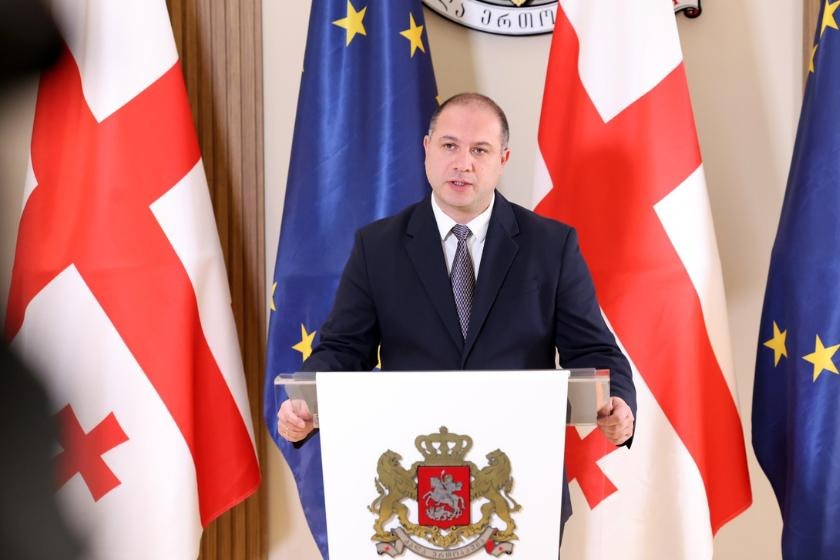
Since August 17, former two-time Georgian Prime Minister Irakli Garibashvili has released a series of Facebook posts from prison accusing the ruling Georgian Dream party and government officials of provocation, blackmail and political persecution (Facebook/IrakliGaribashvili, August 17, 18, 20, 25, September 1, 7, 21). In his statements, Garibashvili claimed he received a letter from Georgian State Minister for Regional Policy Mamuka Mdinaradze warning him, on behalf of the entire “government team,” to cease his political activities or face additional corruption charges. Mdinaradze described Garibashvili’s allegations as “complete absurdity” and said they were among the accusations the government had anticipated as a result of its fight against corruption (Georgia Today, August 19).
In an August 20 post addressed to the Georgian Dream government, Garibashvili asserted that the authorities had “terrorized” his family. He said he “kept all this terrible pain and tragedy to [himself]” out of his “immense love, respect, boundless gratitude, and absolute loyalty” to Georgian Dream founder and honorary chairman Bidzina Ivanishvili (Facebook/IrakliGaribashvili, August 20). At the same time, he insisted that the charges against him were “based on false perceptions, imaginings, envy, fears, and suspicions created by a particular group within the [ruling] team.” Garibashvili has not accused Ivanishvili personally. His criticism has focused primarily on members of the current government and what he describes as an internal group within Georgian Dream (Facebook/IrakliGaribashvili, August 20).
Garibashvili is already serving a five-year prison sentence after pleading guilty to money laundering in January (JAM News, August 17). “The main aim of the so-called ‘fight against corruption’ campaign launched last year was to put me in prison and politically destroy me,” Garibashvili wrote. He said that the threat to charge his 75-year-old father, businessman Tariel Garibashvili, “was the red line that led me to take the most difficult step of my life. Therefore, they are leaving me no choice but to fight” (Facebook/IrakliGaribashvili, August 20).
One week after his first public statement, on August 24, Georgia’s Prosecutor General’s Office brought new charges against Garibashvili (JAM News, August 24). The charges allege that he accepted a particularly large bribe as part of an organized group acting by prior agreement. Prosecutors allege that the case concerns a Defense Ministry procurement scheme involving medical equipment and that Garibashvili received 750,000 lari ($290,000) in connection with the scheme.
Garibashvili’s case is unfolding alongside a broader series of criminal proceedings against the officials who once occupied Georgian Dream’s most senior positions. In October 2025, investigators searched 22 locations linked to Garibashvili and other former officials (OC Media, October 17, 2025). Among those convicted are former Deputy Economy Minister Romeo Mikautadze, sentenced in March to 10 years for abuse of office and money laundering (Civil Georgia, March 16). Former Defense Minister Juansher Burchuladze received a 10-year sentence in April over a Defense Ministry procurement deal for medical equipment, later reduced under plea deals (Civil Georgia, September 14). Former Georgian State Security Service Chief Grigol Liluashvili was sentenced in September to 13 years in prison on four counts of bribery (OC Media, September 16). The pattern suggests that proximity to Ivanishvili no longer offers protection.
On August 27, Mdinaradze resigned as minister of regional development and left politics altogether after roughly a decade in public life. He said the decision was his own and that he wanted to devote more time to his family. He also said that he had discussed the decision with Ivanishvili and Prime Minister Irakli Kobakhidze before making it public (JAM News, August 27). Kobakhidze stated, “We attempted to persuade him to reverse his decision, but his position was firm. Once again, I would like to thank Mamuka Mdinaradze for everything he has done for the country and the team” (1tv.ge, August 27).
Garibashvili’s letters have generated discussion not only about his allegations against the government but also about whether he could emerge as a political force outside the current Georgian Dream leadership. Politicians and experts are waiting to see whether he will make counter-accusations against his former team and, most importantly, against Ivanishvili personally, and whether he will reveal previously unknown facts that could strengthen the opposition movement underway since November 2024, when Kobakhidze announced the suspension of EU membership negotiations.
Georgian political scientist David Zurabishvili, who served as an assistant to Ivanishvili in 2011, said that Garibashvili retains supporters among Georgian Dream voters. The opposition electorate, however, remains highly critical of him. “It is difficult to imagine Garibashvili becoming the leader of the opposition movement,” Zurabishvili noted. He added, “The case of his two-time prime minister, Garibashvili, demonstrates that Georgian Dream’s founder and de facto leader, Ivanishvili, was unable to control the situation and prevent the process from escalating into such a conflict” (Author’s interview, August 23).
Other experts noted that Garibashvili admitted guilt from the outset and went to prison without contesting the charges. Head of the International Relations Master’s Program at the Georgian Institute of Public Affairs (GIPA) Tornike Sharashenidze said, “The more important question is whether the opposition can politically capitalize on this case. Of course, no. I do not think it is a dangerous problem for the ruling party. Georgian Dream has many other problems: polarization, a detonated relationship with the European Union, and so on” (Author’s interview, August 22).
Coalition for Change leader Nika Gvaramia argued that the case sets a precedent, with a former prime minister who was once the system’s most loyal servant now writing from a prison cell. “Every official still in place now knows that loyalty guarantees nothing,” he said, though he added that much depends on what Garibashvili reveals about Ivanishvili. “The question is whether he chooses to act as a whistleblower on Ivanishvili.” On the Western reaction, Gvaramia said that no one in Brussels or Washington regards Garibashvili as a democrat. “Western capitals read this less as a story about one man than as confirmation of two things: that the Georgian justice system is an instrument, and that Georgian Dream’s internal problems are now immanent matter” (Author’s interview, August 23).
Georgian Dream supporters reject the idea that the case is damaging. Political analyst Gia Abashidze argued that Garibashvili’s letters are a futile attempt to create a “crack” within the government rather than the start of a full-scale political crisis. He conceded that if the former prime minister substantiates his promised “truth” with specific and verifiable evidence, it would deal a blow to the ruling team. “Recent history has seen numerous so-called ‘revelations’ by people expelled from or having left the Georgian Dream, or even by individuals who were legitimately prosecuted,” Abashidze said. The biggest mistake for the opposition, he concluded, would be to place a political bet on Garibashvili personally (Author’s interview, August 24).
Political analyst and former Minister of Education and Science Ghia Nodia said that Garibashvili’s “mini-rebellion is not a big deal,” because he has not dared to accuse Ivanishvili personally. “That’s why his rebellion is not serious. I do not think he is able to start any kind of opposition movement, but I do not exclude that Ivanishvili thinks exactly that,” Nodia concluded (Author’s interview, August 23).
Garibashvili is continuing to release letters from prison. In a statement published on September 1, he questioned the official account of the death of Lazare Jorbenadze, a human rights defender who had criticized Kobakhidze in a newspaper article shortly before his death, which was ruled a suicide. Garibashvili asked what the real cause of Jorbenadze’s death was and referred to other unexplained deaths during the Kobakhidze–Mdinaradze period (Facebook/IrakliGaribashvili, September 1). Prosecutors questioned him in prison and said his suspicions had no factual basis and rested solely on press reports (JAM News, September 3).
Garibashvili’s allegations remain unproven, and most analysts doubt he can lead an opposition movement. He is equally unlikely to stay silent for five years, and further letters will create problems for the ruling party. The damage will depend on whether he names Ivanishvili, what new charges are brought against him, and how the struggle between the government and the opposition develops this fall.