Late Stalinism in Beijing
Late Stalinism in Beijing
Executive Summary:
- General Secretary Xi Jinping appears to have prevailed in the latest round of military purges in the Central Military Commission (CMC), but only by further dismantling the institutional safeguards that once stabilized elite politics—deepening, rather than resolving, long-term regime fragility.
- The removal of generals Zhang Youxia and Liu Zhenli marks the elimination of the last residual chain of military authority not fully subsumed under the “CMC chairman responsibility system,” meaning that military command now begins and ends with Xi personally.
- This consolidation does not alter near-term timelines on Taiwan, but it accelerates political drift in the People’s Republic of China toward a late Stalinist disequilibrium in which Xi’s personal control is maximized at the cost of orderly succession management, professional and expertise-based authority—exemplified by figures like Zhang Youxia—and tolerance for dissenting or corrective views within the leadership.
In “Terminal Authority: Assessing the CCP’s Emerging Crisis of Political Succession,” we argued that General Secretary Xi Jinping remained in control of the Chinese Party-state, even as the system around him exhibited growing strain. This judgment was deliberately paradoxical with respect to consequences for the Party itself (China Brief, July 26, 2025). On the one hand, there was no visible indication that Xi’s personal authority had meaningfully eroded. On the other, history shows that the personalization of power he has engineered carries an unavoidable cost: systems governed more by diktat than by institutions are inherently unstable.
That assessment did not rest on an assumption of equilibrium within the system. We noted growing instability inside the military apparatus and mapped a range of possible scenarios this instability might precipitate. On balance, we concluded that Scenario 1, in which Xi continues to dominate, remained the most likely description of the political status quo based on the evidence available in spring and summer 2025. At the same time, we cautioned that signs of rebalancing within the military–security apparatus were adding ambiguity to perceptions of an otherwise intact Xi power center.
What has unfolded since suggests both judgments were right. Available evidence indicates that, for now, Xi has largely prevailed in the military contest, in the sense that the latest round of purges has proceeded without overt resistance. Yet the deeper dynamic we identified still holds. These persistent signs of instability within the system mean that a transition toward fragmentation and elite realignment cannot be ruled out. There is no fixed timetable for such transitions; they may unfold gradually or erupt suddenly if competition spirals. By dismantling the succession management norms the Party once relied on, Xi has exacerbated precisely the internal tensions those norms were designed to contain, ensuring that the dictatorial system he has rebuilt will not hold forever.
The Logic of Personalistic Centralization
On January 24, the Ministry of National Defense (MND) of the People’s Republic of China (PRC) and state media announced investigations into General Zhang Youxia (张又侠), vice chairman of the Central Military Commission (CMC), widely regarded as a key enforcer within Xi Jinping’s military restructuring, and General Liu Zhenli (刘振立), chief of staff of the CMC’s Joint Staff Department (MND, January 24). Both were accused of “serious violations of discipline and law” (严重违纪违法), the standard formulation used to justify elite removals.
Two interpretations immediately presented themselves. The first frames the move as anti-corruption; the second as Xi eliminating rivals. Both readings, however, are flawed: the first does not withstand serious scrutiny, while the second is insufficient as an explanation. Anti-corruption in the Party is best understood as a legitimating language rather than a motive. In a Leninist system characterized by opaque procurement, discretionary authority, and political mediation of resources, virtually all senior cadres are corrupt in some sense. Particularly at the highest levels of power, “anti-corruption” functions as a covering explanation for coercive reorganization that obscures its underlying political purpose. Elimination of rivals within the military is also insufficient. Zhang Youxia is often framed as a credible challenger to Xi. He was a pillar of authority within the People’s Liberation Army (PLA)—one of the few senior officers with combat experience and long-standing institutional credibility. But his removal is better understood through a wider lens. Xi has been purging not just individuals but entire institutional structures as part of a long-running project to remake the military that began in his first term as general secretary. Zhang was not dangerous because he represented an alternative political program or factional challenge to Xi. He was dangerous because he embodied a chain of command that predated—and partially survived—Xi’s restructuring of the PLA.
The PLA’s own explanation hints at why both interpretations miss the point. In a January 25 PLA Daily editorial announcing the investigations, Zhang Youxia and Liu Zhenli are not primarily accused of personal enrichment or disloyalty, but of having committed a political offense against Party’s leadership over the armed forces. The editorial states that the two men “seriously trampled upon and undermined the CMC chairman responsibility system, and in doing so seriously fueled political and corruption problems that weaken the Party’s absolute leadership over the military and endanger the foundations of the Party’s rule” (严重践踏破坏军委主席负责制,严重助长影响党对军队绝对领导、危害党的执政根基的政治和腐败问题) (PLA Daily, January 25). In other words, the offense is defined not as corruption in the ordinary sense, but as interference with the singular chain of authority that links the Party center to the armed forces through the CMC chairman—Xi Jinping himself.
The military has been subjected to this same personalistic logic since Xi’s first term. Beginning in 2015–2016, Xi partially dismantled the command structure that had governed the PLA for decades. The establishment of the Joint Staff Department (JSD) of the CMC in January 2016, superseding the former PLA General Staff Department, was presented another modernizing “reform.” In practice, it tied operational planning, joint training, and combat readiness directly to the authority of the CMC chairman (China Brief, May 11, 2017). This reorganization ultimately operationalized the emerging “CMC chairman responsibility system” (军委主席负责制), which was formally codified after the 19th Party Congress in October 2017 and defines all major defense and force-building decisions as resting with the CMC chairman and, according to a 2015 PLA commentary, requires the entire PLA to carry out the “comprehensive, accurate, timely, and effective implementation of the resolute intent and strategic directives of the CMC chairman” (China Leadership Monitor, January 23, 2018).
This context is the key to understanding Zhang’s fall: it marks the elimination of a residual source of authority that survived earlier rounds of institutional upheaval. What appears to be underway is a further—and possibly final—stage of centralization in which few institutions, offices, or individuals retain authority independently of the chairman responsibility system, even if the process itself generates new risks of elite backlash.
Institutional Mayhem in Totalitarian Systems
The pattern of “personalistic centralization” is not new. At the start of his tenure, Xi confronted a domestic security apparatus that had accumulated substantial autonomy under Zhou Yongkang (周永康). His response was not limited to purging Zhou himself. It involved restructuring the entire architecture of state security. The creation of the Central State Security Commission in 2013 subordinated the Ministry of State Security, the Ministry of Public Security, and related political-legal organs directly to the Party center and, in practice, to Xi personally (War on the Rocks, July 18, 2016).
Xi’s logic has a long pedigree. In The Origins of Totalitarianism, Hannah Arendt argued that totalitarian systems do not rule through stable institutions. They rule by keeping institutions in motion—fragmented, reorganized, and permanently insecure. The purpose is not administrative efficiency, but the security of the leader. [1] Stable institutions create alternative points of appeal and therefore alternative sources of legitimacy. They generate norms, procedures, and coherent policymaking bodies that can outflank the more reactive implementation of one-man rule. Totalitarian rulers therefore weaken institutions deliberately.
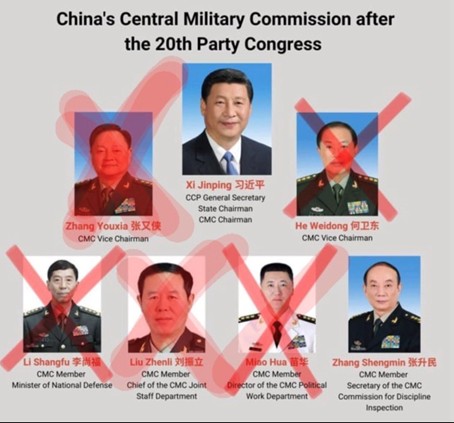
Seen through this lens, Xi’s evisceration of the CMC is logical. The CMC nominally functioned as a body through which military authority was collectively exercised and mediated. It has now been reduced to a veneer. With Zhang Youxia and Liu Zhenli removed, the CMC reportedly consists only of Xi himself and the head of its discipline inspection apparatus, Zhang Shengmin (张升民) (see Figure 1). The lesson is not just that Xi distrusts potential rivals within the PLA. It is that he distrusts any alternative center of authority as such.
Figure 1: The Erosion of Senior Leadership on Xi’s Central Military Commission
(Source: X/Taepodong)
Three Implications From the Latest Purge
Implication 1: Military Command Now Begins and Ends with Xi
The 2016 reorganization of the PLA into a theater command system did not replace the CMC. Theater commands remain subordinate to it. But the political meaning of the arrangement has changed. As the CMC has been hollowed out as a collective deliberative body, the JSD now functions beneath a vestigial apex that serves as a conduit for Xi’s personal authority.
Xi’s largely unnoticed January 22 issuance of the Military Theory Work Regulations (军事理论工作条例) reinforces this shift at the strategic level (Xinhua, January 22). According to Xinhua, the regulations are guided by “Xi Jinping Thought on Socialism with Chinese Characteristics for the New Era” (习近平新时代中国特色社会主义思想) and “Xi Jinping Thought on Strengthening the Military” (习近平强军思想), and reaffirm the principle of “overall command by the Central Military Commission, combat readiness by the theater commands, and ‘construction’ by the services” (军委管总、战区主战、军种主建) (see PLA Daily, May 10, 2016). In effect, these regulations further narrow strategic reasoning within the PLA by institutionalizing review for political alignment with principles of Xi’s “thought.”
Taken together, these developments point to a system in which operational and strategic authority flows through structures bearing Xi’s personal imprint as supreme military commander.
Implication 2: Timeline for Taiwan Remains Fundamentally Unchanged
The CMC purge does not materially alter the correlation of forces across the Strait. It does not meaningfully accelerate or delay operational timelines. At most, it reflects internal judgments that political loyalty and command coherence are prerequisites, whether for faster action or for more deliberate encirclement.
The timing of the move likely tells us more about internal dynamics we will never see than about external contingencies. Personalist systems are opaque by design. Decisions often reflect calculations about loyalty, fear, and control that remain invisible to outsiders.
Implication 3: Late Stalinism and the Party’s Cul-de-Sac
This brings us back to the uncertainty identified at the end of “Terminal Authority” (China Brief, July 26, 2025). Xi’s dominance today is real in structural terms, even if the day-to-day execution of his directives relies on intermediaries and loyalist networks whose actions are not always fully transparent. Like Joseph Stalin, Xi has fused personal authority with regime survival. There are no independent institutions of appeal. There are no durable procedures for succession. There is only the leader and the system he holds together.
This produces permanent uncertainty. As long as Xi remains in command, he can dictate terms. But the very mechanisms that secure his dominance—purges, institutional hollowing-out, and the dismantling of competing centers of authority—also ensure that the system cannot easily survive without him. Late Stalinist systems can endure for years, but with diminishing economic dynamism. And they have a much harder time enduring transition.
Conclusion
Xi has solved the problem of control. But he has also ensured that when the center fails, whether through succession crisis or elite fracture, it is primed to fail catastrophically.
Notes
[1] Hannah Arendt, The Origins of Totalitarianism (New York: Harcourt Brace Jovanovich, 1973).