New Military–Civil Fusion Body for PRC Robotics Ecosystem
Executive Summary:
- A new National Humanoid Robot Standardization Technical Committee sits at the nexus of industrial policy and military modernization, with participation by U.S.-restricted firms (SenseTime, Huawei, ZTE, China Mobile) and PLA-linked universities.
- The Ministry of Industry and Information Technology (MIIT) is using standards to hardwire security, procurement, and ecosystem alignment into humanoid robotics development.
- Mandatory domestic cryptography and industrial cybersecurity embed state control and limit foreign interoperability.
In November, the Ministry of Industry and Information Technology (MIIT) announced the creation of the National Humanoid Robot Standardization Technical Committee (国家人形机器人标准化技术委员会) (MIIT, November 24). This followed the Chinese Communist Party (CCP) Central Committee’s designation of the technology as a focus area in its recommendations for the 15th Five-Year Plan (Xinhua, October 28). Although framed as a technical coordination mechanism, the unusual size and cross-sector composition of the committee reflect a desire to build a humanoid robotics sector around the principles of dual-use integration, centralized control, and alignment with People’s Liberation Army (PLA) modernization priorities.
Engineering a Centralized Ecosystem
The committee comprises 65 members drawn from MIIT, MIIT-affiliated standards bodies, defense-linked universities, cryptography and industrial security institutions, emergency-management organs, regional state-backed innovation centers, and major technology firms. Its cross-domain composition reflects an effort to collapse the boundaries between research, commercialization, and state security oversight.
The committee is chaired by Xie Shaofeng (谢少锋), MIIT’s chief engineer (总工程师). Liang Liang (梁靓), the committee’s secretary-general, responsible for shaping its agenda and building consensus within the group, is currently a deputy secretary-general of the Chinese Institute of Electronics (中国电子学会), an academic and industry organization directly under the ministry (CIE, accessed December 17). Liang is also one of five vice chairs on the committee.
The other four vice chairs further underscore this orientation. Alongside Wang Xingxing (王兴兴) and Peng Zhihui (彭志辉), the founders of leading robotics firms Unitree and Agibot, respectively, the MIIT has tapped the leaders of two state-backed regional humanoid platforms. These include Jiang Lei (江磊) of the Humanoid Robotics (Shanghai) (人形机器人(上海)有限公司) and Xiong Youjun (熊友军) of UBTECH (优必选) and the Beijing Innovation Center of Humanoid Robotics (北京人形机器人创新中心), the PRC’s first humanoid robotics center (Beijing Daily, April 9, 2024). [1] These entities function as national–local industrial vehicles, capable of rapidly translating standards into procurement rules, testing regimes, and large-scale pilot deployments.
Defense Industry Presence Indicates Dual-Use Requirements
Defense-industrial interests on the committee are most explicit in the participation of Fan Chang (范昶) from the 43rd Research Institute of China Electronics Technology Group Corporation (CETC). CETC underpins PLA electronic warfare, ISR, and command systems, and multiple CETC subsidiaries appear on U.S. military-industrial complex lists (China Brief, February 21, 2012; Treasury, December 16 2021). The 43rd Institute holds national, defense, and military laboratory certifications and has supported major military aerospace programs (Anhui University, September 18, 2018, SASTIND, June 13, 2019; The Paper, May 4, 2020). Its proximity to venture-backed robotics firms exemplifies military–civil fusion in practice.
Figure 1: Military–Civil Fusion Elements in National Humanoid Robot Standardization Technical Committee
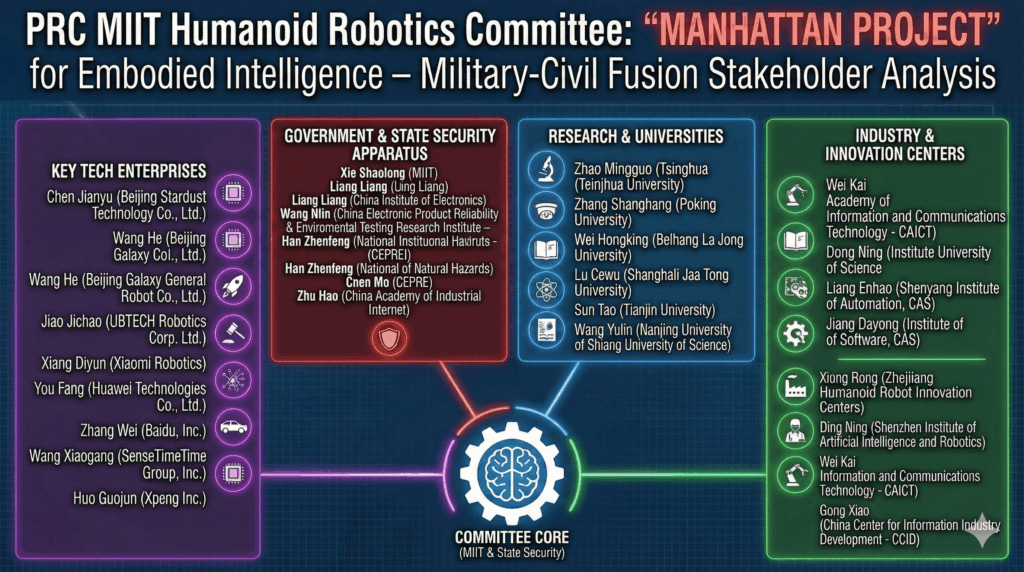
(Source: Created by the author)
The committee is also well represented by the “Seven Sons of National Defense” (国防七子)—universities deeply embedded in the PRC’s defense research ecosystem. Committee members include Wei Hongxing (魏洪兴) of Beihang University (北京航空航天大学), Yang Yi (杨毅) of the Beijing Institute of Technology (BIT; 北京理工大学), Wang Yulin (王禹林) of the Nanjing University of Science and Technology (NUST; 南京理工大学). [2] Han Peng (韩鹏) of the University of Electronic Science and Technology of China (UESTC; 电子科技大学) was also appointed to the committee. Although UESTC is not a “Seven Sons” university, it has a history of working on military and dual-use research. For example, recently it has been working with the Aviation Industry Corporation of China (AVIC) Chengdu Aircraft Research and Design Institute to design advanced military drones (Red Star News, January 12, 2023). Their collective presence suggests that humanoid robotics standards likely will be influenced by military requirements. This will enable the creation of robots with characteristics essential for policing, military logistics, and operations in contested environments. These might include capabilities for electromagnetic resilience and secure communications. In effect, the process for creating standards is set to ensure that humanoid robots are dual-use by design.
Other committee members represent organizations under the Party’s paramilitary organ, the People’s Armed Police. Han Zhenfeng (韩震峰), for instance, works for the National Natural Disaster Prevention and Control Research Institute (应急管理部国家自然灾害防治研究院) at the Ministry of Emergency Management (MEM) (MEM, accessed December 14). Robots involved in disaster response activities such as rubble clearance, operating in hazardous environments and settings where communications have been degraded, could support PLA urban operations and logistics (MIIT, December 29, 2023; Market News, November 9). Framing these capabilities under emergency management allows for testing and refining paramilitary robotics, including via overseas humanitarian deployments, while avoiding the scrutiny associated with explicit military programs.
Cryptography and Cybersecurity Requirements Embed Control
The PRC’s cryptographic and industrial cybersecurity community are also represented on the committee. One member, Zhu Hao (朱浩), leads the Technical Standardization Research Institute (标准化技术研究所) at the China Academy of Industrial Internet (CAII; 中国工业互联网研究院). Also known as the MIIT Cryptography Application Research Center (工信部密码应用研究中心), this entity was created to implement the 2019 Cryptography Law (密码法) and promote domestic cryptographic standards across industry (NPC, June 4, 2023). While officially tasked with innovation, the center enforces mandatory commercial cryptography regimes (商用密码) that govern identity management, key control, and secure communications (MIIT, January 22, 2020; CAII, April 30).
Zhu’s role indicates that humanoid robots manufactured in the PRC will be subject to cryptographic requirements that will limit interoperability with foreign platforms and could facilitate regulatory—and potentially supervisory—access under the PRC’s national security framework. This is reinforced by another member, Li Wei (李卫), who is the deputy director of the Institute for AI (人工智能所) at the National Industrial Information Security Development Research Center (国家工业信息安全发展研究中心), which supports the PRC’s critical information and data infrastructure protection regime (National Business Daily, May 24, 2024). His inclusion reflects a view that humanoid robots play a critical role in the PRC’s technological statecraft that should be subject to centralized vulnerability management, security audits, and lifecycle governance.
Sanctioned Entities Setting Standards
U.S. authorities have already sanctioned several entities represented on the committee. SenseTime, represented by Wang Xiaogang (王晓刚), is on the U.S. Commerce Department Entity List and the Treasury’s Non-SDN Chinese Military-Industrial Complex Companies (NS-CMIC) List for enabling mass surveillance and human rights abuses through facial recognition technologies (Treasury, December 10, 2021). Huawei and ZTE, both long-standing entity list designees, are also represented on the committee. Their robotics work to date has focused on the communications and network hardware and software that govern robotic fleets (Cnyes, March 6; ZTE, August 7). China Mobile, represented on the committee via a Hangzhou subsidiary, is viewed as a Chinese Military Company by the U.S. Department of Defense due to its role in supporting state and military communications infrastructure (DoD, January 7).
Conclusion
The National Humanoid Robot Standardization Technical Committee is best understood as a strategic coordination mechanism, not a neutral technical forum. In the PRC, standards determine security compliance, procurement eligibility, and long-term ecosystem lock-in. By creating a single body to coordinate regional robotics platforms, defense universities, cryptographic authorities, emergency-management organs, and sanctioned national champions, Beijing is shaping a sector optimized for dual-use deployment, centralized control, and rapid national mobilization.
Once the sector begins to export its products around the world, there is a danger that prevailing standards will favor the PRC’s technology ecosystem and will be underpinned by assumptions—particularly around surveillance—that Western authorities deem problematic.
Notes
[1] These two organizations appear to go by several different names in both English and Chinese. The names used here are the ones used in the MIIT list (MIIT, November 24).
[2] Beihang supports PLA aerospace platforms, missiles, and unmanned systems; BIT is the country’s leading hub for ground warfare systems and autonomous weapons integration; NUST descends from the PLA Institute of Military Engineering and remains central to ballistics and explosives research; and UESTC anchors the PRC’s electronic warfare, radar, and secure communications.