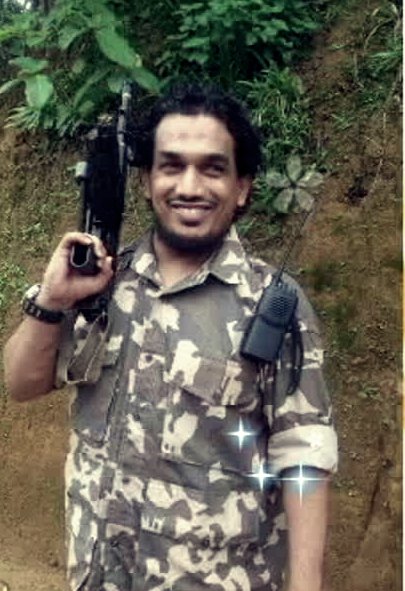
Peng Daxun: MNDAA Leader in Myanmar Retakes Kokang With Chinese Assistance
Peng Daxun: MNDAA Leader in Myanmar Retakes Kokang With Chinese Assistance
Executive Summary:
- Peng Daxun leads the Myanmar National Democratic Alliance Army (MNDAA), one of three major ethnic militias in Myanmar. The MNDAA, alongside the Arakan Army and Ta’ang National Liberation Front, launched a major offensive on October 27, 2023, against the forces of Myanmar’s junta, which has seen major successes. This includes retaking the eponymous homeland of the Kokang people in January, which controls key trade routes with China.
- Peng Daxun’s father, Peng Jiasheng, led the MNDAA in Kokang until 2009, when he was forced into exile in China after being betrayed by a top lieutenant. China provided critical support to Peng Jiasheng and his son.
- With aid from Beijing, the younger Peng rebuilt the MNDAA. The MNDAA gathered its strength until 2021. As part of the deal to gain Chinese support, he has cracked down on gambling and the production and trade of illicit drugs in his territory, which found their way to the neighboring Chinese territory.
- Peng Daxun is a figure with a mixed reputation: he has demonstrated a contempt for human rights, but is also a sound commander with a proven record against the junta’s superior forces.
Peng Daxun, the military mastermind and foremost leader of the Myanmar National Democratic Alliance Army (MNDAA), has been at the forefront of the ongoing civil war in Myanmar since his army achieved a victory against the Myanmar junta’s army (Tatmadaw) in northeastern Shan State (The Irrawaddy, November 11, 2023). Myanmar is home to many ethnic armed militias, but what distinguishes the MNDAA is its recapture of majority-Kokang (ethnicity) territories and their establishment of effective control through successive military campaigns since “Operation 1027.” Three of the strongest ethnic armed militias, the Arakan Army (AA), MNDAA, and Ta’ang National Liberation Front (TNLA), collectively known as the “Three Brotherhood Alliance” in western and northeastern Myanmar, launched this operation on October 27, 2023. It is one of the largest combined military offensives against the junta seen in the war so far (Al Jazeera, January 16).
The ongoing offensive in Myanmar represents Peng Daxun’s most successful military achievement (Myanmar Now, January 3). His low profile is one of the reasons he has not received as much attention as his father. However, Peng Daxun’s significance lies in the present geopolitical realities of the Kokang Zone in Shan State. He now controls the territories that strategically border the major trade routes to China, and any decision by him, such as deepening ties with Beijing, will have a significant impact on the civil war in Myanmar (The Fulcrum, November 14, 2023).
Like Father, Like Son
Born in 1965, Peng Daxun became a cabinet minister in Myanmar under his father, Peng Jiasheng, who was the first leader of the MNDAA from 1995 until 2009. Peng Jiasheng’s army suffered its final blow on August 30, 2009, when it surrendered to the Tatmadaw and fled to China. The MNDAA had controlled Shan State Special Region 1 since 1989, an area which includes the Kokang homeland.
China’s objection to drug cultivation and trading, an internal shift of allegiance in the MNDAA toward the Myanmar junta, and the Tatmadaw’s vision of neutralizing ethnic armed militias by integrating them into the state military apparatus all contributed to the MNDAA’s surrender (The Irrawaddy, August 29, 2009). The MNDAA’s second-in-command, Bai Xuoqian, led a faction that collaborated with Tatmadaw and rebelled against Peng Jiasheng loyalists. Ultimately, this latter group mostly fled and surrendered their arms to China, while Bai Xuoqian’s loyalists reorganized into a Tatmadaw paramilitary unit, becoming Unit 1006 of the Border Guard Forces.
Peng Jiasheng’s long-standing militant leadership career in the Communist Party of Burma (CPB) and subsequent formation of MNDAA provided him with valuable military and strategic insight (BNI, June 6, 2013). The MNDAA leadership is also notorious for its involvement in the drug business. Besides this, Peng Daxun had significant involvement in business related to real estate (Transnational Institute, July 2015). When an internal rebellion and external pressure ousted the elder Peng from the MNDAA, his son was among the group’s four top-ranking leaders.
With Peng Jiasheng forced to seek exile in China, Peng Daxun (the eldest son) became MNDAA’s leader. The events involving his father significantly influenced the younger Peng’s leadership style. Ethnic sentiments, avenging betrayals, and the use of stricter measures to achieve MNDAA’s objectives shaped Peng Daxun’s ideology, personality, and leadership in the lead-up to Operation 1027.
Peng Daxun’s Low Profile
After the disastrous defeat under Peng Jiasheng in 2009, the MNDAA mainly remained out of the picture in Myanmar. In 2014, the elder Peng, however, reappeared in an interview with the Chinese Communist Party-controlled Global Times, where he reiterated his firm stance to recapture Kokang. Peng Jiasheng publicly expressed his intention to return Kokang to MNDAA control for the first time since the junta and its collaborators captured it in 2009 (The Irrawaddy, February 25, 2015). A renewed Kokang offensive against the junta and its allied forces in 2015 suggested that this very well might happen (Shan Herald, October 28, 2023). While in the end, the MNDAA failed to make significant gains, the group obtained a strategic victory in the sense that the offensive demonstrated that the MNDAA had strong support in the Kokang region.
The younger Peng’s decision to launch the Kokang offensive served as the foundation for all future operations and leadership planning. As previously stated, Peng Daxun has been at the forefront of leading the MNDAA since his father allegedly moved into exile in China. It is also thought he accompanied his father and returned to Kokang in February 2024, after MNDAA’s forces achieved total control over the Kokang capital.
This behavior sets Peng Daxun apart from his father. While his father all but disappeared after 2009, the younger Peng exercised visible command and control over MNDAA forces even while in exile. The elder Peng is believed to have continued to have a leadership role in the MNDAA until his death in 2022.
The 2015 Kokang offensive was the first major battle that Peng Daxun oversaw. The younger Peng’s early control over the MNDAA reflected his firm ambitions, ability to (re)build a militia force, and capacity to project power while remaining in exile. He was determined to show the Kokang people that he was a worthy successor to his father, which began to solidify with the most recent offensive (Myanmar Now, January 3).
Between 2016 and 2021, Peng Daxun did not attempt any major action against the junta or the regime-allied Border Guard Force (BGF). This period saw only minor skirmishes and clashes. In the meantime, he was determined to learn from the 2015 Kokang offensive by building up his forces and gathering manpower, logistics, and weapons. The younger Peng also started to consolidate financial resources to support and sustain the MNDAA. Avenging the betrayal of his father by the faction that left MNDAA was a major focus of his work during this time. As a result, in 2021, he attempted to assassinate Bai Xuoqian’s son (The Irrawaddy, March 8, 2023). At the time, Myanmar’s democratic central government allowed Peng Daxun to reenergize and reformulate policies that would be critical for MNDAA’s force buildup in a future conflict.
Resumed Clashes
After a period of relative calm, tensions flared when the junta dissolved the civilian government in February 2021 and imposed de facto martial law in Myanmar. Peng Daxun had long anticipated the eventual resumption of hostilities due to the junta’s opposition to any ethnic armed militias in Shan State. This motivated him to fully prepare his forces in advance for a battle against the junta. He also formed alliances, befriending two other large ethnic armed militias, the AA and the TNLA (The Irrawaddy, November 25, 2023). This culminated in what became Operation 1027, which has also included other small and medium-sized ethnic armed militias beyond the main three in an effort to form a united front against the junta. Operation 1027 exemplifies the younger Peng’s prudence in concealing the asymmetry of forces against the junta via discreet alliances.
Under Peng Daxun’s leadership, the MNDAA liberated the capital city of the Kokang Region, Laukkai. This was the first time since 2009 that the Tatmadaw had lost control of the region, and the younger Peng ultimately declared Kokang’s independence under MNDAA control (Radio Free Asia, January 5). This achievement reflects Peng Daxun’s ability to lead irregular forces to victory over a regular army, allowing him to seize the junta’s ammunition and weapons, retake land, and establish control in the Kokang people’s native territory.
Peng Daxun’s collaboration and cooperation with China played a crucial role in this victory (Radio Free Asia, January 16). For example, China aided the elder Peng and his son in exile and today provides safe houses, handles logistics, and purchases arms for his group. Therefore, to a certain degree, Peng Daxun is a warlord under Beijing’s control. Without Chinese help, it would have been impossible for him to rebuild MNDAA and survive. Accordingly, he paid back China by eliminating illegal drug cultivation and gambling schemes in the Chinese border region, which had rankled Beijing (Asia Times, January 12).
Despite Peng Daxun’s successes, he is allegedly ruthless with his people. For example, he reportedly executed undisciplined MNDAA soldiers under his command (Radio Free Asia, April 25). There are also allegations that he has allowed the recruitment of children into the MNDAA’s ranks (The Diplomat, January 4). This highlights the younger Peng’s long history of breaking the law. A substantial portion of his wealth was obtained from drug syndicates—a practice that the MNDAA continued to enable until Operation 1027, when favorable terms with Beijing became more important (ISP, February 2).
Conclusion
Peng Daxun’s execution of Operation 1027 in tandem with the other two major ethnic armed militias exemplifies his leadership abilities and accomplishments. In addition, his cordial ties with China make him a crucial figure in any Myanmar post-civil war scenario. Because of his warlord father’s tendencies and his own experiences of betrayal by his own people, he has demonstrated a contempt for human rights alongside his achievements, effective leadership, and sound decision-making. Peng Daxun’s efforts will play a crucial role in changing the course of Myanmar’s continuing civil conflict in the near future, particularly in the Kokang area.