Purifying Islam and Combating the West: Post Mortem Analysis of the Indelible Impact of al-Qaeda’s Abu Yahya al-Libi
Purifying Islam and Combating the West: Post Mortem Analysis of the Indelible Impact of al-Qaeda’s Abu Yahya al-Libi
Abu Yahya al-Libi might not have lived long enough to become the next Osama Bin Ladin, but over al-Libi’s seven-year career with al-Qaeda he had an indelible impact. Al-Libi evolved from an ideologue to a military commander to senior leadership. It would not be a stretch to state that al-Libi was the most important individual who joined al-Qaeda in the aftermath of the September 11th attacks. He was allegedly killed in a drone strike on June 5, 2012, though al-Qaeda’s media outlet has released videos of him since; they have neither confirmed nor denied his death. If he is dead, al-Libi’s works will live on, but he will be difficult to replace in terms of his unique skill-set as a warrior-cum-jihadi philosopher.
Background
Born Hasan Muhammad Qa‘id in 1963, but best known as Abu Yahya al-Libi – also taking the names Yunis al-Sahrawi and ‘Abd-al-Hafiz al-Libi – he grew up in the oasis town of Murzuq in the Fezzan region of southwest Libya, with a population of about 7,000. Prior to al-Libi’s jihadi life, he studied chemistry for a year at the University of Sebha, three hours north of his hometown.
Jihad Before al-Qaeda
Although al-Libi is not considered part of the old guard due to his relative youth, he began to associate with Libyan foreign fighters in the aftermath of the 1980s anti-Soviet jihad. He was amongst a group of Arabs that joined up to fight against the Soviet-installed president Mohammad Najibullah, who fell in 1992. While in Afghanistan, al-Libi linked up with the newly established Jama‘at al-Muqatilah al-Islamiyyah (the Islamic Fighting Group better known as the LIFG), which sought to overthrow the Mu‘ammar al-Qadhafi regime.
In 1991, al-Libi was dispatched by the LIFG to Mauritania where he studied under doctrinaire Salafi clerics, including Budah ‘Uld al-Busayri and Muhammad Salim ‘Uld Adud, whom he eulogized in July 2009. One of his classmates was ‘Atiyatullah ‘Abd al-Rahman, who was considered bin Ladin’s consigliore before they were killed by U.S. covert actions, in May and September 2011 respectively. [1] Al-Libi’s time in formal religious training provided important bona fides that conferred upon him a level of credibility that other al-Qaeda figures, including Bin Ladin and Ayman al-Zawahiri, lacked. After two years, he went to Sudan and then later moved to Afghanistan as did the other jihadi groups that were kicked out of Sudan in 1996.
According to Noman Benotman, a former leader in the LIFG’s Shura council who has since de-radicalized, al-Libi was not involved with the insurgency against the al-Qadhafi regime in the 1990s due to a lack of military experience or credentials. Al-Libi’s main skills were used in the intellectual arena where he was involved with LIFG’s da‘wah (missionary) and fatwa committees. He also performed sermons, wrote articles and wrote poetry. [2] While still with the LIFG he published nineteen poems dealing with jihad, al-Qadhafi, martyrdom, and prisoners (specifically writing poems to the blind Sheikh Omar Abdel Rahman and Salman al-Awdah), although his poetic output dropped during his time with al-Qaeda. At this point in his career, it is clear he was still largely focused on the local enemy.
The first sign of a shift to a more global jihadi focus was when al-Libi penned a fatwa two weeks after 9/11 titled “On the American Crusader Attacks on Afghanistan,” which called for jihad against the United States: “By declaring war against the Muslims and occupying their countries, the United States of America has made all of its worldwide interests into legitimate targets for the mujahideen. They [the mujahideen] shall bomb and demolish them by any means necessary. Those interests include military, economic, humanitarian, diplomatic, cultural, tourism, or anyone else anywhere around the globe.”
Based on his close connections to the Taliban, al-Libi may have written the fatwa to legitimize and defend his co-religionists than calling for mass out-of-area casualties in manner of al-Qaeda. Prior to al-Libi’s arrest in Karachi in May 2002, he worked with the Taliban on its website al-Imarah al-Islamiyyah (The Islamic Emirate), an experience he recalled in an interview with the magazine Tora Bora following his break from Bagram Prison in 2005. [3]
Post-Prison Break
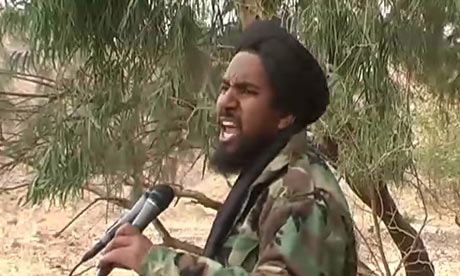
Based on his prior ties to the Taliban, it is unsurprising that his first public appearance came in a video produced by a Taliban-affiliated media outlet al-Labayk. In it, al-Libi reminds everyone that jihad will never die until the glory is returned to the Muslim ummah (community) and “the Shari’a is brought back to the pure land [Afghanistan].” He is shown in a variety of positions shooting an AK-47 and wearing a traditional Pakistani cap. [4] He also accuses the United States of human rights abuses, highlighting the United States’ treatment of female prisoner #650 at Bagram, who some believe is Aafia Siddiqui (though this point is disputed). This could explain why al-Libi dedicated a video and stood up for her cause in 2010. [5] He also rails against the United States’ war against “religion” and attempt to “uproot Islam.”
It is clear that his experience in prison changed al-Libi ideologically to focus on how the “crusaders” (the West and specifically the United States) were pulling the strings with the local so-called “apostate” regimes. [6] He illustrates that the United States brought the prisons to the “apostate” countries to lock up the “mujahidin” locally in countries such as Egypt, Libya, Saudi Arabia, Yemen, Jordan, and Mauritania.
Al-Libi continued his media circuit with two interviews with al-Qaeda’s As-Sahab Media, in 2006 and 2007, essentially parroting similar points while revealing biographical details. [7] He would not officially join al-Qaeda though until 2007 when a faction from the LIFG led by Abu Layth al-Libi merged with al-Qaeda, but was soundly rejected by the LIFG leadership within Libya and exiled in Europe. [8] From there, al-Libi’s star continued to rise, so much so that he was later dispatched to gain field experience heading a battalion within Afghanistan, as attested by the American al-Qaeda operative Bryant Neal Vinas (CNN, June 5, 2012). By the time of his alleged death, American officials believed he had climbed to the number two spot under Ayman al-Zawahiri. Al-Libi also played a key role as broker in the Shura-i-Muraqaba, which was established with the various Taliban factions last winter to temper “unjustified killings” against Pakistan and refocus on the U.S. and NATO forces in Afghanistan (Long War Journal, January 3, 2012). In all, he released approximately sixty-five videos and/or monographs with al-Qaeda, most between 2006-2009.
Purifying Islam: Al-Libi’s Historical Project
In the aftermath of al-Libi joining al-Qaeda he became the go-to individual when al-Qaeda was looking to push back against ideological and theological attacks upon it. In al-Libi’s writings, he made boisterous counterattacks against key ideological and theological threats that were meted out against al-Qaeda’s worldview, most prominently: the ‘ulama (religious scholars), the Saudi establishment, muraja’at (revisions), jihad, shedding Muslim blood, wasatiyyah (moderation) in Islam, and interfaith dialogue. All of these topics, al-Libi attempted to refute and explain why his interpretation was “pure” Islam while those who disagreed “abused” Islam at its “roots.”
A major theme running through most of al-Libi’s works was the role the ‘ulama should play as the ones who show the way forward for the ummah: “[It is important] to know the value of scholars, their status, and their eminence. Scholars are like the sun during midday. If they are present, people are able to live a good life and are able to conduct their lives in a normal manner. But if the sun sets, what will happen? What will befall the people? Darkness, it will be darkness.” [9] In this way, when the ‘ulama do not live up to this mantle or shirk their duties al-Libi puts them on notice: “No jihad. Do we not hear this phrase time and time again every day? And from whom? We hear it from scholars who should have been the heirs of our prophet.” [10]
According to al-Libi, the failure of the ‘ulama to stand up to the Saudi establishment, has allowed a new “monstrous” Saudi version of tawhid (monotheism): “by bending the necks of the texts or even breaking them.” [11] This corruption, al-Libi believes has taken hold as a result of the pernicious Western creations of wasatiyyah in Islam and interfaith dialogue. Al-Libi explains that not only is the West in a military war against Islam, but a full on intellectual war: “In the name of moderation, the evil spreader tampered with the concept of jihad by targeting it with their pens and tongues. They stained its existence, tarnished its glamour, and emptied its rulings in the mold of their defeat, cowardice, and weakness to come up with a distorted form that was unknown to the ancestors and unacceptable to the faithful, but it is sufficient that the civilized infidels of the West are convinced.” [12] The “interfaith convergence” al-Libi argues is a dastardly trick of the Saudi government to please their masters in the West: “They [the Saudis] are making it effortless for their agents by laying the groundwork for the invasion of minds after having eased the invasion of fortresses … They have announced their clear support and unveiled favor for the present-day Crusader campaign.” [13]
Another issue that is a trick of the “apostate” regimes according to al-Libi is muraja’at (revisions) published by imprisoned jihadis who have realized they were wrong and written refutations of al-Qaeda, most notably Dr. Fadl, former leader of the Egyptian Islamic Jihad. Al-Libi assures his global jihadi followers that one should not take these muraja’at seriously when released while one is still imprisoned: “ideas which oozed from the darkness of the prison cells and under the whips of the lashers and the policy of repression and compulsion … perhaps you will agree with me that with ideas produced in circumstances like this, you cannot attribute true conviction to their producer.” [14]
One of the most significant problems for al-Qaeda is the media attention around violence al-Qaeda has been directing against Muslims. According to a study by the Combating Terrorism Center at West Point in 2009, 85% of al-Qaeda’s violence has been perpetrated against Muslims. One of al-Qaeda’s responses was via a full-throttle theological argument for why it was okay to shed Muslim blood in the context of individuals being shielded (al-Tatarrus). Al-Libi concluded that because war is different today and there is a continual onslaught at the hands of the West even if an innocent is murdered, if they were a good Muslim, they will be seen as martyrs in the eyes of God. The argument is hypocritical considering how much of al-Qaeda’s propaganda is based around complaining about collateral damage caused by the United States. [15] Terrorism expert Jarret Brachman says the claim by al-Libi essentially ignores 1,400 years of Islamic scholarly debate as well as key aspects of the actual theory of al-Tatarrus. [16]
Other Key Works
In addition to the works mentioned, al-Libi also attempted to rally global jihadi supporters in various countries to continue fighting and/or attempting to lay the groundwork to implement Shari’a law. The countries he focused on included: Palestine, Iraq, Afghanistan, Libya, Somalia, Saudi Arabia, Pakistan, Algeria, and Syria. In these types of releases al-Libi lambasted local “apostate” regimes for being played by the “crusader” forces and upset at how the local ‘ulama did not stand up for their fellow co-religionists. As a result, the vanguards of the “mujahidin” are the only individuals one should be supporting and praying for. Al-Libi touched on these themes as well as describing the state of the ummah in his khutaba’ (sermons) during the most important Muslim holidays ‘Id al-Fitr and/or ‘Id al-Adha in 2005, 2007-2009, and 2011.
In the past few years, due to the heightened pace of drones strikes in Pakistan, al-Libi released a piece on how to deal with spies among them. [17] He argued that it was important to provide at least two witnesses and have a strong Shari’a reasoning to justify killing someone for helping pinpoint leaders’ locations to U.S. forces. Al-Libi argued that it was better to be over cautious in this instance when convicting someone of such a charge.
The Arab Spring
More recently, al-Libi has taken up the mantle of providing support and guidance to countries following the uprisings that started in the Middle East and North Africa in December 2010. He has released two videos to his home country in Libya, another to Algeria and another to Syria. [18] All four video messages have the tone of watching what is happening from afar and attempting to get in on the action. The videos on Algeria and Syria do not provide much in the way of true guidance. Rather al-Libi goes over their glorious struggles of the past and the present and calls on fellow Muslims to join them in their revolts. On the other hand, in al-Libi’s December 2011 video to the people of Libya, he does provide some instructions on how they should move forward in a post-Qadhafi society, providing recommendations for: the “formation of a board…to oversee the realization of the revolution’s demands”; a call for rebels not to give up their weapons; an invitation for Islamic scholars to form an independent committee that would have a direct role in formulating Libya’s constitution; and the severing of any ties the rebels had with Western governments. Indeed, this release is one of the more substantive points made by an al-Qaeda central senior leader regarding the Arab Spring.
Conclusion
Although al-Qaeda has not confirmed or denied the death of al-Libi, his importance to the global jihadi movement is immense. His leadership skills and ability to control a more radical, younger cadre could lead to major internal leadership and strategic rifts if he was killed. If al-Libi is alive, escaping a second drone strike – the first in December 2009 – would provide even more lore to his story, which includes the prison break. On the other hand, if al-Libi is dead he will be viewed as a glorious martyr that died at the hands of “crusader” America. He is not afraid of death, though, having previously written a pamphlet on forty ahadith (sayings and examples of the Muslim prophet Muhammad) that expounds on the virtues of martyrdom. [19] Further, he understands as do other jihadis that while his death will be a loss, the movement will continue apace without him [20]: “And the Ummah is full of champions who will fill these gaps, and just as the school of jihad produced them, it will produce others, and just as they have led, others will lead, with Allah’s permission.”
Notes
1. ‘Abd al-Karim al-Libi (‘Atiyatullah) and Yunis al-Sahrawi (Abu Yahya) “Eulogy for the Two Mauritanian Scholars,” al-Fajr Media, July 6, 2009.
2. All his works were sourced from the LIFG’s old website https://www.almuqatila.com, which is no longer accessible. All copies of the documents are in my archives.
3. “Dialogue with Shaykh Hasan Muhammad Qa‘id with Majalat Tora Bora,” Majalat Tora Bora, Issue 2, 2005. Available here: https://www.tawhed.ws/r?i=w2qk0jed.
4. “Escape From Bagram Prison, Part 1,” Labayk Media.
5. Abu Yahya al-Libi, “‘Aafia Siddiqi…Captured and Subjugated…Where are the Heroes?,” As-Sahab Media, December 15, 2010.
6. “Escape From Bagram Prison, Part 2,” Labayk Media.
7. “First Meeting with As-Sahab Media,” As-Sahab Media, June 17, 2006 and “Dots on the Letters: Second Meeting with As-Sahab Media,” As-Sahab Media, September 9, 2007.
8. Abu Layth al-Libi and Ayman al-Zawahiri, “Libyan Islamic Fighting Group Joins Al-Qaeda,” As-Sahab Media, November 3, 2007.
9. Abu Yahya al-Libi, “The Closing Statement for the Religious Training that was Held at One of the Mujahidin Centers,” As-Sahab Media, November 7, 2007.
10. Abu Yahya al-Libi, “Khutbah ‘Id al-‘Adha 1428 H,” As-Sahab Media, January 22, 2008.
11. Abu Yahya al-Libi, “Tawhid of the Saudis and the Tawhid of Truth,” As-Sahab Media, May 30, 2007.
12. Abu Yahya al-Libi, “Moderate Islam and Moderate Defeatism,” As-Sahab Media, May 22, 2008.
13. Abu Yahya al-Libi, “Interfaith Dialogue, a New Step in the Crusader War,” As-Sahab Media, July 28, 2008.
14. “Dots on the Letters: Second Meeting with As-Sahab Media.”
15. Abu Yahya al-Libi, “The American Military and the Ethics of War,” As-Sahab Media, June 22, 2012.
16. Abu Yahya al-Libi, “al-Tatarrus in Modern Jihad,” As-Sahab Media, April 16, 2006; Jarret Brachman and Abdullah Warius, “Abu Yahya al-Libi’s “Human Shields in Modern Jihad”,” CTC Sentinel, Volume 1 Issue 6, May 2008.
17. Abu Yahya al-Libi, “Guidance on the Ruling of the Muslim Spy,” As-Sahab Media, June 29, 2011.
18. Abu Yahya al-Libi, “To Our People in Libya,” As-Sahab Media, March 12, 2011; Abu Yahya al-Libi, “Algeria and the Battle of Patience,” As-Sahab Media, October 18, 2011; Abu Yahya al-Libi, “What Is Intended For Libya?,” As-Sahab Media, December 5, 2011; and Abu Yahay al-Libi, “The Tragedy of ash-Sham: Between the Crimes of the Nusayris and the Scheming of the West,” As-Sahab Media, June 12, 2012.
19. Abu Yahya al-Libi, “Forty Virtues in Martyrdom and the Required Attributes,” As-Sahab Media, March 22, 2011.
20. “Dots on the Letters: Second Meeting with As-Sahab Media.”