The Fall of Islamic State’s Female Militants: A Case Study
The Fall of Islamic State’s Female Militants: A Case Study
As an increasing number of Islamic State (IS) female militants have been captured and sentenced to death after the collapse of the so-called “caliphate,” gender roles within the group have been deconstructed once more. This process marks the fall of female militancy within the terrorist group. Meanwhile, as courts have delivered a series of judgments and death sentences against captive female militants, those female militants yet to be tried are attempting to become the architects of their own fate by reshaping their once violent rhetoric. With a total of 509 foreign women detained—including 400 Turkish female jihadists and 200 children who are being held in Iraq, with 16 of these women having been sentenced to death—captivity is a recurring theme in modern female militancy, whether at the hands of the terrorist group or their opponent (irakna.com, February 28).
For years, IS succeeded in manipulating gender norms within jihadist militancy by giving female insurgents visibility as jihadist brides and recruiters. Still, female jihadists experienced captivity a form of captivity. With the group’s considerable territorial losses and their last stronghold, Raqqa, having fallen, their dream of an everlasting Caliphate has been shattered. However, the defeat of the group has failed to change an important aspect of female militancy—captivity. Ironically, female militants have been met with captivity of a different sort—this time, at the hands of the group’s state adversaries, who seek to deliver a harsh justice.
Now captured female militants are attempting to abandon much of what IS female militancy stood for, shifting their rhetoric in an attempt to save themselves. Two prominent examples of how this shift is taking place are the cases of French jihadists Djamila Boutoutaou, 29, and Melina Boughedir, 27, who was the first female IS militant to be captured by the Iraqi forces (irakna.com , February 28).
The Case of Melina Boughedir
Melina Boughedir, the wife of an Islamic State cook, is facing a death sentence for belonging to IS. Her case was heard by the Central Penal Court in Baghdad, which delivered the sentence despite claims that she did not engage in acts of terrorism (alroya.om, February 20). Boughedir entered Iraq illegally with her husband in October 2015 after they spent four days on the Syrian border. Her husband was reportedly killed in the Battle of Mosul.
Boughedir, mother of four, was arrested in February 2017, during the Battle of Mosul. Three of her children were returned to France in December 2017 by the Iraqi government. On February 19, Boughedir, who entered the courtroom in a black gown, grey jacket and purple hijab (headscarf), was sentenced to seven months in prison for illegally entering Iraq, and she was to be deported to France. Though not sentenced for terrorism by the judge, later, on March 29, the Iraqi appeals court issued a sentence to re-try Boughedir’s case. The ruling was issued on the grounds that Boughedir cannot only be sentenced for illegal entry into Iraq as she was aware that her husband was joining IS, and yet she still chose joined him (arabic.euronews.com, April 10).
In May 2018, Boughedir denied all allegations that she is an IS supporter during her retrial court hearing. Boughedir stated that she is not an “ideologized” militant. When asked about her husband, Boughedir responded: “He went to fetch water and never came back, and I do not know anything about him” (al-Arabiya, May 3).
During the court hearing, Boughedir was shown a series of photographs and asked to identify different jihadists who were featured in them. Boughedir was then presented with a photograph in which she appears, and the judge stated “you look so comfortable in this photograph in comparison to your claims that you were forced by your husband to join him in Iraq as he threatened you to take your children.” She responded: “I was at home, and my husband took the photo. I want to reunite with my children who have been repatriated to France” (alhayat.com, May 3). The court decided to hold a second hearing in June based on the request of her new lawyer appointed by her family.
The Case of Djamila Boutoutaou
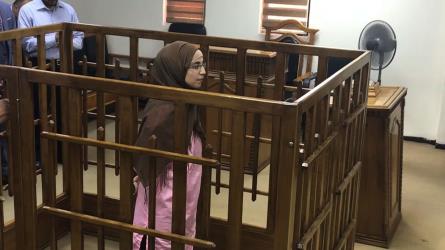
In a pink jacket and a brown hijab, Djamila Boutoutaou was in the public spotlight at her Baghdad court hearing. Surrounded by men while standing in her wooden cell, Boutoutaou failed to manipulate the judge with her rhetoric of victimization. “I want to raise my daughter,” she stated. Boutoutaou single-handedly embodies a new stage of female militancy, one which symbolizes the fall of IS’ female militancy as previously known. On the April 17, 2018, the Iraqi court gave Boutoutaou, who is a convert to Islam of Algerian descent, a life sentence for joining the terrorist group (alaraby.co.uk, April 17).
Boutoutaou left France after she married a former rapper, Mohammed Nassereddine. A mother to two—Khadija and Abdul Allah who are being held by the Iraqi forces in Tel Keppe (Tel Kaif)— Boutoutaou denied the court’s allegations that she joined the terrorist group. She claimed that she was tricked by her husband and left France for Turkey on a holiday with him. Boutoutaou, who says she wore a headscarf under the influence of her mother-in-law, claimed her husband received a call from someone named “al Qurtibi” while in Turkey. She said she overheard them talking about moving to Syria and Iraq. Boutoutaou alleges that they locked her up in a cave with her two children (almarjie-paris.com, April 17).
Boutoutaou lost her son Abdullah in an Iraqi airstrike, and she claims to have since lost 70 kilograms out of grief. In response to the judge’s question about whether she joined IS with her husband, Boutoutaou claimed she was forced by her husband to join the group. She stated that “during the ten months we spent in Iraq, I did not see my husband as he used to spend most of his time not at home.” Boutoutaou was taken by her neighbor to Tal Afar where she handed herself over to the Kurdish Peshmerga forces in the north of Nineveh Governorate (almarjie-paris.com, April 17).
The Deconstructed Female Militancy
Separation from male jihadists forces the female militant to acquire a tone designed to win sympathy. It is this oratory that symbolizes the failure of female militants to survive when separated and alone. Boutoutaou and Boughedir both failed to utilize their gender role and maternal responsibilities to survive. Thus, they both can be seen to exemplify how the female militant identity collapses when taken out of the context of the group.
New IS Propaganda
An IS propaganda video released in February, which shows women fighting on the front line, presents a revision of female militants’ identity within the group. The video redefines the role of female jihadists after the group’s territorial loss. It manipulates the previously defined gender roles to carve out a new role of female power within the ranks of male militants. This new image transcends the stereotypical image of the jihadist brides who live a love fantasy in the land of jihad and are viewed as a means of reproduction to guarantee the continuity and survival of the organization. Women are utilized in the video by the group to prove the survival of the jihadist cause. The five women armed with guns who are featured in the video present a distorted caricature of a militant. With the narrator hailing “the chaste mujahid woman journeying to her lord with the garments of purity and faith,” the depiction presents an ironic contrasted to the image of captive Boutoutaou and Boughedir in the courtroom. This contrast proves the futility of the invisible, pure female jihadist militant covered in black to survive beyond the insurgency (palestinetoday.net, February 20).
Conclusion
Captive female jihadists like Boutoutaou and Boughedir fit perfectly with the deconstructed image of a female militant after the collapse of IS’ “caliphate.” IS manipulates female gender roles as necessary to maintain its myth. The group is ready to present its female militants as solitary individuals who can fight on the front line. But the fate of captured militants like Boutoutaou and Boughedir proves the futility of IS’ attempt to be a female empowered group. Boutoutaou and Boughedir symbolize a new dimension of the Islamic State’s female militancy, one in which the “militant” readily compromises her extreme rhetoric for survival. The deviation of these two militants from the constructed image of IS female militancy not only highlights the futility of IS in creating long-serving female militants who maintain a worldview saturated by the beliefs of the groups, but also highlights how the role of female militancy is deteriorating and regressing within the terrorist group.