Strategic Snapshot: Four Years Since the Start of Russia’s Full-Scale Invasion of Ukraine
Today, February 24, marks four years since the start of Russia’s full-scale invasion of Ukraine, as Russia’s war against Ukraine—which began in 2014—enters its thirteenth year. The Ukrainian people and their military, with support from allies and partners, have withstood Russia’s unjustified, unprovoked, and brutal assault on Ukraine’s territorial integrity and sovereignty, while Russian officials are pressuring Ukraine to accept a peace deal on the Kremlin’s own terms.
The Facts

Russia occupies nearly 20 percent of Ukrainian territory (Institute for the Study of War, accessed February 23). Since February 24, 2022, at least 55,000 Ukrainian soldiers have been killed (Kyiv Independent, February 19). Some databases have reported this number is much higher, at approximately 62,000 (UALosses.org, accessed February 23). In addition to military personnel, the Office of the United Nations High Commissioner for Refugees (UNHCR) has reported that a verified 15,172 Ukrainian civilians have been killed, and 41,378 have been injured since Russia’s full-scale invasion (UNHCR, February 2026). About 3.7 million Ukrainians have been internally displaced, and 6.9 million are refugees abroad (International Organization for Migration, January 2026; UNHCR, accessed February 23). At least 177,433 Russian military personnel have been killed, according to an analysis of confirmed casualty lists by Mediazona since February 2022 (Mediazona, accessed February 23). Other estimates place this number much higher at 350,000 Russian military personnel deaths out of a total 1.3 million casualties since Russia started its full-scale invasion of Ukraine, according to a North Atlantic Treaty Organization (NATO) representative. In 2025 alone, Russian military casualties amounted to nearly 400,000, according to NATO (DW, February 11).
The Talks
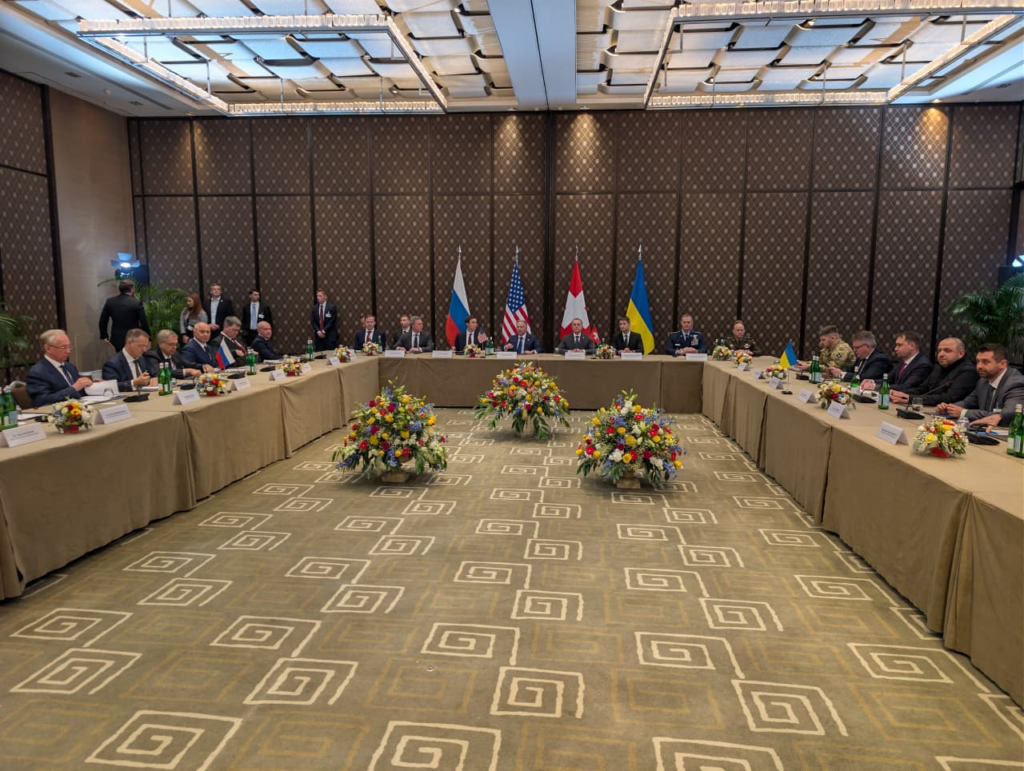
On February 17 and 18, trilateral talks between Ukraine, Russia, and the United States in Geneva ended without any breakthroughs. Since talks began last year, Russia has not budged on its demands for full control of Ukrainian territory that it illegally annexed in 2022, which includes the Donetsk, Luhansk, Kherson, and Zaporizhzhia oblasts (see EDM, September 26, 2025). This remains a major sticking point for Russia, and Moscow shows little willingness to compromise. For Ukraine, the surrender of these areas amounts to a loss of independence from Russia. The establishment of a demilitarized zone, potentially combined with a free trade zone, is being met with Russian demands for the right to patrol it with Russian police or National Guard troops (RBC, December 20, 2025; RBC-Ukraine; Meduza, February 18). Ukraine has asked for an international peacekeeping force to patrol such a zone (Meduza, February 18).
Ukrainian demands have centered on concrete security guarantees to eliminate the possibility of future conflict with Russia and enable national elections to take place safely. Ukrainian President Volodymyr Zelenskyy has offered to meet Russian President Vladimir Putin face-to-face to achieve a breakthrough on territorial matters (Ukrainska Pravda, February 17). When asked about Zelenskyy’s offer, Kremlin spokesperson Dmitry Peskov said that it was too early to discuss such a possibility (Interfax, February 18).
Conditions and Concessions

As the parties anticipate the next round of meetings, it is essential to understand the demands, conditions, and concessions that Russia and Ukraine have expressed regarding any negotiated settlement (RBC, February 18). The gulf between Kyiv and Moscow’s stated conditions will require one or both sides to change their positions. Until that happens, a real peace will remain beyond reach.
The following is a compilation of these conditions and concessions, as stated publicly by Moscow and Kyiv.
| Ukraine | Russia |
| 1. Real Security Guarantees: Any peace agreements must be preceded by security guarantees for Ukraine to eliminate the possibility of future war. According to Zelenskyy, the United States must be involved as a security guarantor because “security guarantees without America are not real security guarantees.” Kyiv is seeking to extend the current U.S. proposal for 15-year security guarantees to at least 20 years to reduce risks raised by U.S. investors and businesses seeking to operate in Ukraine. | 1. “Root Causes” Must Be Addressed: Putin has repeatedly claimed that Ukrainian radicals and neo-Nazis—sometimes with Western backing—have created a “harsh and artificial division of Russians and Ukrainians.” The so-called root cause of the war is the Kremlin’s perception of what Ukraine really is: an artificial state that “actually never had stable traditions of real statehood” and is an “inalienable part of [Russia’s] history, culture and spiritual space.” |
| 2. Elections 60 Days After Ceasefire: Kyiv needs 60 days to organize and hold national elections once security guarantees and a subsequent ceasefire are in place. According to Zelenskyy, Russia has agreed only to a one-day ceasefire. Security guarantees and a ceasefire are required as the Ukrainian constitution does not allow national elections to be held while the country is under martial law, which was declared on the day Russia launched its full-scale invasion. Zelenskyy recently said in regard to elections, “First comes security, then politics.” | 2. Zelenskyy Must Be Replaced: Russia considers Zelenskyy’s signature on any peace agreements to be void and insists that Ukraine hold presidential elections. Ukraine’s constitution does not allow for elections while martial law remains in effect. |
| 3. Lost Territories Must Be Returned: Kyiv demands that Ukrainian territories occupied by Russia must be returned. Ukrainian officials have not mentioned a specific timeline by which this must occur. Zelenskyy recently stated, “I don’t know when it will happen, but we must return them through diplomacy” (implying that the return of occupied territories may not be immediate). Zelenskyy indicated on February 11, 2025, that “We will swap one territory for another,” referring to an exchange of the Ukrainian-occupied portion of Kursk oblast without specifying which Russian-occupied territories Kyiv would demand back in return. | 3. Ukrainian Withdrawal From Territories Claimed by Russia, and recognize Crimea and Donbas as Russian Territories: In addition to withdrawing from Russia itself, the Kremlin demands that Ukrainian forces must withdraw from the territories Russia officially illegally annexed in 2022, but does not fully control: Donetsk, Luhansk, Kherson, and Zaporizhzhia oblasts. |
| 4. No Frozen Conflict: Freezing the conflict along the current frontlines is not acceptable to Ukraine’s military or civil society. Zelenskyy stated in February 2025 that agreeing to a ceasefire based on the current position of troops would depend on security guarantees . | 4. No Frozen Conflict: Moscow officially rejects a ceasefire along current lines. In a speech on June 14, 2024, Putin stated, “We are not discussing freezing the conflict, but its definitive resolution.” This speech in particular is important because it is consistently referred to by Russian officials as the point of reference for Russian conditions on negotiations because, according to Putin, “Everything is said there, no point in repeating myself.” |
| 5. Treaty Must Adhere to the Istanbul Communiqué of 2022: According to Putin and Russian Foreign Minister Sergei Lavrov, a peace deal must be based on the 2022 draft Treaty on Permanent Neutrality and Security Guarantees for Ukraine, which was summarized in the private Istanbul Communiqué released on March 29, 2022. The draft treaty entailed the following conditions, among others: Ukraine’s permanent neutrality (including not joining military alliances such as NATO) .The stipulation of guarantor states (the United Kingdom, the People’s Republic of China, the Russian Federation, the United States, the French Republic, the Republic of Belarus [position of Russia, not agreed by Ukraine], the Republic of Türkiye [position of Ukraine, not agreed by Russia]); andCriteria in which Ukraine would be justified in defending itself against any aggression violating its neutrality. | |
| 6. Recognition of Russia’s Annexation of Occupied Territories: In his June 2024 speech, Putin added that international agreements must officially recognize Russia’s annexation of the Russian-occupied territories of Crimea, Sevastopol, Donetsk, and Luhansk as people’s republics and Kherson and Zaporizhzhia as part of Russia. | |
| 7. Removal of Sanctions: All Western sanctions against Russia must be removed. | |
| 2. Elections 60 Days After Ceasefire: Kyiv needs 60 days to organize and hold national elections once security guarantees and a subsequent ceasefire are in place. According to Zelenskyy, Russia has agreed only to a one-day ceasefire. Security guarantees and a ceasefire are required as the Ukrainian constitution does not allow national elections to be held while the country is under martial law, which was declared on the day Russia launched its full-scale invasion. Zelenskyy recently said in regard to elections, “First comes security, then politics.” |
**For table sourcing, see PDF**
Selected Jamestown Analysis on Russia’s Full-Scale Invasion of Ukraine
- Kremlin Institutionalizing ‘Preventive Repression’ in Ukraine’s Occupied Territories, February 19, Maksym Beznosiuk.
- Ukraine Responds to Russia’s Starlink Use, February 10, Yuri Lapaiev.
- Putin Stalling Ninety Percent Complete Peace Deal, January 12, Pavel K. Baev.
- Russia Builds Coercive State Apparatus in Ukraine’s Occupied Territories, December 3, 2025, Maksym Beznosiuk.
- Flaws in Putin’s Art of No-Deal for Peace Become Apparent, December 1, 2025, Pavel K. Baev.
- Strategic Snapshot: Moscow’s Need for Leverage in Peace Talks, November 26, 2025.
- Kremlin Builds Patronage Economy in Ukraine’s Occupied Territories, November 12, 2025, Maksym Beznosiuk.
- Talks On Peace Deal for War Against Ukraine Can Still Rebound, November 11, 2025, Pavel K. Baev.
- Non-Russians in Russia Arm Themselves as War in Ukraine Drags On, November 6, 2025, Paul Goble.
- Russia’s War Transforms Ukraine into a World-Leading Military Producer, October 5, 2025, Taras Kuzio.
- Russian Troops in Ukraine Selling Guns, Harming Unit Effectiveness, and Boosting Crime, September 11, 2025, Paul Goble.
- War Against Ukraine Leaving Russian Police State Without Enough Police, October 30, 2025, Paul Goble.
- Ukrainians Work Toward Options for Post-War Justice, October 29, 2025, Sebastian Schäffer.
- More Russians Oppose the Kremlin’s War Than Officially Known, October 21, 2025, Kassie Corelli.
- Putin–Trump Call Stalls Tomahawks but Reactivates Ceasefire Discussions, October 20, 2025, Pavel K. Baev.
- Ukraine Braces for Another Hard Winter, October 16, 2025, Yuri Lapaiev.
- Kyiv Moving Toward More Direct Support of Non-Russian Movements within Russia, October 16, 2025, Paul Goble.
- Russia Ignores Global Peace Developments to Focus on Putin’s War, October 14, 2025, Pavel K. Baev.
- Kremlin Expands Youth Indoctrination in Russia and Occupied Territories of Ukraine (Part Two), September 29, 2025, Maksym Beznosiuk.
- Kremlin Expands Youth Indoctrination in Russia and Occupied Territories of Ukraine (Part One), September 24, 2025, Maksym Beznosiuk.
- Kremlin Works to Erase Ukrainian Identity and Militarize Occupied Regions, September 3, 2025, Maksym Beznosiuk.
- Putin’s War Against Ukraine Diminishing Moscow’s Dominance of Former Soviet Space, July 22, 2025, Paul Goble.
- Ukraine Clears Up Airspace With Modernized Munitions, July 17, 2025, Yuri Lapaiev.
- Putin’s Game of War-Making and Bargaining Comes to End, July 14, 2025, Pavel K. Baev.
- Moscow Losing Out to Criminals in Russian Regions Along Ukrainian Border, July 10, 2025, Paul Goble.
- Lack of Substantive Peace Talks Continues Russian Economic Downturn, July 7, 2025, Vadim Shtepa.
- Putin’s War Against Ukraine Increasing Corruption in Russia, June 26, 2025, Paul Goble.
- Russian Mobilization Falls Short Ahead of Putin’s Summer Offensive, June 26, 2025, Ksenia Kirillova.
- Russia’s Maximalist Demands Undermine Peace Talks Despite Mounting Domestic Strains, June 2, 2025, Pavel K. Baev.
- Putin Tries to Dodge Pressure For Ceasefire, But is Stuck in Tight Corner, May 19, 2025, Pavel K. Baev.
- Russia Uses Black Sea Ceasefire Talks to Regain Former Hegemony, April 10, 2025, Vladimir Socor.
- Russia Details Preconditions to Ukraine For Ceasefire and Political Settlement: Political Terms, June 4, 2025, Vladimir Socor.
- Russia Details Preconditions To Ukraine For Ceasefire And Political Settlement: Military Terms, June 3, 2025, Vladimir Socor.
- U.S. Preemptive Concessions Gain Nothing From Russia in Ukraine Ceasefire Talks (Part Two), April 1, 2025, Vladimir Socor.
- U.S. Preemptive Concessions Gain Nothing From Russia in Ukraine Ceasefire Talks (Part One), March 28, 2025, Vladimir Socor.
- Russian Army’s Degradation in Ukraine Makes Returning Veterans Even Greater Threat, May 29, 2025, Paul Goble.
- Comparing and Contrasting Western Peace Frameworks for Russia-Ukraine War, May 2, 2025, Vladimir Socor.
- U.S. Preemptive Concessions Gain Nothing From Russia in Ukraine Ceasefire Talks (Part Two), April 1, 2025, Vladimir Socor.
- U.S. Preemptive Concessions Gain Nothing From Russia in Ukraine Ceasefire Talks (Part One), March 28, 2025, Vladimir Socor.
- Ukraine Brings War Home to Russia, March 26, 2025, Richard Arnold.
- Putin Sets Additional Preconditions For Ceasefire in Ukraine, March 21, 2025, Vladimir Socor.
See Strategic Snapshot: Three Years Since the Start of Russia’s Full-Scale Invasion of Ukraine, for Jamestown coverage of the war prior to February 24, 2025.